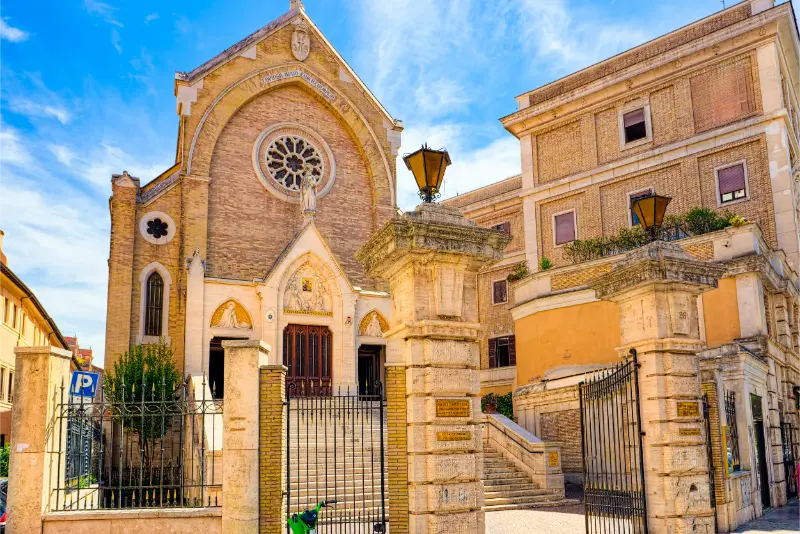
San Lorenzo fuori le Mura Rome: Basilica, Tombs and Visiting Guide
San Lorenzo fuori le Mura is one of Rome’s historic pilgrimage basilicas and an excellent destination for travelers who want to move beyond the compact tourist center. Standing beside the monumental Verano Cemetery, the basilica preserves layers of early Christian, medieval and modern history around the venerated tomb of Saint Lawrence.
It is very different from the huge papal basilicas of St John Lateran and St Paul Outside the Walls. The atmosphere is quieter, the architecture more complex and the surrounding district feels much more local.
A basilica built in layers
The current church combines structures from different periods. An early sanctuary associated with Saint Lawrence developed into a major pilgrimage destination, and later rebuilding joined spaces that originally had different orientations. That layered construction is one of the basilica’s most interesting features.
The tomb of Saint Lawrence
The principal religious focus is the burial place traditionally associated with Saint Lawrence, one of Rome’s most important martyrs. The site has attracted pilgrims for centuries and remains an active place of prayer. Visit with the same respect you would bring to any important shrine.
Cosmatesque work and medieval atmosphere
Look for medieval pavements, furnishings and architectural details rather than expecting a uniformly Baroque interior. San Lorenzo preserves a character that helps visitors imagine medieval Rome, a period often overshadowed by the ancient and Renaissance city.
Pius IX and later history
The basilica also contains the funerary monument of Pope Pius IX, adding a nineteenth-century layer to the site. The church suffered severe damage during the bombing of Rome in 1943 and was subsequently restored, another important chapter in its modern history.
Opening hours in 2026
The basilica’s official website currently lists opening every day from 7:00 to 12:00 and from 16:00 to 19:00. Tourist visits are suspended during religious functions. Check the official San Lorenzo opening-hours page before making a dedicated trip, especially on feast days.
The cloister and catacomb context
The complex includes one of Rome’s historic cloisters and connections with the ancient burial landscape of the Ager Veranus. Access to specific areas and catacomb-related visits can follow separate schedules, so do not assume that every part of the complex is open whenever the basilica doors are open.
Combine it with the Verano Cemetery
The adjacent Verano Cemetery is one of Rome’s great monumental cemeteries. If you are comfortable visiting respectfully, the two sites make a thoughtful half-day focused on memory, architecture and modern Italian history. Dress for walking and remember that Verano is an active cemetery, not an open-air museum.
How to get there
San Lorenzo is east of the historic center. Public transport is usually more efficient than walking all the way from the Pantheon or Vatican. The basilica also combines naturally with the San Lorenzo neighborhood if you want to see a less tourist-oriented part of the city.
How long to spend
Allow about 45–60 minutes for the basilica itself. Add much more if you plan to visit the cemetery or arrange access to other parts of the religious complex.
Frequently asked questions
Is San Lorenzo fuori le Mura free?
General entry to the basilica is normally free, while guided visits or separately managed areas may have different arrangements.
Is it open every day?
The official basilica site currently lists daily opening with a midday closure, but services and special events can affect tourist access.
Is Saint Lawrence buried here?
The basilica developed around the venerated burial place associated with Saint Lawrence, making it one of Rome’s major pilgrimage churches.
Is it worth leaving the historic center?
Yes for travelers interested in early Christianity, medieval Rome, pilgrimage history or quieter monuments away from the busiest central routes.
How to fit this into a Rome itinerary
When planning San Lorenzo fuori le Mura Rome, think in neighborhoods rather than isolated attractions. Rome is easier when each half day contains places that are genuinely close together. Check walking time on the map, add a realistic pause for coffee or lunch, and avoid placing another fixed reservation immediately afterward unless the transfer is short and predictable.
A useful rhythm is one major commitment in the morning, a flexible lunch, and one or two nearby secondary stops in the afternoon. This gives you room for security queues, temporary church closures, heat, rain or simply finding a place more interesting than expected. The most memorable Rome days are rarely the ones with the highest number of tickets.
Best time of day and seasonal considerations
Morning usually offers cooler temperatures and more energy, while late afternoon can provide softer light and a calmer atmosphere after tour groups move on. In summer, protect the middle of the day for indoor spaces or a long lunch whenever possible. In winter, remember that daylight is shorter and some archaeological sites close earlier.
Religious buildings can change visitor access around Masses, feast days, weddings and funerals. Museums may close rooms for conservation or installations. Outdoor sites are affected by weather. Always check the official page shortly before visiting instead of relying only on the timetable you saved months earlier.
What to bring
- A small refillable water bottle unless the site prohibits it inside.
- Comfortable shoes suitable for cobblestones and long standing.
- A charged phone with the reservation or address saved offline.
- A light layer for churches and air-conditioned museums.
- Only the bag size you actually need, especially at security-controlled attractions.
A more rewarding way to visit
Before entering, spend two minutes identifying the one or two details you most want to understand. That might be an architectural plan, a specific fresco, a practical local habit or the way a neighborhood developed. Having a question in mind makes the visit more memorable than trying to absorb every label.
Afterward, connect what you saw with another place in Rome. Compare artistic styles, building materials, urban scale or visitor experience. The city becomes easier to understand when attractions stop feeling like separate checklist items and begin to form a network of periods, neighborhoods and everyday routines.
Budget and reservation strategy
Do not reserve every hour of the day. Book only the experiences that genuinely require a time slot, then leave flexible spaces around them. For paid attractions, buy through the official website whenever practical and read cancellation conditions before payment. For free churches, treat opening hours as guidance rather than a guarantee of uninterrupted tourist access.
Keep small expenses in perspective. A short metro ride, public toilet fee, luggage locker or coffee break can save substantial walking time and make the rest of the day more comfortable. A good Rome budget should include these practical costs rather than accounting only for headline museum tickets.
Final advice
Rome rewards curiosity but punishes overplanning. Give yourself enough time to notice details, change direction and sit down occasionally. If the day becomes too crowded, remove the least important stop instead of rushing the places you care about most. You can always save another church, museum or neighborhood for a future visit.

Who should prioritize this experience
This guide to San Lorenzo fuori le Mura Rome is most useful for travelers who want more than a photo stop. First-time visitors can use it to add context around the famous sights, while repeat visitors will appreciate the chance to explore a more specific layer of Rome. Families should adjust the pace to attention spans, and travelers with mobility needs should verify the exact accessible route because historic sites can change lift or entrance arrangements.
If your itinerary is already full, do not add this simply because it appears on a list. Add it when it matches your interests or sits naturally beside another planned stop. Relevance is more important than quantity, and a focused hour often creates a stronger memory than a rushed sequence of three attractions.
Before you leave your hotel
Check the latest opening information, save the address, verify any ticket or ID requirement, and look at the walking route from your previous stop. Rome has streets with stairs, hills and uneven surfaces that can make a short distance slower than it appears. A five-minute check in the morning can prevent a wasted cross-city journey later in the day.
Carry as little as possible. Security lines move more smoothly with a compact day bag, and walking is more enjoyable without unnecessary weight. Keep essential medication, identification and payment methods with you, and store large luggage before sightseeing when the day falls between check-in and departure.
A final practical perspective
One of the easiest ways to improve a Rome itinerary is to leave a buffer before and after this stop. A short delay at security, a service inside a church, a room temporarily closed for conservation or simply a longer-than-expected walk can otherwise create unnecessary stress. Ten or fifteen unscheduled minutes often make the difference between a comfortable day and a sequence of rushed appointments.
Use the visit as a reason to explore the immediate streets rather than jumping directly onto public transport. Look for a nearby square, fountain, small church, bakery or café that was not part of the original plan. These unscripted details give context to the famous attraction and help the neighborhood feel like a real part of Rome rather than a backdrop between tickets.
If you are writing notes or taking photographs for later, record the practical details that future-you will actually want to remember: how crowded it felt, how long the visit really took, whether the walk was steep, where the entrance was and what detail surprised you. Those observations are often more useful than trying to document every object or room.