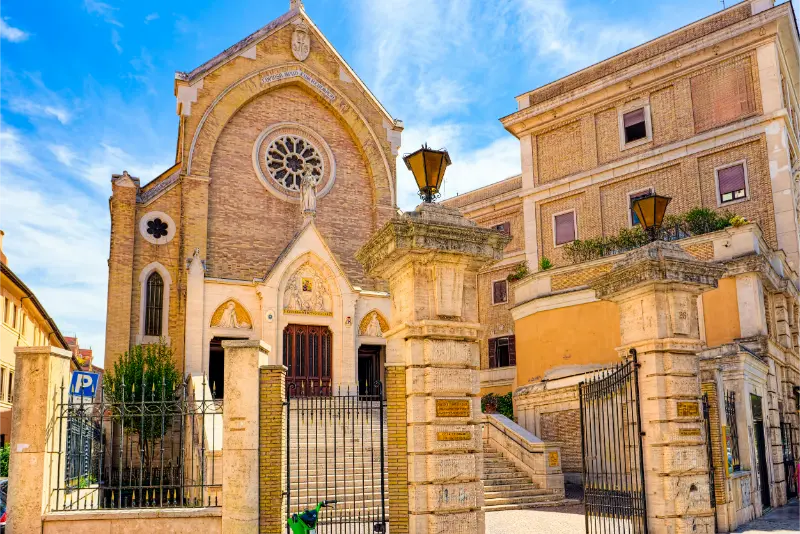
Santo Stefano Rotondo Rome: Circular Church, Frescoes and Visiting Guide
Santo Stefano Rotondo is one of Rome’s most unusual early Christian churches. Hidden on the Celio, its circular plan immediately sets it apart from the long basilican interiors visitors see elsewhere in the city. The quiet setting and complex history make it an excellent stop for travelers interested in architecture, early Christianity and places that still feel removed from mass tourism.
The church works particularly well in a Celio itinerary with the Museo della Forma Urbis, the Case Romane del Celio and San Clemente. All four sites reveal different ways Roman antiquity and Christianity interacted over centuries.
Why the circular plan is special
Santo Stefano Rotondo was built in the fifth century with a centralized plan rather than the more common rectangular basilica form. Repeated rings of columns and open space once created an even more complex circular geometry than visitors see today.
Stand near the center before exploring the perimeter. The building is easier to understand as a spatial composition when you first observe the rhythm of columns and the relationship between the central zone and surrounding ambulatory.
The fresco cycle of martyrdoms
The interior is famous for a later cycle depicting the martyrdoms of Christian saints in graphic detail. The images can be disturbing, especially for children, but they provide a striking example of how sacred art could teach, warn and inspire through vivid narrative.
Hungarian connections
The church has long-standing connections with Hungarian religious institutions and is associated today with the Pontifical German-Hungarian College. These links add another layer to the history of a church whose identity continued evolving long after late antiquity.
Opening hours in 2026
The official college website lists Tuesday to Sunday opening, with Monday closed. In the 2026 summer period the church is generally open 10:00–13:00 and 15:30–18:30; winter afternoon hours are earlier. The site also published a special closure from 2 to 24 August 2026. Check the official Santo Stefano Rotondo page because seasonal and holiday closures matter here.
How long to spend
Thirty to forty-five minutes is enough for most visitors. Architecture enthusiasts may want an hour, especially if they plan to compare the church with other early Christian basilicas.
Who should visit?
Santo Stefano Rotondo is ideal for repeat visitors, architecture enthusiasts, pilgrims and travelers looking for quieter places. Families should know that some martyrdom frescoes are visually intense and may not suit very young or sensitive children.
Best nearby itinerary
Begin at the archaeological park of the Celio, continue to Santo Stefano Rotondo and the Case Romane, then descend toward San Clemente. The route uses the geography of the hill efficiently and avoids unnecessary transport.
Mistakes to avoid
- Arriving on Monday, when the church is normally closed.
- Ignoring the midday closure.
- Assuming August hours are normal; special closures are common.
- Focusing only on the frescoes and missing the architecture.
- Bringing young children without considering the graphic martyrdom scenes.
Frequently asked questions
Is Santo Stefano Rotondo free?
General church entry is normally free, with donations appreciated.
Why is the church round?
Its fifth-century design uses a centralized circular plan, making it one of the most distinctive surviving early Christian church spaces in Rome.
Is it open on Monday?
The official schedule currently lists Monday as closed.
How far is it from the Colosseum?
It is on the Celio and can be reached on foot from the Colosseum area, though the uphill approach and route should be included in your walking time.
How to fit this into a Rome itinerary
When planning Santo Stefano Rotondo Rome, think in neighborhoods rather than isolated attractions. Rome is easier when each half day contains places that are genuinely close together. Check walking time on the map, add a realistic pause for coffee or lunch, and avoid placing another fixed reservation immediately afterward unless the transfer is short and predictable.
A useful rhythm is one major commitment in the morning, a flexible lunch, and one or two nearby secondary stops in the afternoon. This gives you room for security queues, temporary church closures, heat, rain or simply finding a place more interesting than expected. The most memorable Rome days are rarely the ones with the highest number of tickets.

Best time of day and seasonal considerations
Morning usually offers cooler temperatures and more energy, while late afternoon can provide softer light and a calmer atmosphere after tour groups move on. In summer, protect the middle of the day for indoor spaces or a long lunch whenever possible. In winter, remember that daylight is shorter and some archaeological sites close earlier.
Religious buildings can change visitor access around Masses, feast days, weddings and funerals. Museums may close rooms for conservation or installations. Outdoor sites are affected by weather. Always check the official page shortly before visiting instead of relying only on the timetable you saved months earlier.
What to bring
- A small refillable water bottle unless the site prohibits it inside.
- Comfortable shoes suitable for cobblestones and long standing.
- A charged phone with the reservation or address saved offline.
- A light layer for churches and air-conditioned museums.
- Only the bag size you actually need, especially at security-controlled attractions.
A more rewarding way to visit
Before entering, spend two minutes identifying the one or two details you most want to understand. That might be an architectural plan, a specific fresco, a practical local habit or the way a neighborhood developed. Having a question in mind makes the visit more memorable than trying to absorb every label.
Afterward, connect what you saw with another place in Rome. Compare artistic styles, building materials, urban scale or visitor experience. The city becomes easier to understand when attractions stop feeling like separate checklist items and begin to form a network of periods, neighborhoods and everyday routines.
Budget and reservation strategy
Do not reserve every hour of the day. Book only the experiences that genuinely require a time slot, then leave flexible spaces around them. For paid attractions, buy through the official website whenever practical and read cancellation conditions before payment. For free churches, treat opening hours as guidance rather than a guarantee of uninterrupted tourist access.
Keep small expenses in perspective. A short metro ride, public toilet fee, luggage locker or coffee break can save substantial walking time and make the rest of the day more comfortable. A good Rome budget should include these practical costs rather than accounting only for headline museum tickets.
Final advice
Rome rewards curiosity but punishes overplanning. Give yourself enough time to notice details, change direction and sit down occasionally. If the day becomes too crowded, remove the least important stop instead of rushing the places you care about most. You can always save another church, museum or neighborhood for a future visit.

Who should prioritize this experience
This guide to Santo Stefano Rotondo Rome is most useful for travelers who want more than a photo stop. First-time visitors can use it to add context around the famous sights, while repeat visitors will appreciate the chance to explore a more specific layer of Rome. Families should adjust the pace to attention spans, and travelers with mobility needs should verify the exact accessible route because historic sites can change lift or entrance arrangements.
If your itinerary is already full, do not add this simply because it appears on a list. Add it when it matches your interests or sits naturally beside another planned stop. Relevance is more important than quantity, and a focused hour often creates a stronger memory than a rushed sequence of three attractions.
Before you leave your hotel
Check the latest opening information, save the address, verify any ticket or ID requirement, and look at the walking route from your previous stop. Rome has streets with stairs, hills and uneven surfaces that can make a short distance slower than it appears. A five-minute check in the morning can prevent a wasted cross-city journey later in the day.
Carry as little as possible. Security lines move more smoothly with a compact day bag, and walking is more enjoyable without unnecessary weight. Keep essential medication, identification and payment methods with you, and store large luggage before sightseeing when the day falls between check-in and departure.
A final practical perspective
One of the easiest ways to improve a Rome itinerary is to leave a buffer before and after this stop. A short delay at security, a service inside a church, a room temporarily closed for conservation or simply a longer-than-expected walk can otherwise create unnecessary stress. Ten or fifteen unscheduled minutes often make the difference between a comfortable day and a sequence of rushed appointments.
Use the visit as a reason to explore the immediate streets rather than jumping directly onto public transport. Look for a nearby square, fountain, small church, bakery or café that was not part of the original plan. These unscripted details give context to the famous attraction and help the neighborhood feel like a real part of Rome rather than a backdrop between tickets.
If you are writing notes or taking photographs for later, record the practical details that future-you will actually want to remember: how crowded it felt, how long the visit really took, whether the walk was steep, where the entrance was and what detail surprised you. Those observations are often more useful than trying to document every object or room.