Roman Forum Rome: Tickets, Route, Highlights and Visiting Guide
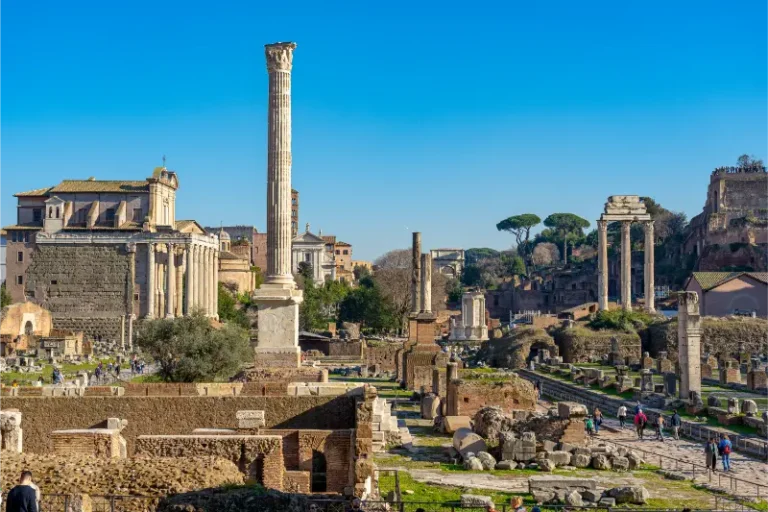
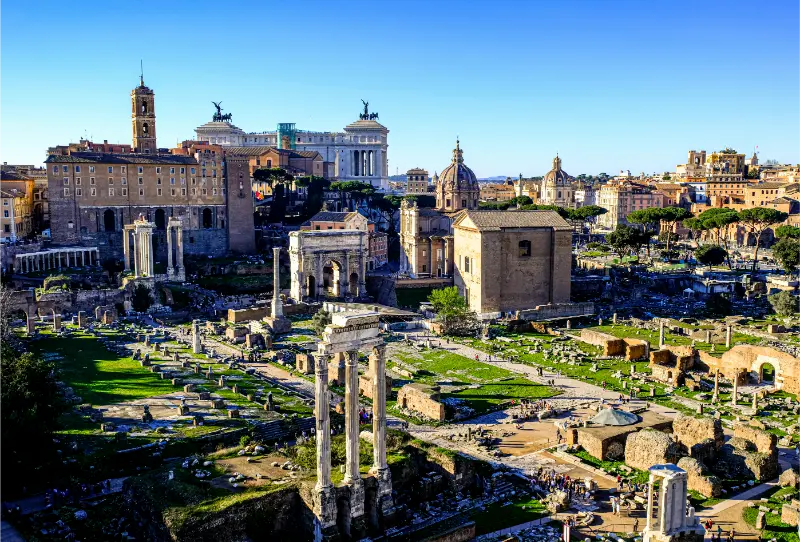
The Roman Forum is the archaeological heart of ancient Rome, but it can be harder to understand than the Colosseum. What looks at first like a field of columns and broken walls was once a dense civic center filled with temples, law courts, triumphal processions, speeches, elections and monuments. A good visit therefore depends less on seeing every stone and more on following a clear route and recognizing a handful of structures that explain how the space worked.
In 2026, the Roman Forum forms part of the Parco archeologico del Colosseo. The official 24-hour Colosseum–Roman Forum–Palatine ticket is currently €18 and includes one entrance to the Forum–Palatine archaeological area within the ticket’s validity rules. A separate Forum Pass SUPER also costs €18 and focuses on the Forum, Imperial Fora, Palatine and selected special sites. Always check the official ticket page because opening conditions and access to individual buildings can change.
Quick facts
| Official full ticket | €18 for the standard Colosseum–Forum–Palatine ticket |
| Forum-Palatine opening | 9:00 in 2026 |
| Summer closing | PArCo closes 19:15 through 30 September 2026 |
| Typical visit | 2–3 hours for Forum + Palatine |
| Best footwear | Supportive shoes with grip |
Choose the right ticket before you arrive
The standard €18 ticket is the simplest choice for most first-time visitors because it combines the Colosseum with the Roman Forum and Palatine Hill. The official park states that the Colosseum requires a booked time slot, while the Forum–Palatine area can be entered once within the ticket’s validity window. If you do not need the Colosseum, the Forum Pass SUPER can make more sense because it concentrates on the archaeological area and selected special sites.

Buy through the official ticketing platform or use the official park information to understand current on-site sales. Since May 2026, the park has different ticket-office rules for standard 24-hour tickets and Forum Pass SUPER products. Avoid buying from unofficial sellers merely because their page appears first in an advertisement.
A logical route through the Forum
A first visit works well if you think of the Forum as a corridor rather than a maze. Enter, orient yourself toward the Via Sacra, and move gradually through the central monuments instead of zigzagging. The Via Sacra was the ceremonial spine of the area and gives the ruins a narrative: triumphal arches, temples, political buildings and the slope toward the Capitoline end all begin to relate to one another.
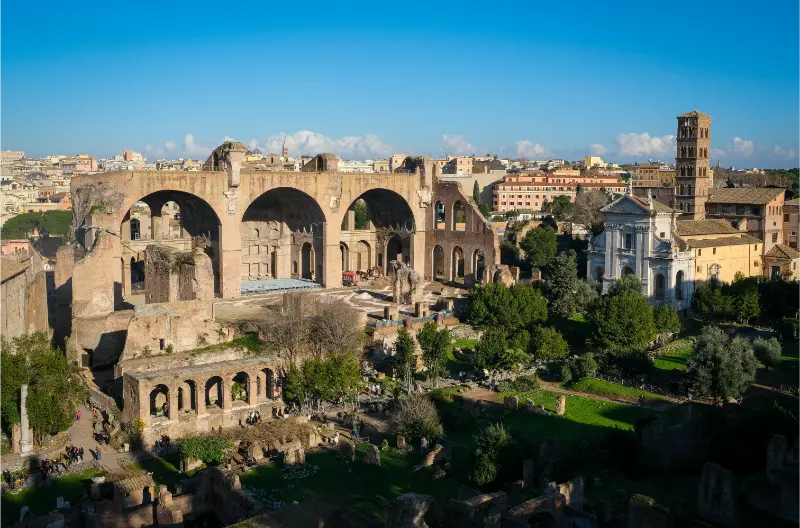
If you enter from the Colosseum side, the Arch of Titus provides a strong opening point. From there, continue toward the Temple of Antoninus and Faustina, the House of the Vestals, Temple of Vesta, Basilica of Maxentius and the central civic zone. If you enter closer to the Capitoline side, the sequence is reversed. Neither direction is ‘correct’; what matters is avoiding unnecessary backtracking on uneven ground.
The Curia, Rostra and political center
The Curia Iulia is one of the most immediately legible buildings because its large brick volume survives more completely than many nearby structures. It is associated with the Roman Senate and helps visitors imagine that the Forum was a working political district rather than a ceremonial ruin. Nearby, the Rostra and surrounding monuments belonged to the world of speeches, public communication and power.
Spend time here even if you are not a specialist in Roman history. The value lies in scale and proximity: institutions that seem abstract in a textbook were physically clustered in this compact valley. From this point you can also understand how the Capitoline Hill rose over the civic center and why later buildings transformed the edges of the ancient Forum.
House of the Vestals and Temple of Vesta
The House of the Vestal Virgins is one of the most evocative areas in the Forum because it introduces domestic and religious life alongside politics. The courtyard, statues and remains of rooms help explain the status of the Vestals, while the nearby circular Temple of Vesta marks one of the most important cult sites in the city.
Do not rush this section to reach a more famous arch. It is one of the best places to pause and reconstruct the Forum as a lived environment. On very hot days, the open archaeological area can be tiring, so use shaded edges when available and carry water.
Opening hours and 2026 planning
The official park lists the Forum–Palatine area as opening at 9:00. From 29 March through 30 September 2026, last admission is 18:15 and the park closes at 19:15; autumn and winter closing times become earlier. The park is closed on 25 December 2026 and 1 January 2027, with free-entry dates including the first Sunday of the month and certain national dates.
Those hours are park-wide rules, but individual SUPER sites can operate on separate schedules or close temporarily. If a particular interior such as a house, museum room or church is essential to you, check the current official notices on the morning of the visit rather than assuming that the archaeological area’s general opening time guarantees every sub-site.
How much time to allow
Allow at least 90 minutes for the Forum alone if you want more than photographs. Two to three hours is more realistic when combining it with the Palatine Hill. If you also have a timed Colosseum entry, avoid compressing all three into a single two-hour block. The distances are not enormous, but heat, rough surfaces and visual overload slow visitors down.
A useful rhythm is to identify six or seven priority monuments, then leave room for unexpected discoveries. The Forum becomes more rewarding once you stop trying to ‘complete’ it. If ancient Rome is a major interest, consider returning with a Forum-focused ticket or adding the Imperial Fora and Capitoline Museums on another day.
Accessibility, families and heat
The archaeological terrain includes slopes, cobbles, steps and uneven surfaces. Families should use a carrier or a sturdy stroller strategy rather than assuming every path will be smooth. Visitors with reduced mobility should check the park’s current accessibility routes and entrances before arrival, because the easiest path can differ from the most scenic one.
Summer heat is a major practical factor. There is limited shade across large sections, and stone surfaces amplify the temperature. Start early, refill water when possible and avoid scheduling the Forum after several hours of outdoor sightseeing. In cooler months, rain can make ancient paving slippery, so footwear matters year-round.
Common mistakes to avoid
Do not arrive without a basic map or route idea. The ruins are too dense to interpret efficiently by improvisation alone. Another mistake is spending most of the visit taking photos from the first viewpoint and then rushing the central Forum. Save energy for the monuments at ground level, where the historical relationships become clearer.
Finally, do not confuse the Roman Forum with the Imperial Fora. They are related but distinct archaeological areas with different access arrangements. Our Imperial Fora and Forum of Augustus guides can help you understand how these zones connect across Via dei Fori Imperiali.

Frequently asked questions
How much is the Roman Forum ticket in 2026?
The standard official Colosseum–Roman Forum–Palatine ticket is currently €18 full price. The Forum Pass SUPER is also €18.
What time does the Roman Forum open?
The official park lists the Roman Forum–Palatine archaeological area as opening at 9:00.
Can I visit the Forum without the Colosseum?
Yes. The Forum Pass SUPER is designed around the Forum, Imperial Fora, Palatine and selected special sites.
How long do I need?
Plan at least 90 minutes for the Forum alone and around two to three hours if you combine it with the Palatine.
Is the Roman Forum free on the first Sunday?
The park lists the first Sunday of the month among its free-admission dates, subject to the current official conditions.
Plan the rest of your Rome trip
Pair this guide with our Colosseum guide, the Palatine Hill guide and the Forum of Augustus guide for a stronger Ancient Rome cluster.
A practical way to fit this into your itinerary
For a first trip, visit the Colosseum and Forum–Palatine on the same day but separate the experience into blocks. A timed Colosseum slot gives structure, while the Forum and Palatine benefit from a looser pace. Keep lunch simple and nearby rather than leaving the archaeological zone for a distant reservation.
If you already visited the Colosseum on another day, enter with a Forum-focused plan and spend more time around the Curia, Vestals and Palatine approaches. Repeat visitors often enjoy the site more because they no longer feel pressure to see every headline attraction at once.
What makes this stop worth your time
The Roman Forum deserves its own article because it is not merely the open-air space attached to a Colosseum ticket. It was the civic center of the Roman world, and many of the institutions that shaped Roman public life stood within a few minutes’ walk of each other here.
A slower route also makes the ruins visually easier to read. Compare reconstructed diagrams with the surviving foundations, look back frequently to understand the valley’s shape, and use the Capitoline slope as an orientation point rather than navigating only by individual monuments.