Hidden Courtyards and Cloisters in Rome: Quiet Architecture Beyond the Main Sights
Some of Rome’s most memorable spaces are not visible from the street. Step through a church entrance, palace gateway or museum complex and the city can suddenly become quiet: columns frame a square of sky, orange trees soften stone arcades and medieval cloisters preserve a scale completely different from the monumental avenues outside.
This is not a list of secret places that you are entitled to enter. Many courtyards are private, institutional or accessible only with a museum or church visit. The goal is to understand the architecture, prioritize places with legitimate public access and approach residential courtyards with respect.
| Place type | What you may see | Access | Best behavior |
|---|---|---|---|
| Church cloister | Columns, mosaics, gardens | Often ticketed or limited hours | Dress appropriately and keep voices low |
| Museum courtyard | Sculpture, arcades, palace architecture | During museum opening | Use as part of the museum visit |
| Palace courtyard | Renaissance or Baroque architecture | Varies widely | Enter only when clearly public |
| Residential courtyard | Everyday Rome | Usually private | Admire from public space; do not trespass |
Why Rome’s cloisters are worth seeking out
Rome is visually dominated by ancient ruins, Renaissance palaces and Baroque churches, so medieval architecture can feel less obvious. Cloisters restore that missing layer. Their repeated columns, geometric plans and enclosed gardens were designed for movement, contemplation and practical connection between monastic spaces.
The official Rome tourism site highlights the cloisters of San Giovanni in Laterano and San Paolo fuori le Mura as important medieval examples. They reward slow looking in a way that complements the big basilicas. Pair them with our Rome churches guide if that link exists in your itinerary.
San Giovanni in Laterano cloister
The Lateran cloister is one of the city’s great medieval architectural spaces, associated with the Vassalletto family of Roman marble workers. Its twisted columns, mosaic decoration and calm proportions create a strong contrast with the enormous basilica next door.
Treat the cloister as more than an add-on photo stop. Walk the perimeter slowly, look at how no two column combinations feel exactly the same and notice the fragments preserved around the galleries. Check the current basilica and cloister access information before visiting because ticketing and hours can change.
San Paolo fuori le Mura cloister
The cloister of the Basilica of Saint Paul Outside the Walls offers another exceptional sequence of medieval columns and mosaic work. Because the basilica lies outside the tight historic center, the visit often feels less compressed than central church-hopping.
Combine the cloister with the basilica interior and then continue to the Ostiense area if you want a full half-day. This makes the transfer worthwhile and shows how ancient, medieval, industrial and contemporary Rome overlap outside the postcard center.
Bramante’s Cloister: Renaissance balance
The Chiostro del Bramante, near Piazza Navona, belongs to a different architectural moment. Its balanced Renaissance language provides a useful comparison with medieval cloisters, and the complex is also used for exhibitions and cultural programming.
Because exhibitions change, do not assume the experience is identical from one visit to the next. Check the official program if contemporary art matters to you; if architecture is the priority, plan enough time to appreciate the courtyard itself rather than rushing straight through to a temporary show.
Museum courtyards as part of the experience
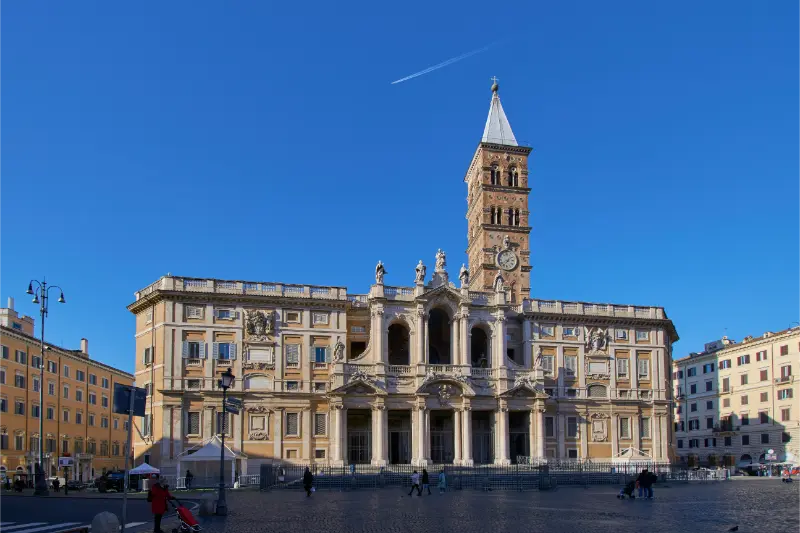
Rome’s museums often occupy palaces whose courtyards are architectural exhibits in their own right. The Capitoline Museums, Palazzo Altemps and other historic complexes reveal sculpture, arcades and reused ancient fragments before you even reach the main galleries.
This is one reason a museum day in Rome should not be planned only around famous masterpieces. Allow transition time between galleries. Courtyards are places to reset your eyes, understand the building and notice how collections are staged within historic architecture.
Renaissance palace courtyards
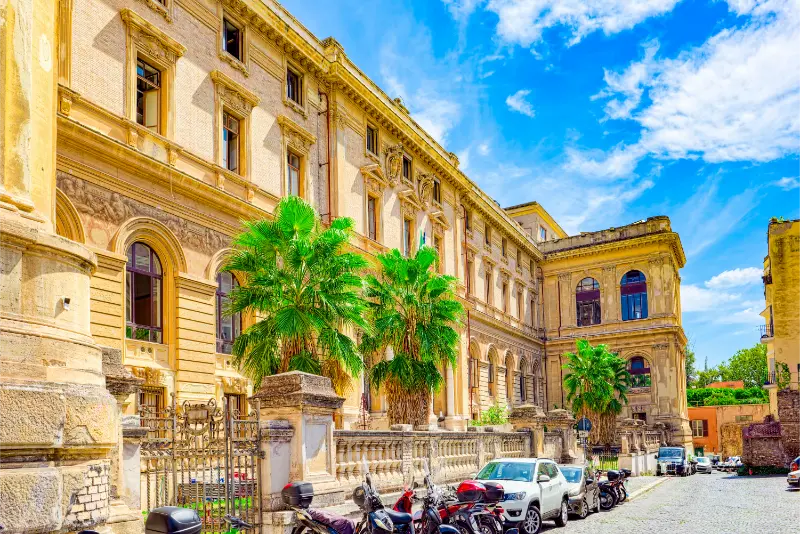
Many palaces in the center were organized around internal courtyards that provided light, circulation and ceremonial space. Some are accessible through museums, public institutions or occasional events; many others remain private. Access can change from day to day.
Never tailgate through a residential gate because a courtyard looks beautiful. If the entrance is clearly private, admire what is visible from the public street. Rome’s charm does not depend on turning someone’s home into an attraction.
How to recognize a worthwhile courtyard while walking
Look for open museum entrances, church complexes, civic buildings and clearly signed cultural spaces. A glimpse through a gateway may reveal a fountain or loggia, but signage tells you whether the space is actually open to visitors. When in doubt, ask staff rather than assuming access.
A good courtyard walk is about observation, not collection. Architectural details repeat across the city: coats of arms, ancient columns reused in later buildings, loggias, paving patterns, wells and fountains. Once you learn to notice them, ordinary routes become richer.
Photography without becoming intrusive
Courtyards are ideal for symmetrical photographs, framed views and soft light, but some are still active religious or residential spaces. Avoid blocking doorways, photographing private interiors or setting up tripods where people need to pass.
Late morning and afternoon can produce beautiful reflected light under arcades. In cloisters, look for diagonal compositions rather than photographing every side from the exact center. The space often feels more three-dimensional when you include a column in the foreground.
A quiet half-day route
One practical approach is to choose a district rather than crossing Rome for individual courtyards. In the historic center, combine a Renaissance courtyard or museum complex with Piazza Navona and nearby churches. On another day, make the Lateran cloister part of a San Giovanni and Celio itinerary.
Keeping the route compact leaves time for the city around the architecture. Our Rome walking tours guide can help structure a broader walking day.
Best times for a courtyard and cloister walk
Weekday mornings often work well because churches and museums are active but not yet at their busiest. Religious spaces may close around services, liturgical events or midday hours, so verify any must-see cloister individually.
Rain changes the mood rather than ruining the plan: arcades create shelter and wet stone can photograph beautifully. Just remember that museum queues may grow when outdoor sightseeing becomes less appealing.
Respecting churches and monastic spaces
Dress codes and behavior matter even when you are entering primarily for architecture. Keep shoulders and knees appropriately covered where required, silence your phone and do not treat a service as a backdrop for photographs.
If a sign prohibits photography or closes part of a cloister, follow it. Access is a privilege, not a guarantee, and conservation or religious needs take priority over a travel checklist.
Architectural details worth noticing
Columns are not just supports. In Roman cloisters they may vary in material, shape and decoration, creating rhythm as you walk. Mosaic bands, capitals, inscriptions and reused fragments can reveal both craftsmanship and the long recycling of ancient stone.
Courtyards also organize light. Stand under an arcade and watch how the bright central rectangle changes your perception of depth. This is especially useful for photography, but it also explains why these spaces feel calm after the visual noise of a major street.
Finally, notice thresholds. A plain street façade may lead to a richly proportioned inner court. Rome repeatedly hides architectural quality behind modest entrances, which is why attentive walking is more rewarding than simply following a list of landmarks.
How to fit hidden courtyards in Rome into a Rome itinerary
Plan hidden courtyards in Rome around geography and energy rather than treating it as an isolated checklist item. Rome days work best when major activities sit near one another and when you leave realistic time for meals, queues and the walk back to transport. A good itinerary protects the experience itself instead of maximizing the number of stops.
Keep one flexible block in the day. Opening hours, weather, traffic and personal energy can all change, and the ability to move lunch earlier or drop a minor stop often improves the trip. Save essential addresses and official links offline before leaving the hotel.
Finally, decide what success looks like before you start. If the main goal is one museum, one neighborhood experience or one day trip, complete that well. Rome rewards repeat visits, and there is no prize for turning every free hour into another reservation.
Common mistakes to avoid
- Entering residential courtyards that are clearly private.
- Assuming a church cloister follows the same opening hours as the basilica.
- Photographing people or private interiors without consideration.
- Crossing the whole city for ten-minute stops instead of building a compact route.
- Ignoring dress codes in religious complexes.
- Rushing through courtyards as empty space between “important” galleries.

Frequently asked questions
Are Rome’s hidden courtyards free to enter?
Some are, many are not, and others are private. Church cloisters and museum courtyards may require a ticket or specific opening hours.
Which cloisters are most important?
San Giovanni in Laterano and San Paolo fuori le Mura are two major medieval examples; the Chiostro del Bramante offers a Renaissance contrast.
Can I enter a courtyard if a gate is open?
Not automatically. Open gates can still lead to private residential or institutional space. Look for signs or ask staff.
Are courtyards good in rainy weather?
Yes. Arcades provide partial shelter and many are attached to indoor museums or churches.
Final advice
Use courtyards and cloisters to slow down your Rome itinerary. Prioritize spaces with legitimate public access, look at the architecture carefully and allow the quieter parts of the city to balance the blockbuster monuments.