Trajan’s Markets Rome: Museum of the Imperial Forums Guide
Trajan’s Markets are among the best places in Rome to understand how monumental architecture and everyday urban life once overlapped. The complex rises above the Imperial Forums in a remarkable stack of brick buildings, vaulted corridors, stairways and terraces. It is often described as an ancient shopping center, but that label is too simple: the site had administrative, commercial and service functions connected with Trajan’s Forum and the wider imperial city.
The modern museum housed here, the Museo dei Fori Imperiali, makes the visit much richer by displaying architectural fragments and explaining the forums of Caesar, Augustus, Nerva and Trajan. If you already plan to visit the Roman Forum, use this article together with our Ancient Rome guide to avoid treating all archaeological sites as interchangeable.
Why Trajan’s Markets are worth your time
The Colosseum gives you spectacle and the Roman Forum gives you political and religious monuments, but Trajan’s Markets provide something different: enclosed spaces at human scale. You can walk through rooms, ramps and streets that still feel architectural rather than purely archaeological. That makes the site easier to imagine as part of a functioning city.
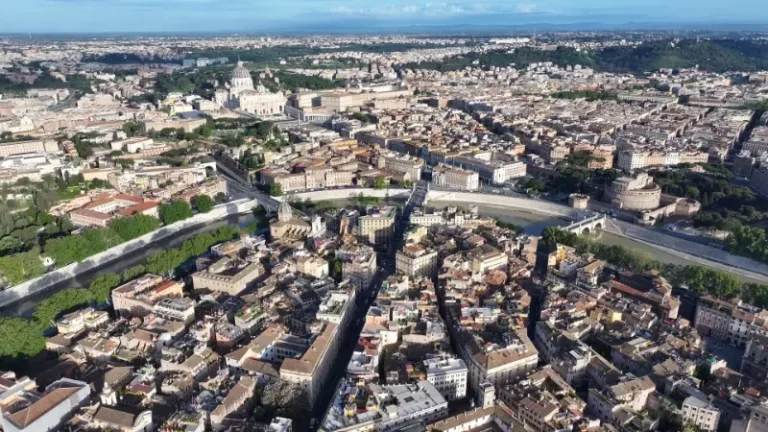
The elevated position also creates outstanding views across Trajan’s Forum and the surrounding center. From several points, you can see the relationship between the Markets, Trajan’s Column, the Vittoriano and later Rome. This visual layering is one of the strongest reasons to visit, particularly if ancient urban planning interests you.
What were Trajan’s Markets?
The complex was built in the early second century AD in connection with the enormous project of Trajan’s Forum. The brick architecture adapts to the slope of the Quirinal Hill, using multiple levels to solve a difficult urban problem. The result includes the curved Great Hemicycle, the Via Biberatica and a network of rooms that may have served offices, shops, archives and administrative activities.
Calling the entire complex a shopping mall creates a misleading picture of rows of retail stores. Archaeologists interpret different areas in different ways, and functions changed over time. A better approach is to think of the site as a multifunctional urban complex closely tied to the administration and infrastructure of the forum.
The Museum of the Imperial Forums
The museum is essential because many sculptures and architectural pieces from the Imperial Forums cannot be understood in their original setting. Displays reconstruct decorative programs, identify building materials and explain how fragments once fitted into enormous monuments. Even if you do not normally enjoy archaeological museums, the connection between the exhibits and the surrounding ruins keeps the visit concrete.
The Great Hall
The Great Hall is one of the first spaces that communicates the ambition of the complex. Its volume, brickwork and vaulted architecture are impressive without needing much reconstruction. Look at how doors and upper galleries connect different levels; the building was designed for circulation, not just static display.
Via Biberatica
Via Biberatica is a preserved ancient street running through the complex. Walking on it is one of the most memorable parts of the visit because the scale feels intimate. Instead of looking down at ruins from a barrier, you move between façades and doorways. The name is medieval rather than certainly ancient, but the street itself helps visitors imagine movement through the district.
Opening hours and tickets in 2026
The official Musei in Comune information lists Trajan’s Markets as normally open every day from 9:30 to 19:30, with last admission one hour before closing. Special holiday hours and closures apply, so consult the notice page before visiting.
Ticket prices can change when temporary exhibitions are included. In 2026 Musei in Comune introduced free museum admission for residents of Rome and the Metropolitan City in specific civic museums while non-residents pay the applicable full or reduced rate. For travelers, the safest planning method is to check the official ticket page on the day you choose your itinerary rather than relying on an old screenshot.
How long to spend
| Visitor type | Suggested time |
|---|---|
| Quick highlights | 60 minutes |
| Typical first visit | 90 minutes |
| Archaeology enthusiast | 2–2.5 hours |
| Markets + Imperial Forums area | Half day |
The museum is not huge by Vatican standards, but the architecture is complex and includes stairs, ramps and changing levels. Ninety minutes gives you enough time to read selected panels, walk Via Biberatica and pause at the viewpoints without turning the visit into a checklist.
Best route through the museum
Follow the museum sequence at first rather than immediately chasing the outdoor views. Understanding the models and fragments makes the later viewpoints more meaningful. Once you reach the exterior paths, slow down and use Trajan’s Column and the forum pavement as reference points. On the way out, revisit any major room you rushed through at the beginning.
Best time to visit
Morning is good for a quieter museum experience, while late afternoon often produces better light on the brick façades and forum ruins. On hot summer days, Trajan’s Markets are a useful compromise because much of the visit is indoors or shaded. Rain can make some exposed surfaces slippery, but the site remains a strong bad-weather option compared with fully outdoor archaeological areas.
How to get there
The entrance is on Via Quattro Novembre, very close to Piazza Venezia. From the Colosseum, you can walk along Via dei Fori Imperiali and then climb toward the museum. From Trevi Fountain, the walk is also straightforward. Buses serve the area, but central traffic and construction can make walking more reliable for short distances.
What to combine with Trajan’s Markets
- Trajan’s Column and the exterior ruins of Trajan’s Forum
- Vittoriano and Piazza Venezia
- Capitoline Hill and Capitoline Museums
- Roman Forum and Palatine Hill
- Monti for lunch or an evening walk
A particularly effective combination is Trajan’s Markets followed by the Vittoriano and Capitoline Hill. If you also have a timed Colosseum ticket, keep enough buffer between sites; archaeological visits nearly always take longer than expected.
Accessibility and footwear
The museum occupies a historic multi-level complex, so the visitor route includes changes in height and uneven surfaces. Accessible routes and lifts serve important sections, but not every ancient passage functions like a modern building. Comfortable shoes are essential for everyone, and visitors with mobility needs should consult current accessibility notes before arrival.
Common mistakes
- Thinking the site is only a row of ancient shops
- Skipping the museum displays and rushing straight to the views
- Trying to combine it with every major ancient site in one day
- Ignoring temporary exhibition pricing
- Underestimating stairs and changes of level
- Visiting without looking across to Trajan’s Column afterward
Is Trajan’s Markets better than another archaeological museum?
It depends on what you want. Palazzo Massimo has extraordinary sculpture, frescoes and mosaics; the Capitoline Museums offer masterpieces across many periods. Trajan’s Markets are strongest when you want architecture in context. The building itself is part of the collection, and its views connect objects with the forum landscape outside.
FAQ
Are Trajan’s Markets part of the Roman Forum ticket?
They are a separate civic museum complex with their own admission system. Do not assume a Colosseum or Forum ticket automatically includes them.
Is the site good with children?
Children who enjoy exploring buildings often respond well to the ramps, ancient street and changing views. The museum interpretation may be more demanding for very young visitors, so focus on architecture rather than reading every panel.
Can I visit in the rain?
Yes. Some areas are exposed, but much of the museum is covered, making it a useful option alongside our Rome on a rainy day guide.
How to make the visit more rewarding
Do not try to absorb every date or label. Choose three anchors before you enter: the building itself, one artistic or historical feature, and the relationship with the surrounding neighborhood. This keeps the experience coherent and gives you something to remember beyond photographs. Rome can overwhelm visitors with layers of information; a selective approach usually produces better understanding than reading every panel while worrying about the next reservation.
Planning around crowds
Crowds in Rome are uneven rather than constant. Large tour groups often arrive in waves, while smaller sites may become almost empty between them. If a room or viewpoint is packed, move to another section and return later when possible. Carrying a flexible sequence is more useful than chasing a theoretical “perfect” minute. In warm months, also consider how sun exposure affects outdoor sections and save covered areas for the hottest part of the visit.
A note on changing information
Opening hours, ticket rules, restoration closures and access routes can change with little notice, especially at active churches, archaeological sites and state monuments. Treat the official website as the final source for operational details and check it shortly before leaving your accommodation. This is more reliable than saving an old screenshot months before the trip. If a small area is closed, do not assume the whole visit has lost its value; Rome’s major sites usually contain far more than one headline feature.
How to fit this stop into a Rome day
The easiest way to protect the quality of a visit is to group sights geographically. Put one major timed attraction at the center of the day, then use nearby churches, viewpoints, parks or streets as flexible additions. This avoids spending the best hours crossing the city and gives you room to respond to queues, weather or temporary closures. Leave at least thirty minutes between the end of this visit and any reservation in another district; central Rome looks compact on a map, but security exits, pedestrian diversions and crowded streets can consume that buffer quickly.
What to notice beyond the headline feature
Many visitors arrive knowing the single image that made a place famous and leave as soon as they have seen it. A better method is to look for three quieter details: how people move through the architecture, which materials change from one period to another, and what you can see of the surrounding city from the site. Those observations turn a famous attraction into part of Rome rather than an isolated object. They also make the visit more memorable because you leave with a spatial story, not only the same photograph that appears on thousands of travel pages.