Santa Maria della Consolazione Rome: Hidden Church Below the Capitoline Hill
Santa Maria della Consolazione occupies one of the most historically charged corners of central Rome. It stands below the Capitoline Hill near the Tarpeian Rock and the edge of the Roman Forum, yet it receives only a fraction of the visitors who pass through the archaeological zone above. The church’s origin is linked to the consolation of condemned prisoners, giving the site a darker civic history than its serene interior first suggests.
Architecturally, the building bridges the late Renaissance and later completion campaigns. Martino Longhi the Elder designed the major rebuilding begun in the late sixteenth century, while the upper façade was completed in the nineteenth century by Pasquale Belli. The result is a church whose elegant exterior hides a story connected with justice, execution, charity and urban memory.
| Planning point | Useful detail |
|---|---|
| Location | At the foot of the Capitoline Hill, near the Roman Forum and Tarpeian Rock |
| Access | Active church. Visiting access can vary with services and local arrangements; verify before making a dedicated trip. |
| Cost | Ordinary church access is generally free when open. |
| Suggested time | 35–55 minutes |
| Best for | Hidden central Rome, Capitoline history, Renaissance-Baroque churches and quiet detours |
Why Santa Maria della Consolazione is worth visiting
Santa Maria della Consolazione works best when you treat it as part of Rome rather than as a box to tick. Its value comes from the way art, architecture, worship and the surrounding streets reinforce one another. Because it is less crowded than the city’s headline monuments, you can usually spend more time observing materials, inscriptions and spatial details instead of following a fixed tourist flow.
For travelers building a deeper itinerary, Santa Maria della Consolazione also provides useful contrast. Rome’s major basilicas show imperial scale and papal ceremony; smaller churches often reveal guilds, foreign communities, confraternities, neighborhood devotion and the practical history of local worship. That human scale is one reason these sites become memorable after the first trip.
History and context
A tradition recorded by the city’s tourism authority links the church’s name to a Marian image placed here in the late fourteenth century to console people condemned to death near the Tarpeian Rock. The devotion grew, and a church was built in the fifteenth century.
The current structure largely reflects rebuilding between the late sixteenth and early seventeenth centuries under Martino Longhi the Elder. The location was already dense with ancient remains and civic symbolism, so construction here connected Christian charity with one of Rome’s oldest political landscapes.
The upper part of the façade was completed only in the nineteenth century by Pasquale Belli, creating the harmonious appearance seen today. This long chronology is worth remembering: the façade looks unified, but it is the product of campaigns separated by centuries.
What to see
The setting beneath the Capitoline
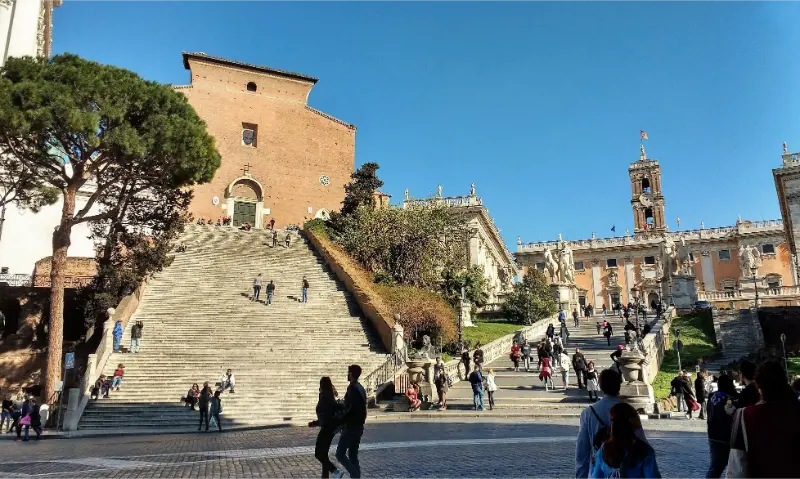
Before entering, look at the topography. The church sits below the Capitoline Hill, close to the route toward the Forum and the area associated with the Tarpeian Rock. This physical setting explains the historical traditions attached to consolation and punishment.

Walk a short distance away and then back toward the façade. Rome’s hills often determine how monuments are perceived, and Santa Maria della Consolazione makes more sense when seen as part of the slope rather than as a freestanding church on a flat piazza.
The five-part lower façade
The lower façade by Martino Longhi the Elder is broad and carefully ordered, using pilasters and multiple entrances to create a more horizontal composition than many Roman churches.
The later upper level continues the architectural language, producing a visual unity that can hide the building’s long construction history. This is a good example of later architects deliberately completing an older design rather than imposing a sharply contrasting style.
Interior chapels and devotional art
Inside, side chapels and altars preserve the layered patronage typical of central Roman churches. The atmosphere is usually calmer than at the nearby Forum, making details easier to study without large tour groups.
Look for how images of the Virgin and saints relate to the church’s title of consolation. Even when specific works come from different periods, the devotional theme helps unify the interior experience.
The memory of justice and mercy
The most distinctive aspect of the site is not a single painting but the historical tension between punishment and mercy. The nearby Tarpeian Rock carried ancient associations with execution, while later traditions around the church focused on comforting the condemned.
That contrast makes Santa Maria della Consolazione an excellent stop for travelers interested in how Rome reused symbolic landscapes. Ancient civic memory did not disappear; Christian institutions reinterpreted the same terrain through new rituals and values.
How to plan your visit
This church works best as an extension of a Capitoline or Roman Forum day. Because it is active and not managed like a major ticketed attraction, verify current access if seeing the interior is important.
Wear shoes suitable for slopes and uneven paving. The immediate area can involve changes in level, and routes around the Capitoline are not always intuitive. Using the church as a waypoint between the Forum, Capitoline Hill and Jewish Ghetto can make the geography easier to understand.
Season and time of day can change the visit. Summer heat makes a shaded church stop especially welcome, while winter light can make interiors noticeably darker. During major religious periods, liturgies and community events may alter access. Keep the schedule flexible and check recent notices rather than relying on a timetable copied months earlier. In Rome, active churches are living institutions first and sightseeing venues second.
After leaving Santa Maria della Consolazione, spend a few minutes outside without immediately opening a map. Look at street width, building height, paving and the direction of pedestrian movement. The relationship between a church and its surroundings often explains why an entrance is modest, why a façade is viewed at an angle or why a bell tower dominates from one street but disappears from another. Rome’s sacred buildings were shaped by dense neighborhoods, not isolated museum plazas.
Practical tips before you go
- Check current access shortly before visiting, especially because liturgies, maintenance and special events can change normal routines.
- Dress for an active place of worship: shoulders and knees should be covered, and hats should normally be removed inside.
- Use silent camera settings and avoid flash unless staff or posted rules explicitly allow it.
- Do not place an inflexible timed attraction immediately after the visit; allow a small buffer for unexpected closures or ceremonies.
- Read one or two key historical points before entering so the architecture and artworks have context rather than becoming a list of unfamiliar names.
If the doors are closed when you arrive, do not force the itinerary. Santa Maria della Consolazione sits in an area with other worthwhile sights, so use the nearby route below and return later if practical. This is often a better strategy in Rome than waiting outside an active church whose schedule has changed.
What to see nearby
Santa Maria della Consolazione combines naturally with Roman Forum, Capitoline Hill, Jewish Ghetto, Santa Maria in Portico in Campitelli. These nearby pages are already part of MyRomeTrip and can help readers turn one church visit into a coherent half-day rather than a disconnected detour.
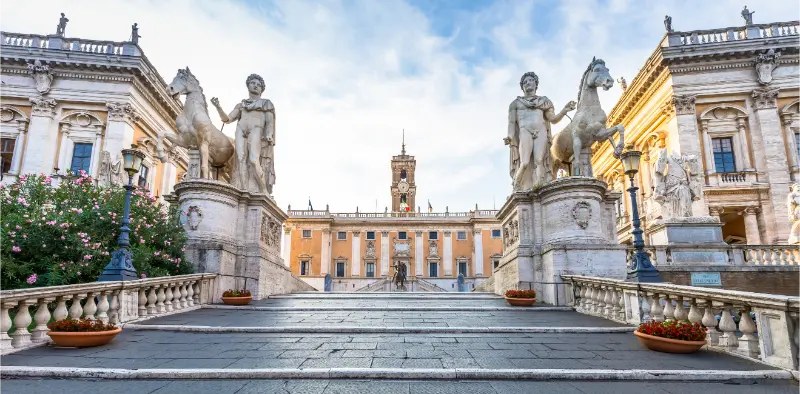
Visit the Capitoline Hill first, descend toward Santa Maria della Consolazione, then continue toward the Jewish Ghetto and Santa Maria in Portico in Campitelli. The route links ancient civic Rome with later religious and neighborhood history while avoiding a return up the same hill.
Who will enjoy this stop most?
The church is especially suitable for travelers who enjoy historical context more than checklist sightseeing. It appeals to visitors interested in Rome’s topography, justice traditions and lesser-known sacred spaces close to major archaeological attractions.
First-time visitors with only a few hours in Rome do not need to replace the Colosseum, Pantheon or Vatican with Santa Maria della Consolazione. The better approach is to add it when geography already brings you nearby. Repeat visitors, art lovers and travelers who enjoy slower city exploration will usually get the greatest value from the stop.
Photography, accessibility and respectful visiting
The church itself may be easier than some ruins, but the surrounding slopes and historic paving can be challenging. Confirm step-free entrance conditions if needed and plan the approach carefully. Interior photography should be discreet and subject to posted rules.
One more practical approach is to spend the first five minutes inside Santa Maria della Consolazione without taking photographs. Let your eyes adjust, identify the main axis and notice which details attract your attention naturally. Photograph afterward. This reduces screen time in a sacred space and usually results in better images because you understand the room before framing it.
Official information and changing access
For current access, services and special closures, consult the official or municipal information page: visitor information for Santa Maria della Consolazione. Hours published online can change, particularly around feast days, restoration campaigns and liturgical events, so readers should verify details close to the day of the visit.
FAQ
Why is it called Santa Maria della Consolazione?
The name is linked to a Marian image associated with consoling people condemned to death in the nearby area.
Is it close to the Roman Forum?
Yes. It stands at the foot of the Capitoline Hill very close to the Forum area.
Who designed the church?
The major late sixteenth-century rebuilding is associated with Martino Longhi the Elder; the upper façade was completed later by Pasquale Belli.
Is it worth a detour?
Yes if you are already near the Capitoline or Forum. It adds a quieter layer of urban and religious history with little extra walking.
Final tips
Santa Maria della Consolazione is the kind of place that makes a Rome itinerary feel more personal. It does not require the logistics of a major museum, but it rewards context, patience and respectful attention. Pair it with nearby sights, keep the timing flexible and focus on a few details rather than trying to memorize every name. That approach is often the difference between simply entering another church and actually understanding why the building belongs to the story of Rome.