Temple of Saturn Rome: Treasury, Saturnalia and Roman Forum Visiting Guide
Temple of Saturn deserves more than a quick photograph. It is one of those places where a few minutes of historical context completely changes what you see. Many travelers pass it while concentrating on the Colosseum or the headline monuments of the Forum, but understanding its function, later transformations and position in the ancient city makes the surrounding ruins far easier to read.
This guide focuses on what is actually useful on site: what the monument was, what survives, which details are easy to miss, how access works in 2026, and how to place it inside a sensible walking route. If this is your first time in the archaeological area, also keep our Roman Forum guide and Colosseum, Roman Forum and Palatine guide open, because the Forum is much easier to understand when individual monuments are tied back to the larger topography.
Why Temple of Saturn is worth your time
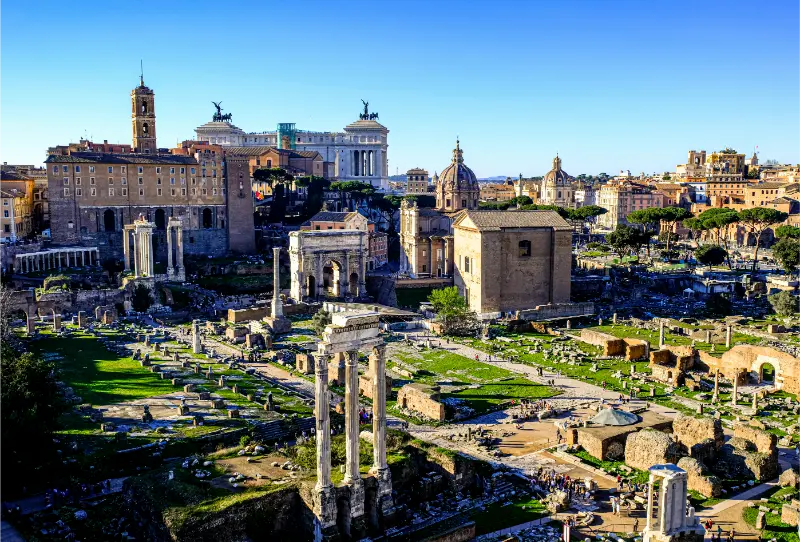
The temple occupies the western end of the Forum close to the Arch of Septimius Severus and the route toward the Capitoline. Its row of columns forms one of the classic silhouettes seen from viewpoints on the Capitoline Hill.
The most common mistake in the Roman Forum is to treat every ruin as an isolated object. Ancient Romans experienced streets, temples, halls, arches and houses as parts of a continuous ceremonial and political landscape. The best way to visit this monument is therefore to understand both its own story and the buildings immediately around it.
History of Temple of Saturn
The cult of Saturn belonged to the earliest religious landscape of the Roman Forum. Ancient tradition connected the temple with the beginning of the Republic, and a dedication date in the early fifth century BC is commonly associated with it. The structure visible today, however, is the result of later rebuilding and restoration rather than a perfectly preserved archaic temple.
The temple was closely connected with the Aerarium, the state treasury of the Roman Republic. Public funds and important documents were associated with this sacred and political setting. That combination may seem unusual today, but in Rome religion, state finance and civic authority were deeply intertwined.
Saturn was also at the center of the Saturnalia, the festival beginning on 17 December. The celebration became famous for banquets, gifts and temporary social inversions. Modern retellings sometimes simplify Saturnalia into a direct ancestor of Christmas; it is better to understand it as a specifically Roman festival whose customs later became part of broader discussions about winter celebrations.
The eight surviving columns and entablature belong to a late restoration after a fire. The inscription across the front states that the Senate and People of Rome restored the temple after it had been consumed by fire. The irregular reuse of architectural elements helps explain the late antique rebuilding process.
Because the temple stood at the base of the Capitoline ascent, it occupied a position where religious ritual, treasury functions, triumphal movement and political space converged. That location matters as much as the surviving architecture.
What to look for on site
Begin with the eight granite columns and the entablature above them. Their survival creates an elegant ruin, but remember that the original temple had a much fuller architectural setting and a broad stairway rising from the Forum.
Read the restoration inscription if you can, or at least identify its position. It is one of the easiest examples in the Forum of an ancient monument openly announcing that it had already been rebuilt in antiquity.
Look down at the high podium and the relationship to the modern archaeological ground level. The temple’s elevated platform helps explain why the columns dominate photographs taken from the center of the Forum.
Then turn around. From this point you can connect the Temple of Saturn visually with the Arch of Septimius Severus, the Curia area and the Capitoline. The site becomes much clearer when read as a network rather than a sequence of isolated ruins.
Tickets and access in 2026
The Temple of Saturn stands inside the Roman Forum at the foot of the Capitoline Hill. Its surviving columns are easily visible during a normal Forum visit; there is no separate entry ticket or interior room to book.

Opening arrangements inside the archaeological park can change because of restoration, events, weather or conservation limits. Before setting out, check the official Parco archeologico del Colosseo page and the official opening-times and ticket page. This is particularly important for protected interiors and SUPER sites, where capacity can be lower than in the open-air Forum.
How much time to allow
If you are following a highlights route, allow around 15–25 minutes specifically for this monument, in addition to the time needed to walk between sites. Archaeology enthusiasts should budget closer to 30–45 minutes because the most interesting details are often not visible from the first viewpoint. Protected interiors may also involve short waits or controlled entry.
For the Roman Forum as a whole, rushing is usually false economy. A two-hour visit can cover major landmarks, but three hours gives you enough time to stop, read the landscape and take a few detours. If you also plan a serious visit to the Palatine, consider half a day. See our dedicated Palatine Hill guide for route planning.

Best route and nearby sights
Pair the Temple of Saturn with the Arch of Septimius Severus and Curia Iulia. Then cross the Forum toward the Temple of Vesta and House of the Vestals. This short sequence moves from finance and government to dynastic propaganda and sacred ritual.
On the western side of the Forum, the strongest cluster is the Curia Iulia, Arch of Septimius Severus and the ascent toward the Capitoline Hill guide. You can then continue to the Forum of Caesar guide and Forum of Augustus guide to widen the story from the Republican Forum to the Imperial Fora.
Best time of day and photography
The classic view from the Forum places the columns against the Capitoline slope. From higher viewpoints around the Capitoline, the same columns become part of a broader panorama. Morning and late-afternoon side light usually gives more definition than flat midday sun.
The Forum has little continuous shade, so comfort matters as much as light. In warm months, early morning is usually the easiest time for careful viewing. Bring water, sun protection and footwear suitable for uneven stone and gravel. In winter, low sun can be excellent for reliefs and architectural texture, but surfaces may be slippery after rain.
Accessibility and practical realities
The archaeological park has improved accessible routes, but the Forum and Palatine remain historic landscapes with slopes, cobbles, thresholds and occasional route changes. Visitors with reduced mobility should consult the official accessibility information before arrival and ask staff which entrances and paths are operating on the day.
Toilets, water points and exits are not always exactly where first-time visitors expect them, so do not wait until the last moment to look for facilities. Keep your ticket accessible on your phone and avoid leaving the archaeological area until you are certain your ticket permits re-entry; most products are designed around a single access to defined zones.
Is it worth seeing if you are short on time?
Yes, especially if you are already visiting the Forum. Temple of Saturn adds a specific piece of the story that the broader ruins cannot communicate on their own. Even a short stop becomes meaningful if you identify two or three key details before moving on. If you only have a few hours in ancient Rome, prioritize the Colosseum, Forum and Palatine first, then use monuments like this one to give the route depth rather than adding a distant attraction.
FAQ
What was the Temple of Saturn used for?
Besides its religious role, the temple was associated with the Aerarium, the Roman state treasury.
Are the columns from the original Republican temple?
No. The monument was rebuilt more than once; the surviving colonnade belongs to a later restoration after a fire.
What was Saturnalia?
It was a major Roman festival beginning on 17 December, associated with feasting, gifts and temporary changes in normal social conventions.
Can you enter the Temple of Saturn?
Visitors normally view the surviving temple from the Forum paths. There is no separate interior attraction requiring its own ticket.
Final tips for visiting Temple of Saturn
Read a little before you arrive, but save detailed interpretation for the monument itself. Stand back for the overall form, move closer for material and carving, then turn around and study the neighboring buildings. That three-step method—whole monument, details, context—is one of the simplest ways to make the Roman Forum feel legible rather than overwhelming.
For current access, closures and ticket inclusions, always rely on the official monument information rather than an old screenshot or cached travel blog. Then use our Roman Forum guide to integrate this stop into a larger itinerary.
How to read the monument like an archaeologist
When you look at an ancient monument in Rome, separate what belongs to its original construction from what belongs to later repair. Changes in stone color, masonry technique, floor level and reused architectural fragments are clues rather than imperfections. The Forum was rebuilt continuously in antiquity, then adapted again in the Middle Ages and modern period. A structure that looks visually irregular may therefore be more historically informative than a ruin restored to a single ideal phase.
Also pay attention to ground level. Modern excavation removed meters of soil and later occupation from parts of the Forum, exposing ancient pavements while leaving medieval doorways or later buildings at apparently strange heights. Understanding this vertical history helps explain why some entrances seem suspended and why stairs no longer connect naturally with the surrounding paths.
Finally, use sightlines. Ask what could be seen from the monument and what the monument was designed to face. Temples, arches and civic halls were positioned to control movement and attention. The surviving ruins become much easier to interpret when you imagine processions, crowds, senators, priests and petitioners moving through the space rather than viewing the Forum as an empty archaeological park.