Domus Tiberiana Rome: Imperial Palace, Museum Rooms and Palatine Visiting Guide
Domus Tiberiana deserves more than a quick photograph. It is one of those places where a few minutes of historical context completely changes what you see. Many travelers pass it while concentrating on the Colosseum or the headline monuments of the Forum, but understanding its function, later transformations and position in the ancient city makes the surrounding ruins far easier to read.
This guide focuses on what is actually useful on site: what the monument was, what survives, which details are easy to miss, how access works in 2026, and how to place it inside a sensible walking route. If this is your first time in the archaeological area, also keep our Roman Forum guide and Colosseum, Roman Forum and Palatine guide open, because the Forum is much easier to understand when individual monuments are tied back to the larger topography.
Why Domus Tiberiana is worth your time
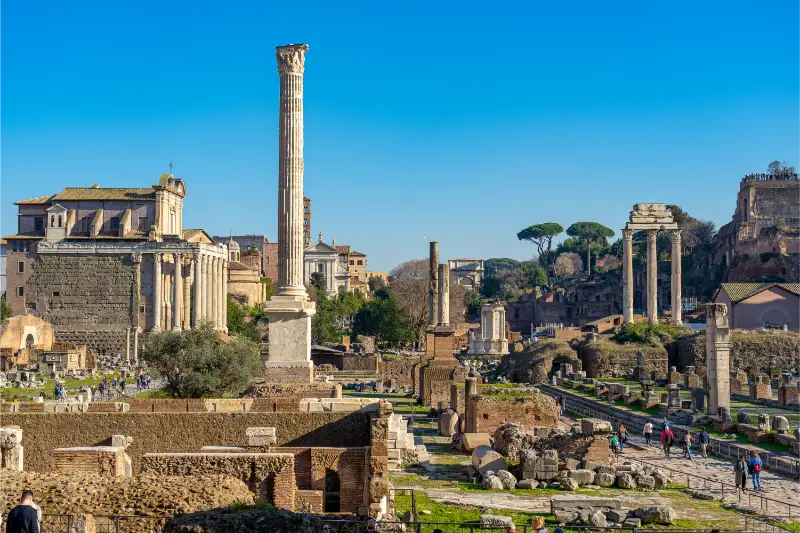
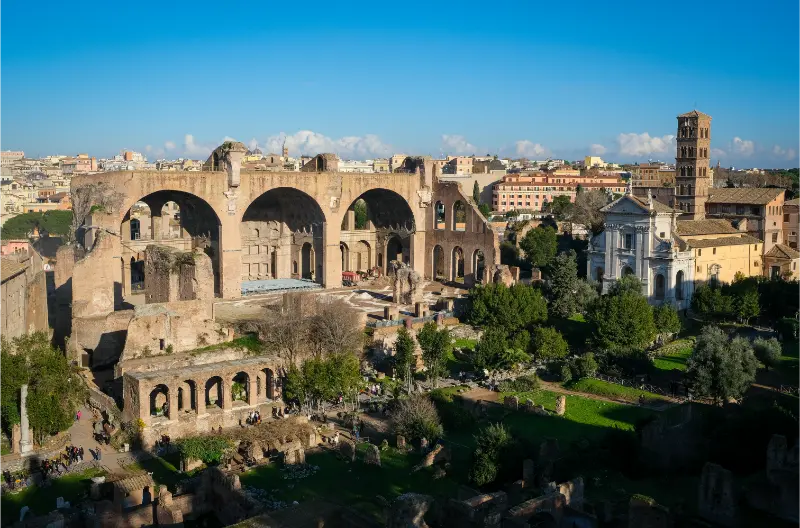
The palace occupies the north-western Palatine and overlooks the Roman Forum through massive multi-level substructures. From below, the arcades form a dramatic wall above the Forum; from the palace route, the relationship reverses and you look outward from the imperial hill toward Rome’s civic center.
The most common mistake in the Roman Forum is to treat every ruin as an isolated object. Ancient Romans experienced streets, temples, halls, arches and houses as parts of a continuous ceremonial and political landscape. The best way to visit this monument is therefore to understand both its own story and the buildings immediately around it.
History of Domus Tiberiana
The Domus Tiberiana is considered the first true imperial palace on the Palatine. Despite its name, the archaeological phases are complex. Important construction belongs to the first century AD, with a major phase after the fire of 64 under Nero, followed by expansion and reorganization under later emperors including Domitian and Hadrian.
The palace eventually covered roughly four hectares. It was not just a set of private rooms. The complex included gardens, religious areas, spaces associated with the guard and extensive service quarters. The imperial residence functioned as a small administrative and logistical city positioned above the Forum.
One of the key experiences today is the covered route known as the Via Tecta or Clivo della Vittoria. Moving through these substructures helps visitors understand how palace circulation worked vertically and how the imperial household could move between the Forum level and the Palatine.
The Domus Tiberiana remained closed to normal public circulation for nearly half a century because of structural problems. It reopened in September 2023 after major restoration, re-establishing a route between the Forum and Palatine and creating a new museum experience within spaces facing the Forum.
The exhibition rooms present finds that illuminate life in and around the palace across different periods. Archaeological deposits include evidence of food consumption, imported goods and later reuse. This makes the museum valuable because it shifts attention from emperors and architecture to the practical life of a palace that required huge networks of supply and service.
What to look for on site
From the Forum, look up at the multi-level arcades beneath the Palatine. They are not merely retaining walls; they supported and organized the enormous palace complex above.

On the route itself, pay attention to changes in level, covered passages and sightlines. Movement is one of the best ways to understand a palace that cannot be reconstructed from a single façade.
Inside the exhibition rooms, focus on the relationship between objects and excavation context. Small finds can tell more about daily palace life than a monumental fragment viewed in isolation.
Finally, use the views toward the Forum. The emperor’s residence was physically positioned above the civic center, and the topography itself communicates political hierarchy.
Tickets and access in 2026
The Domus Tiberiana route has two access levels. The archaeological park states that the freely walkable section within the site is covered by a standard Colosseum–Forum–Palatine ticket, while the museum/exhibition rooms require the relevant supplement unless your ticket—such as Forum Pass SUPER or a Full Experience product—already includes them. Always check current ticket details before visiting.
Opening arrangements inside the archaeological park can change because of restoration, events, weather or conservation limits. Before setting out, check the official Parco archeologico del Colosseo page and the official opening-times and ticket page. This is particularly important for protected interiors and SUPER sites, where capacity can be lower than in the open-air Forum.
How much time to allow
If you are following a highlights route, allow around 15–25 minutes specifically for this monument, in addition to the time needed to walk between sites. Archaeology enthusiasts should budget closer to 30–45 minutes because the most interesting details are often not visible from the first viewpoint. Protected interiors may also involve short waits or controlled entry.
For the Roman Forum as a whole, rushing is usually false economy. A two-hour visit can cover major landmarks, but three hours gives you enough time to stop, read the landscape and take a few detours. If you also plan a serious visit to the Palatine, consider half a day. See our dedicated Palatine Hill guide for route planning.
Best route and nearby sights
A strong itinerary is Roman Forum first, Domus Tiberiana next, then the Farnese Gardens and central Palatine. If you have SUPER access, coordinate the palace rooms with Santa Maria Antiqua and other limited interiors rather than spending all your time outdoors before discovering that indoor sites are closing.
To build a deeper ancient-Rome itinerary, connect this visit with the Ancient Rome beyond the Colosseum, the Capitoline Museums guide and the Palatine Hill guide. These pages help place sculpture, imperial residence and Forum archaeology in one narrative instead of treating them as unrelated attractions.

Best time of day and photography
The most memorable images often come from the relationship between the palace arches and the Forum below. Inside museum rooms, follow photography rules and avoid flash. Outdoors, a moderate wide-angle lens works better than extreme distortion because the architecture already has strong perspective.
The Forum has little continuous shade, so comfort matters as much as light. In warm months, early morning is usually the easiest time for careful viewing. Bring water, sun protection and footwear suitable for uneven stone and gravel. In winter, low sun can be excellent for reliefs and architectural texture, but surfaces may be slippery after rain.
Accessibility and practical realities
The archaeological park has improved accessible routes, but the Forum and Palatine remain historic landscapes with slopes, cobbles, thresholds and occasional route changes. Visitors with reduced mobility should consult the official accessibility information before arrival and ask staff which entrances and paths are operating on the day.
Toilets, water points and exits are not always exactly where first-time visitors expect them, so do not wait until the last moment to look for facilities. Keep your ticket accessible on your phone and avoid leaving the archaeological area until you are certain your ticket permits re-entry; most products are designed around a single access to defined zones.
Is it worth seeing if you are short on time?
Yes, especially if you are already visiting the Forum. Domus Tiberiana adds a specific piece of the story that the broader ruins cannot communicate on their own. Even a short stop becomes meaningful if you identify two or three key details before moving on. If you only have a few hours in ancient Rome, prioritize the Colosseum, Forum and Palatine first, then use monuments like this one to give the route depth rather than adding a distant attraction.
FAQ
Is the Domus Tiberiana open?
Yes, the complex reopened to visitors in 2023 after decades of closure, though access to specific rooms can still vary for conservation or operational reasons.
Do you need a special ticket?
The walkable archaeological route is covered by standard Forum-Palatine admission, while exhibition rooms require the appropriate supplement unless included in a SUPER or Full Experience ticket.
Why is it called Domus Tiberiana?
The traditional name associates the palace with Tiberius, but the surviving archaeological development includes major phases under Nero, Domitian, Hadrian and others.
How long should I allow?
Allow at least 45–60 minutes if you want to walk the route and visit exhibition rooms without rushing; more if you are combining it with the Palatine.
Final tips for visiting Domus Tiberiana
Read a little before you arrive, but save detailed interpretation for the monument itself. Stand back for the overall form, move closer for material and carving, then turn around and study the neighboring buildings. That three-step method—whole monument, details, context—is one of the simplest ways to make the Roman Forum feel legible rather than overwhelming.
For current access, closures and ticket inclusions, always rely on the official monument information rather than an old screenshot or cached travel blog. Then use our Roman Forum guide to integrate this stop into a larger itinerary.
How to read the monument like an archaeologist
When you look at an ancient monument in Rome, separate what belongs to its original construction from what belongs to later repair. Changes in stone color, masonry technique, floor level and reused architectural fragments are clues rather than imperfections. The Forum was rebuilt continuously in antiquity, then adapted again in the Middle Ages and modern period. A structure that looks visually irregular may therefore be more historically informative than a ruin restored to a single ideal phase.
Also pay attention to ground level. Modern excavation removed meters of soil and later occupation from parts of the Forum, exposing ancient pavements while leaving medieval doorways or later buildings at apparently strange heights. Understanding this vertical history helps explain why some entrances seem suspended and why stairs no longer connect naturally with the surrounding paths.
Finally, use sightlines. Ask what could be seen from the monument and what the monument was designed to face. Temples, arches and civic halls were positioned to control movement and attention. The surviving ruins become much easier to interpret when you imagine processions, crowds, senators, priests and petitioners moving through the space rather than viewing the Forum as an empty archaeological park.