San Carlo alle Quattro Fontane Rome: Borromini Church and Visiting Guide
San Carlo alle Quattro Fontane—usually called San Carlino—is one of the smallest great buildings in Rome. Francesco Borromini designed the church and convent for the Spanish Trinitarians, turning a restricted corner site into a masterpiece of curved walls, an oval dome, geometric light and constantly shifting perspective. You do not need to be an architect to feel how unusual the space is; the building seems to expand and contract as you move through it.
The official church site provides unusually clear visitor information. The current San Carlino visiting page lists free entry on weekdays from 10:00–13:00 and 15:00–17:00 from October to April, changing to 16:00–19:00 for the afternoon period from May to September. The church, sacristy, cloister and crypt can be visited during those hours; Sunday and solemnity Mass is listed at 11:00. A donation is appreciated for maintenance.
| Planning point | Current practical detail | What it means for your visit |
|---|---|---|
| Location | Via del Quirinale 23, at the Quattro Fontane intersection | Combine with Quirinal Palace, Santa Maria della Vittoria and Via Nazionale. |
| Admission | Free; donation appreciated | No museum ticket is needed during normal visiting hours. |
| 2026 visiting pattern | Weekdays 10:00–13:00 plus seasonal afternoon hours | Check the official page because the afternoon schedule changes between winter and summer. |
Why Borromini’s design is revolutionary
The site was extremely small, but Borromini refused to treat that as a limitation. Instead of designing a simple rectangular chapel, he created a complex sequence of convex and concave forms. Walls seem to pulse inward and outward, columns organize movement without making the room feel static, and the oval geometry directs attention upward toward the patterned dome.
This is the opposite of monumentality through size. St. Peter’s impresses by overwhelming the body; San Carlino impresses by making every centimeter work. Architecture students often study it through plans and diagrams, but the essential lesson becomes clear only inside: geometry, light and movement can make a tiny building feel spatially rich.
What to see
The façade
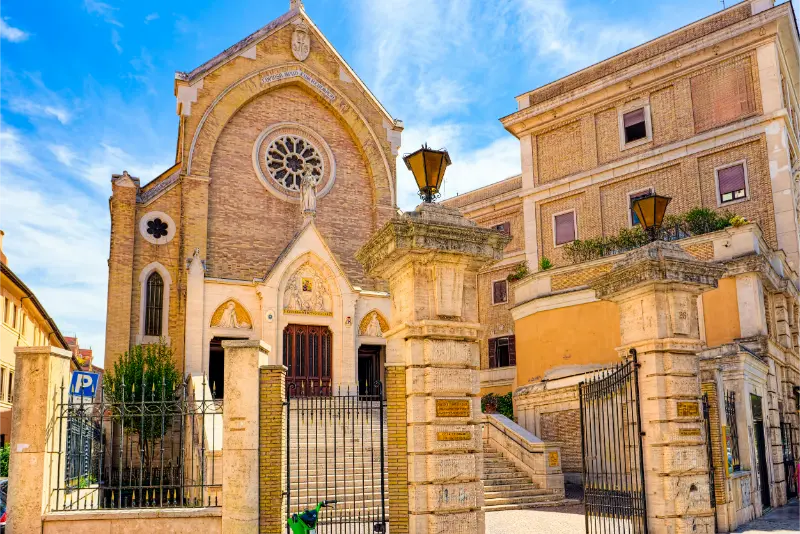
Stand across the street carefully and examine the façade’s undulating surface. Concave and convex bays create a restless rhythm that breaks away from a flat Renaissance wall. The upper level was completed after Borromini’s death, but the overall effect remains one of the clearest signatures of his architectural language.
The oval interior and dome
Inside, look up at the coffered dome. Crosses, octagons and hexagons form a geometric pattern that becomes smaller toward the lantern, increasing the illusion of height. White surfaces reflect light so effectively that the small interior feels luminous rather than cramped.
The cloister
The compact cloister is a quieter complement to the church. Its rounded corners and layered columns continue the manipulation of geometry at a domestic scale. Do not skip it simply because the church dome is more famous; the cloister shows how Borromini could create elegance without theatrical decoration.
The crypt
The crypt is restrained and architecturally fascinating, traditionally associated with Borromini’s intention to be buried there. Its simplicity makes a strong contrast with the complexity above. Access is part of normal visiting hours according to the current official page, but follow any staff direction if an area is temporarily restricted.
The Quattro Fontane outside
The church stands at a famous crossroads where four late-sixteenth-century fountains occupy the building corners. Two represent rivers, while the others are usually interpreted as female allegorical figures. Traffic makes the intersection less serene than a museum courtyard, so look carefully from the pavement rather than stepping into the road for photographs.
From here it is easy to continue to Quirinal Palace, Santa Maria della Vittoria or down toward Via Nazionale and Monti. This concentration of Baroque architecture makes the church ideal for a themed walk rather than an isolated stop.
How to visit respectfully
San Carlino is small: the official site notes a capacity of around forty-five people. A large group can transform the atmosphere instantly, so if you arrive with a crowd, wait a few minutes rather than forcing your way into every corner. Keep voices low, remove hats and give worshippers space.
Free entry does not mean the building costs nothing to maintain. A small donation is a reasonable way to support the church, especially if you visit the sacristy, cloister and crypt as well as the main nave. Do not treat the donation box as a ticket gate; contribute discreetly and continue the visit without blocking circulation.
A low-stress visit plan
- 24–48 hours before: recheck the official website for closures, restoration notices, services or event changes.
- Before leaving: save tickets or reservation details offline and confirm the exact entrance, not only the attraction name.
- On arrival: identify the two or three details you most want to understand instead of trying to absorb everything at once.
- During the visit: take a short pause before attention drops; even five minutes can improve the second half of a museum or church visit.
- Afterward: keep the next stop flexible whenever possible and use the surrounding neighborhood rather than immediately crossing Rome.
The difference between a good Rome itinerary and an exhausting one is often the number of fixed commitments. One timed ticket in a half-day is usually easy to manage; three can make every bus delay or security line feel like a problem. Keep free churches, squares, viewpoints and walks around the ticketed anchor so the day can expand or contract naturally.
Save screenshots of reservations and official notices. Mobile data is usually reliable in central Rome, but basements, thick historic walls and crowded networks can make loading a confirmation surprisingly slow at the worst moment. A simple offline copy also protects you if a booking email is difficult to find at the entrance.
How much time to allow
Allow 30–45 minutes to see the church, cloister, sacristy and crypt at a thoughtful pace. Architecture enthusiasts may stay closer to an hour, especially if sketching or comparing the plan with the space. Because the building is small, a quiet visit can be more rewarding than a long one during a group rush.
Leave a buffer of at least 20–30 minutes before the next fixed reservation. Rome looks compact on a map, but security checks, crowded pavements, uneven surfaces and public-transport delays can turn an optimistic connection into a stressful sprint. A slower schedule also gives you room to stop for a coffee, look at a church that catches your attention or simply stay longer when a place is better than expected.
Best time of day and season
Weekday morning soon after opening is ideal for a calmer interior. In May–September, the later afternoon opening period begins at 16:00 under the current schedule, which can work well after the hottest part of the day. Always check the seasonal timetable because winter and summer afternoon hours differ.
Season changes the feel of almost every Rome visit. In July and August, place exposed outdoor sections early or late and use museums and churches during the hottest hours. In winter, remember that daylight disappears much earlier. Spring and autumn usually give the easiest balance, but weekends, school holidays and major religious or civic events can still change crowd patterns.
Visiting with children
The church can be surprisingly good for children if you turn geometry into a game: find ovals, crosses, octagons and hexagons in the dome. Keep the visit short, especially when the interior is crowded, and explain before entering that it is a small active church where voices need to stay low.
For a wider family plan, compare our Rome with kids guide and keep the day varied. Children usually respond better when one detailed cultural stop is followed by a park, gelato break or open-air walk rather than another long interior immediately afterward.
Accessibility and comfort
The compact historic complex includes different spaces and level changes, so visitors with mobility limitations should contact the church for the most current route. The small scale can make maneuvering harder when groups are present. Choose a quieter time and ask staff which parts of the cloister or crypt are accessible.
Historic Rome has no single accessibility standard. A site can be technically accessible while a specific staircase, crypt, basement or temporary route remains difficult. Use our accessible Rome guide for city-level planning, but contact the venue directly when step-free access, an accessible toilet, lift dimensions or companion policies are essential.
What to combine nearby
Build a Borromini-and-Baroque walk with Santa Maria della Vittoria, the Quattro Fontane and the Quirinal Palace area. For a broader comparison, our best churches in Rome guide helps place San Carlino among the city’s larger basilicas.
Geographic combinations usually create better Rome days than thematic ones. Two famous sights on opposite sides of the city may look attractive on a checklist but waste time in transit. A lesser-known church, square, market or neighborhood beside your main stop often creates a more memorable route and leaves enough energy for the evening.
Food, water and practical breaks
Do not wait until you are exhausted to think about food. Around central monuments, walk one or two streets away from the busiest viewpoint before choosing a café or restaurant, read the menu before sitting and avoid places that pressure passers-by. For a quick sightseeing day, a bakery, pizza al taglio counter or simple trattoria is often more useful than a long lunch immediately beside a landmark.
Carry water in warm weather and refill responsibly where public drinking fountains are available; our Rome drinking water guide explains the city’s nasoni. Churches and museums may require bottles to stay closed or be stored, so finish drinks before entering sensitive spaces and follow staff instructions.
Common planning mistakes
- Checking only generic Rome church hours and missing the seasonal afternoon schedule on the official site.
- Standing in traffic to photograph the façade or four fountains.
- Skipping the cloister and crypt after seeing the famous dome.
- Visiting with a large noisy group mindset even though the church capacity and atmosphere are intimate.
Is it worth it on a first trip?
Yes, particularly for architecture lovers, and the visit is easy to justify because it is free and centrally located. Even first-time visitors can include it if their route passes the Quirinal or Via Nazionale. The church offers a very different kind of “wow” from Rome’s giant monuments.

If you are still building the overall schedule, use our best things to do in Rome page as a framework and then replace one generic stop with the places that match your interests. Rome becomes much more rewarding when an itinerary reflects what you actually enjoy rather than trying to reproduce every top-ten list.
Frequently asked questions
Is San Carlo alle Quattro Fontane free?
Yes, the official visiting page lists free entry during normal visiting hours; a donation for maintenance is appreciated.
What are the opening hours?
Weekdays 10:00–13:00, plus 15:00–17:00 from October to April or 16:00–19:00 from May to September under the current schedule.
Can you visit the cloister and crypt?
The official page states that the church, sacristy, cloister and crypt can be visited during normal visiting hours.
Why is it called San Carlino?
The nickname reflects the church’s small size; it is a diminutive form of San Carlo and has long emphasized how compact the masterpiece is.
Final advice
San Carlino proves that Rome’s greatest architecture is not always the biggest. Visit when the interior is quiet, stand under the oval dome long enough to understand its geometry, then move through the cloister and crypt before looking back at the restless façade. The whole experience can take less than an hour and still change the way you see Baroque space.