Piazza Barberini Rome: Triton Fountain, Bernini and Visiting Guide
Piazza Barberini is a busy central square with one extraordinary reason to stop: Bernini’s Fontana del Tritone. The fountain turns what might otherwise feel like a traffic junction into one of the clearest demonstrations of Baroque sculpture shaping urban space. Around it, Via Veneto, Palazzo Barberini and the streets toward Trevi and the Spanish Steps create an unusually useful sightseeing crossroads.
The piazza is best understood as part of a cluster. Pair it with Palazzo Barberini, Via Veneto, and a walk toward Trevi Fountain. You can see the square quickly, but the surrounding route can easily fill half a day.
Piazza Barberini at a glance
| Area | Central Rome, at the junction of Via Veneto and Via del Tritone |
| Best for | Bernini, Baroque Rome, architecture and central walking routes |
| Suggested time | 20–40 minutes for the square; 2–3 hours with Palazzo Barberini |
| Cost | Free to see the square and fountains |
| Best moment | Early morning or evening when traffic feels less dominant |
Why this place is worth your time
The Fontana del Tritone is not just a decorative object dropped into a square. Bernini designed the sculpture so water, shell, dolphins and the upward movement of Triton form a single theatrical composition. Seeing it in its original urban setting is more instructive than viewing Baroque sculpture only inside museums.
The square also gives practical orientation. Via Veneto climbs away in one direction, Palazzo Barberini lies close by, Trevi sits downhill and Piazza di Spagna is within an easy walk. That makes the stop useful even for travelers with limited time.
History and context
The square took its modern identity from the Barberini family and the great palace they developed nearby. Under Pope Urban VIII Barberini, the area became a stage for dynastic symbolism, architecture and public works.
Bernini created the Fontana del Tritone in 1642–1643. Four dolphins support a large shell from which the muscular Triton rises, blowing into a conch. Barberini bees appear prominently as heraldic symbols, tying a public fountain to the patronage of the papal family.
Bernini also designed the smaller Fontana delle Api, now located at the beginning of Via Veneto. Together, the two fountains show how Baroque Rome used water, family emblems and sculptural invention to transform ordinary movement through the city.
What to see and notice
Fontana del Tritone
Walk a slow circle around the fountain from the legal pavement viewpoints. The most striking feature is the sense of lift: the central figure appears to rise above an open base rather than sit heavily on a masonry pedestal.
Look for the three bees of the Barberini arms between the dolphins. Small details make the work easier to read as both sculpture and political statement.
Fontana delle Api
A short walk toward Via Veneto brings you to Bernini’s smaller Fontana delle Api. Its shell-like form and bee imagery make it an easy companion piece to the Triton Fountain.
Because it sits near a busy street edge, visitors often pass without stopping. Give it a few minutes and compare its scale and function with the monumental centerpiece of Piazza Barberini.
Palazzo Barberini
Just off the square, Palazzo Barberini is one of the best nearby indoor visits, with major works by Caravaggio and Raphael as well as a palace setting connected to Bernini and Borromini.
If you have time for only one museum in this part of Rome, the palace is a strong choice because it connects directly to the family whose name and symbols define the square.
The start of Via Veneto
From the piazza, Via Veneto climbs toward the walls and Villa Borghese area. Its twentieth-century Dolce Vita reputation contrasts with the seventeenth-century Barberini setting below.
Walking even the first section helps you understand how this junction links different eras and social identities within central Rome.
A practical way to visit
A compact route lets you see Bernini outdoors and then choose between art, shopping or a classic central walk.
- Start at the outer edge of Piazza Barberini and view the Triton Fountain from more than one angle.
- Walk briefly toward Via Veneto to see the Fontana delle Api.
- Visit Palazzo Barberini if its collection fits your day.
- Continue downhill toward Trevi Fountain or west toward the Spanish Steps.
- If you want green space, keep climbing Via Veneto toward the Villa Borghese area.
Because the square sits at a transport and traffic junction, it is usually better as the beginning or midpoint of a walk than as the final destination of a special journey.
Best time to go
Early morning gives you the easiest views of the fountain and lighter traffic. It is ideal if you want photographs before opening time at Palazzo Barberini.
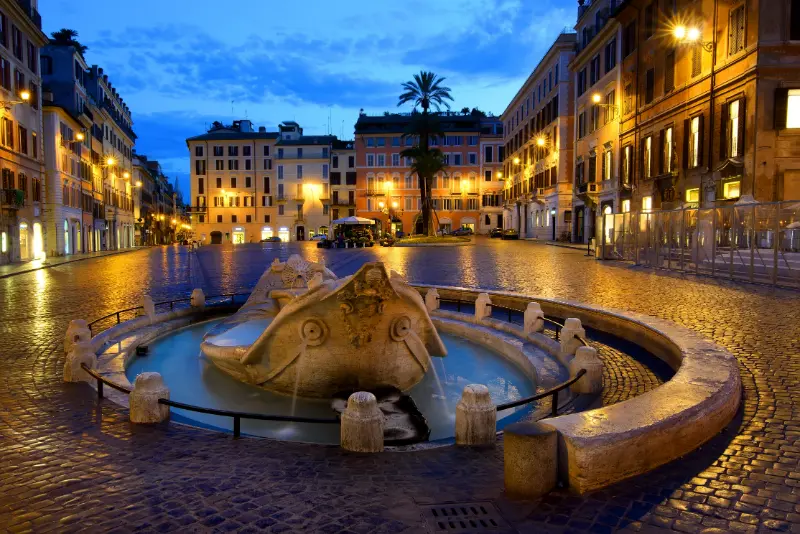
Evening is also attractive because the fountain and surrounding buildings are illuminated. Midday can be hot and busy, but the location remains practical if you are linking indoor attractions.
How to get there and move around
Barberini station on Metro Line A is immediately useful for this area. Buses also serve surrounding streets, but walking from Trevi, Spagna or the Quirinale is often simpler than making a short central transfer.
The square has significant road traffic, so use crossings rather than following other pedestrians into unsafe gaps. The central fountain is not a pedestrian island designed for casual access.
How to combine it with nearby Rome
Combine the piazza with Palazzo Barberini for a Baroque-focused block. After the museum, continue to the Quattro Fontane area or descend toward Trevi.
For a more relaxed route, walk up Via Veneto and continue toward Villa Borghese. This changes the pace from busy traffic to greener streets and park space.
Practical tips
- Use the metro if Piazza Barberini is your starting point, not for a one-stop transfer from nearby Spagna.
- Photograph from pavements and crossings; do not step into traffic for a centered composition.
- Look for the Barberini bees on both fountains.
- Check Palazzo Barberini hours separately from the public square.
- In hot weather, schedule the outdoor stop before or after an indoor museum rather than at the hottest part of the day.
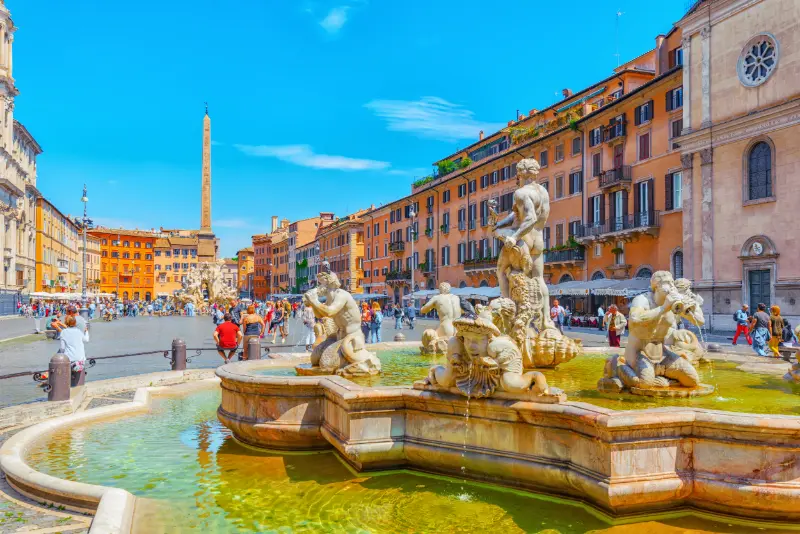
The square itself is quick, but the surrounding cluster is rich. Plan one major nearby attraction and let the piazza provide the connective tissue.
Photography and atmosphere
A lower viewpoint emphasizes the way Triton rises above the shell and dolphins, while a wider angle includes enough of the square to show the fountain in context. Morning reduces visual clutter.
At night, exposure can be tricky because bright water highlights contrast with dark buildings. Use a stable stance and avoid blocking crossings while composing.
Accessibility and comfort
The area is paved and central, but slopes toward Via Veneto, curb crossings and traffic can complicate movement. Metro access is convenient, though station accessibility should be checked if step-free travel is essential.
Palazzo Barberini has its own accessibility information. Travelers who need regular seating may find the square itself less comfortable than a pedestrian piazza, so plan café or museum breaks.
Common mistakes to avoid
- Seeing only the Triton Fountain and missing the Fontana delle Api.
- Assuming Palazzo Barberini is directly on the center of the square; it is nearby but requires a short walk.
- Crossing traffic informally to chase a photograph.
- Confusing the square with the quieter atmosphere of Piazza Navona.
- Planning an entire morning for the square alone instead of using the surrounding cluster.
How it fits into a first-time Rome itinerary
On a first Rome trip, Piazza Barberini fits naturally between Trevi and the Spanish Steps or before a visit to Palazzo Barberini. It is an efficient way to add Bernini without a separate reservation.
If your itinerary already includes Piazza Navona and St. Peter’s, this square gives a different kind of Baroque experience: less ceremonial, more integrated into everyday city traffic.
Where to stay nearby
The Barberini area is highly central and convenient for Metro Line A, Trevi, Spagna and Via Veneto. Hotels can be expensive, but the walkability is excellent for first-time visitors.
Choose a room away from major traffic lanes if noise matters. Compare the value with nearby Monti or Prati rather than paying only for a famous street name.
Official information and current conditions
Turismo Roma describes Bernini’s 1642–1643 fountain and its Barberini symbolism on the official Fontana del Tritone page.
The fountains and square are public, but restoration barriers, road works and museum schedules can change. Verify any indoor attraction independently before setting out.
Frequently asked questions
Is Piazza Barberini free?
Yes. The square, Triton Fountain and nearby Fontana delle Api can be seen without a ticket.
How long should I spend there?
About 20–40 minutes is enough for the square and both fountains. Add two hours or more if you visit Palazzo Barberini.
What metro stop is closest?
Barberini on Metro Line A serves the square directly.
Is Piazza Barberini worth seeing at night?
Yes. The illuminated fountain can be atmospheric, and the location works well as part of an evening walk toward Trevi or Via Veneto.
Final thoughts
Piazza Barberini is a classic example of a Rome sight that becomes much better once you stop treating it as a traffic junction. Bernini’s fountain is a compact masterpiece of movement, water and family symbolism.
See the fountain, find the bees, add Palazzo Barberini or Via Veneto, and then keep walking. The square’s real strength is how efficiently it connects major chapters of central Rome.