
Spanish Steps Rome: What to See Around Piazza di Spagna
The Spanish Steps are one of Rome’s most photographed urban spaces, but they make more sense when you see them as part of a larger landscape rather than a staircase to tick off a list. Piazza di Spagna below, the terraces above, Trinità dei Monti, Via dei Condotti, the Pincio and nearby Villa Borghese all fit together into one of the city’s best walking areas.
The steps are free to visit and remain open as a public monument, yet behavior is regulated to protect the site. The key practical point is simple: do not sit on the steps. Local rules have long restricted sitting and behavior that can damage or obstruct the monument. Instead, keep moving, use the terraces and enjoy the views from several levels.
Why are they called the Spanish Steps?
The staircase takes its English name from Piazza di Spagna and the nearby Spanish Embassy to the Holy See. In Italian, the monument is usually called the Scalinata di Trinità dei Monti. The monumental stairway was created in the eighteenth century to connect the lower square with the church of Trinità dei Monti above.
The theatrical shape is part of the appeal: broad flights split and reconnect, creating changing views as you climb. Rather than marching directly to the top, pause on the landings and look back over the rooftops. The staircase is designed to be experienced in motion.
What to see in Piazza di Spagna
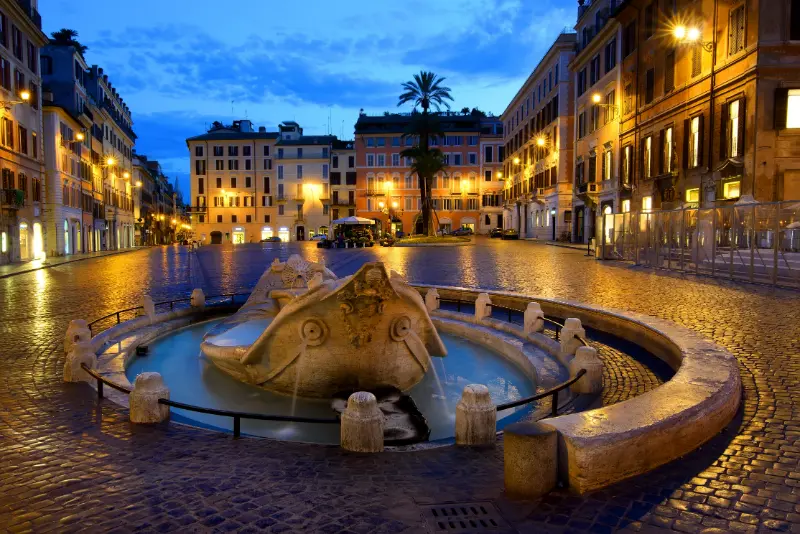
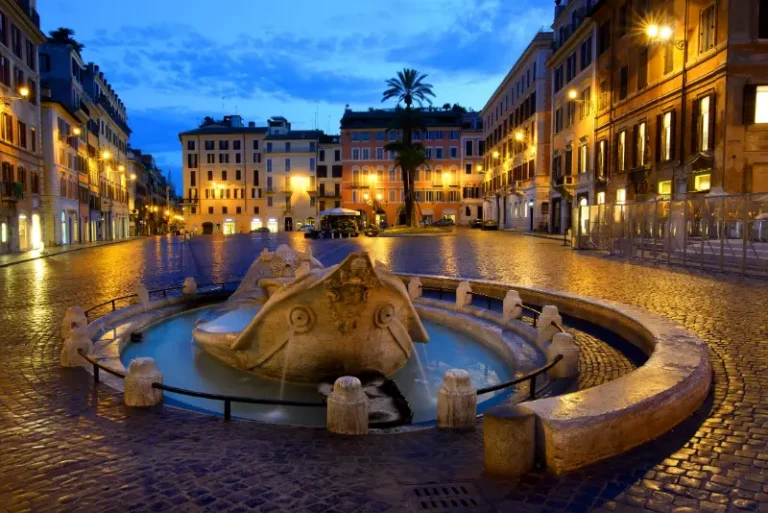
At the foot of the steps sits the Fontana della Barcaccia, the low boat-shaped fountain traditionally associated with Pietro Bernini and his son Gian Lorenzo Bernini. Its sunken form works with the relatively low water pressure of the historic Acqua Vergine system. The fountain is not a backdrop to climb on; admire it from the edge and keep the area clear.
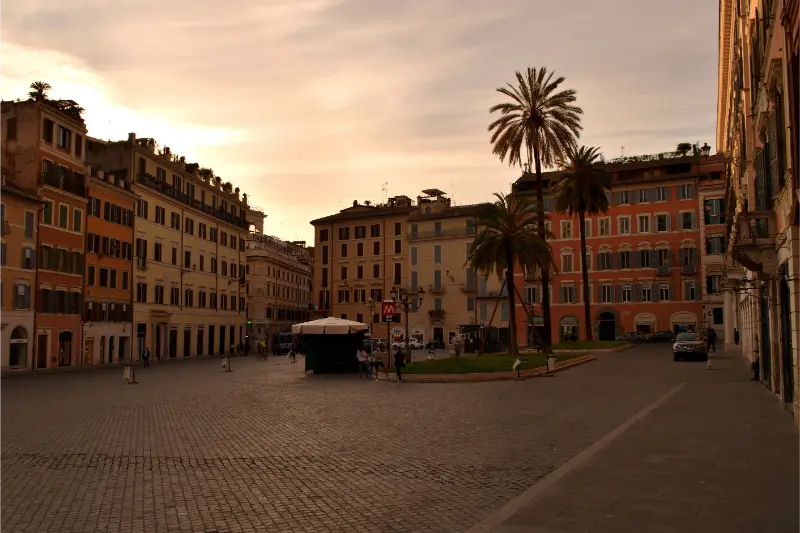
The square itself is a major crossroads between historic lanes, luxury shopping streets and the route toward Trevi Fountain. It is often crowded in the afternoon, so early morning offers the best chance to appreciate the shape of the space.
Climb to Trinità dei Monti
At the top, the church of Trinità dei Monti and the obelisk create the classic skyline above the steps. From here, the view opens toward central Rome. Continue along the elevated route toward the Pincio rather than immediately walking back down; this turns a short photo stop into a much better urban walk.
Best time to visit the Spanish Steps
Sunrise and early morning are ideal for photography and a calmer walk. Late afternoon can be beautiful when the light softens, but the area is busier. After dark, the steps and surrounding façades are illuminated and the atmosphere is elegant, especially if you combine the visit with Via del Babuino, Piazza del Popolo or Trevi Fountain.
Spring brings flowers and a particularly photogenic scene, while summer can be very hot because there is little shade on the staircase itself. In July and August, climb slowly and save Villa Borghese for a cooler part of the day.
Shopping around Piazza di Spagna

Via dei Condotti runs directly from the square and is associated with international luxury brands. Even if you are not shopping, it is worth walking a short section to understand why this neighborhood has long been linked with fashion and elegant retail. Nearby Via del Corso offers a broader mix of mainstream shopping.
For a larger overview of shopping districts, markets and souvenir ideas, see our shopping in Rome guide.
Walk from the Spanish Steps to Trevi Fountain
One of the simplest first-time routes is to walk from Piazza di Spagna to Trevi Fountain. The distance is short enough that public transport would add more effort than it saves. From Trevi, continue to the Pantheon and Piazza Navona for an almost continuous sequence of landmarks.
Continue to Villa Borghese and Pincio
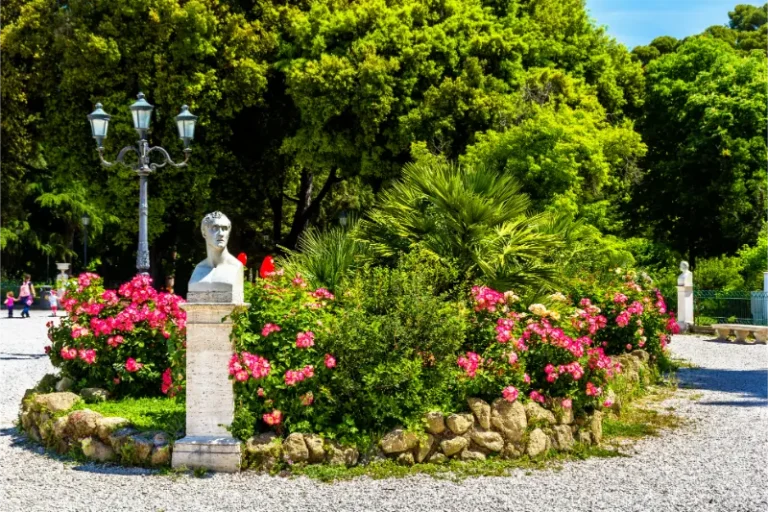
For a less crowded direction, climb the steps and continue north-west toward the Pincio terrace and Villa Borghese. The park creates a useful break after several hours on stone streets. Families can use it as a reset point, while art lovers can plan a timed visit to the Galleria Borghese elsewhere in the park.
The Keats-Shelley House
At the foot of the steps, the Keats-Shelley House is associated with the English Romantic poets and occupies the building where John Keats died in 1821. For literature lovers, this small museum adds a very different layer to a square usually experienced only as a visual landmark. Check its current official schedule before making it the anchor of your visit.
How long do you need?
If you only want the classic view, 20–30 minutes is enough. A better visit takes 60–90 minutes, allowing time to climb, explore the top, walk part of Via dei Condotti and perhaps continue toward Pincio. If you add Villa Borghese or shopping, the area can easily fill half a day.
Spanish Steps with children and strollers
Families should not feel obliged to push a stroller up the full staircase. Approach the square from below, enjoy the fountain and the lower view, then use surrounding streets to reach higher ground if necessary. The historic center has uneven surfaces, and the crowds around the foot of the steps can be more challenging than the distance itself.
Photography tips
- Arrive early for a cleaner view of the staircase and Barcaccia fountain.
- Photograph from the lower square for symmetry, then from the upper terraces for a city view.
- Use the side landings to capture the curve and movement of the staircase.
- After dark, expose for the illuminated architecture rather than the brightest shop windows.
- Respect barriers and do not block people who are using the steps as a route.
Where the Spanish Steps fit in a first Rome itinerary
The steps work best on the same day as Trevi Fountain, Pantheon and Piazza Navona, or as the beginning of a Villa Borghese morning. They are less logical on the same block of time as the Colosseum or Vatican Museums because those areas deserve separate focus.
If you have only a few days, our Rome in 3 days itinerary and Rome in 4 days itinerary show how to group neighborhoods so that you spend less time crossing the city.
Common mistakes to avoid
- Sitting on the steps despite local restrictions.
- Treating the area as a five-minute photo stop and missing the route to Pincio.
- Scheduling the visit at the hottest part of a summer afternoon.
- Taking a taxi between Spanish Steps and Trevi Fountain instead of walking.
- Focusing only on luxury shops and missing the church, fountain and viewpoints.
Final tip
Climb the steps once, but do not walk straight back down the same way. Continue along the upper streets toward Pincio or Villa Borghese, then descend through a different route. Rome is at its best when a famous monument becomes the doorway to the next neighborhood rather than the end of the walk.
Piazza di Spagna beyond the staircase

The neighborhood rewards looking sideways. Via Margutta, historically associated with artists and film culture, is a short walk away; Via del Babuino leads toward Piazza del Popolo; and the small streets behind the luxury-shopping axis contain galleries, cafés and less formal storefronts. If the staircase itself feels too crowded, simply use it as the starting point for a wider walk rather than waiting for the perfect empty photograph.
How to combine the area with Piazza del Popolo
From the top of the steps, continue toward the Pincio terrace and descend to Piazza del Popolo. This creates a much more satisfying route than walking down the same staircase. You gain a panoramic viewpoint, park paths and another monumental square while staying in the same part of the city. From Piazza del Popolo, metro and tram connections can help if you are tired.
Coffee, meals and tourist pricing
Piazza di Spagna sits in one of Rome’s most expensive retail districts, so cafés and restaurants with prime views may charge accordingly. If your priority is value, walk toward Via del Corso, Campo Marzio or quieter side streets before choosing a table. Always check the menu and service conditions, especially if you want to sit rather than drink a quick coffee at the bar.
Accessibility and alternative routes
The staircase itself is not the easiest route for travelers with mobility limitations, heavy luggage or strollers. Fortunately, the wider neighborhood can be reached from several directions, and public transport can bring you close to both the lower square and Villa Borghese side. Plan the visit as an area rather than as a required climb; the views, fountain and atmosphere can still be enjoyed without walking every step.
Why the Spanish Steps are worth seeing even if you dislike crowds
The reason to visit is not simply celebrity or social-media fame. The staircase demonstrates how Baroque and eighteenth-century Rome used architecture to solve changes in elevation while creating a public spectacle. If you arrive early or approach from the park above, the geometry becomes much easier to appreciate. The best strategy is not to avoid the site entirely, but to choose a time and route that let you see why it became famous.
One Comment
Comments are closed.