Tivoli from Rome: Villa d’Este and Hadrian’s Villa Day Trip Guide
Tivoli is one of the most rewarding day trips from Rome because it combines two completely different UNESCO-level experiences in a compact area: the Renaissance gardens and fountains of Villa d’Este and the enormous archaeological landscape of Hadrian’s Villa. One is theatrical, vertical and full of moving water; the other is spacious, fragmented and designed on an imperial scale.
You can visit both in one day, but the schedule needs thought. They are not next door to each other, and each deserves more than a quick walk. Travelers who prefer gardens can give Villa d’Este the larger share of time, while archaeology enthusiasts may want to spend most of the day at Hadrian’s Villa and treat Tivoli’s historic center as a shorter stop.
Villa d’Este opening hours in 2026
The official VILLÆ website lists Villa d’Este as open every day with seasonal closing times, while Monday opening begins at 2:00 p.m. under the current schedule. That Monday rule is crucial: a standard morning-at-Villa-d’Este itinerary will not work unless a holiday or special opening changes the pattern.
Seasonal last-entry times extend into the evening in spring and summer and become earlier in winter. High visitor numbers can also lead to controlled access or temporary route changes. Always check the official timetable for your exact date rather than relying on a generic travel article.
Hadrian’s Villa opening arrangements
Hadrian’s Villa is open daily under seasonal hours, with January 1 and December 25 listed as closure days unless extraordinary openings are announced. The site is much more physically demanding than Villa d’Este because of its size, paths and gradients. Proper shoes make a noticeable difference.
How to get to Tivoli from Rome
Public transport is possible by regional train and bus combinations, but the best route depends on whether you want to start at Tivoli town/Villa d’Este or at Hadrian’s Villa. The two sites are separated enough that you should plan the transfer between them, not assume you can casually walk from one entrance to the other.
For couples or small groups, a taxi for the local Tivoli transfer can save time even if you use public transport from Rome. Organized tours simplify logistics but reduce independence. If you enjoy slow archaeology, independent travel usually gives you more control over how long to stay at Hadrian’s Villa.
Start with Hadrian’s Villa or Villa d’Este?
On most non-Mondays, starting with Hadrian’s Villa works well because the archaeological site benefits from cooler morning temperatures and fresh legs. Move to Tivoli town for lunch, then spend the afternoon among the fountains of Villa d’Este. On Monday, the 2:00 p.m. opening of Villa d’Este naturally reinforces this order.
If your priority is photography at Villa d’Este or you are visiting in winter when daylight ends early, reverse the logic and check exact times carefully. The gardens are most enjoyable when you are not racing the light.
What Hadrian’s Villa actually is
Hadrian’s Villa was not a single country house. It was an imperial complex of palaces, baths, gardens, pavilions and service buildings spread across a vast estate. Emperor Hadrian drew on architectural ideas from across the Roman world, creating spaces that feel experimental even today.
Canopus and Serapeum
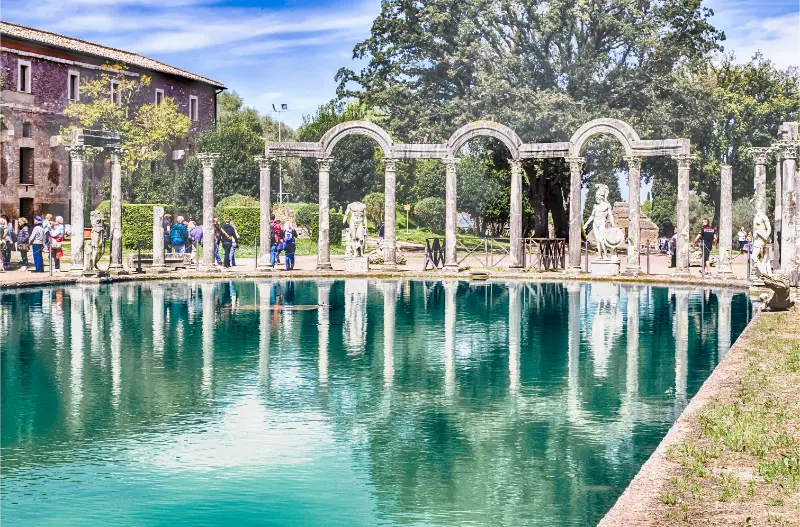
The Canopus is the image many travelers recognize: a long water basin framed by columns and sculpture, terminating near the monumental Serapeum. The setting demonstrates how architecture, landscape and water were combined to create an imperial environment rather than a conventional urban building.
Maritime Theatre
The so-called Maritime Theatre is one of the most intriguing spaces at the villa, a circular structure with a central island that may have functioned as a private retreat. Even without knowing every scholarly debate, the architecture communicates the emperor’s desire for controlled, secluded space within the much larger complex.
How long at Hadrian’s Villa?
Two hours gives you only the major highlights. Three hours is a better minimum, and archaeology enthusiasts can easily spend four. Distances are significant, so do not judge the visit by the number of named buildings on a map. The open landscape between ruins is part of the experience.
Villa d’Este: why the fountains matter
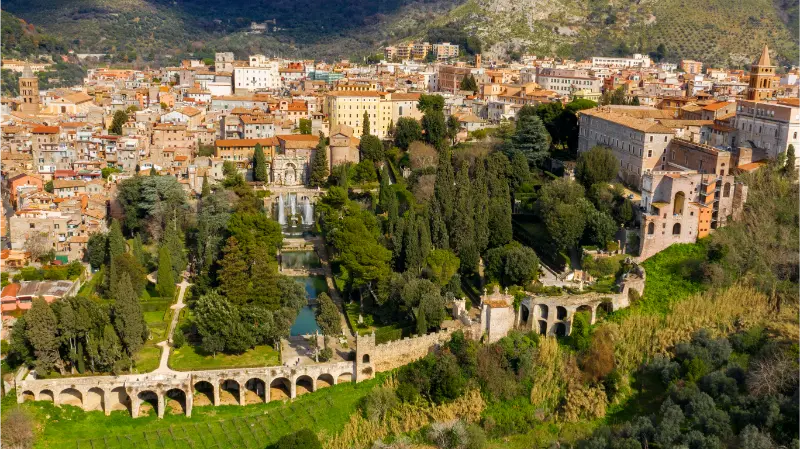
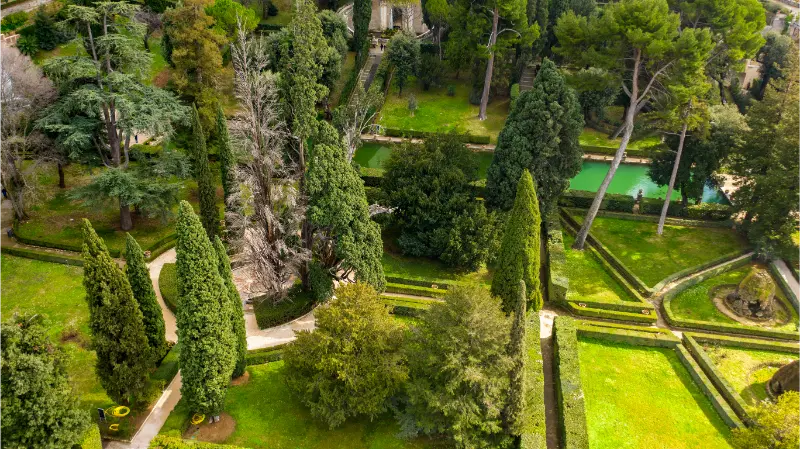
Villa d’Este was created for Cardinal Ippolito II d’Este in the sixteenth century and became one of Europe’s most influential Renaissance gardens. Its fountains are not decorative additions; water organizes the entire garden experience through sound, movement, coolness and surprise. Terraces open toward the landscape while paths descend through increasingly immersive water features.
The Hundred Fountains
The long avenue known as the Hundred Fountains is one of the garden’s most memorable sequences. Water emerges from masks and sculpted forms along a wall, creating a continuous sound as you walk. Visit slowly rather than trying to photograph every detail.
Fountain of the Organ
The official Villa d’Este information notes that the hydraulic organ is normally activated daily beginning around 10:30 a.m. and every two hours, subject to conditions. Weather and water levels can affect fountain operation, so treat any performance time as something to confirm on the day rather than a guarantee.
Neptune Fountain and the lower terraces
The Neptune Fountain creates one of the garden’s grandest scenes, especially when viewed from the terraces above. The choreography of water, vegetation and architecture is what makes Villa d’Este more than a collection of fountains. Give yourself enough time to walk both downhill and back up without rushing.
How long at Villa d’Este?
Two hours is a comfortable first visit, while garden lovers may want three. The villa interior adds frescoed rooms and context, but most visitors remember the outdoor sequence. Allow extra time in hot weather because the slopes and stairs can become tiring.
Lunch in Tivoli
Tivoli’s historic center is a good place to pause between the two sites. A proper lunch can be enjoyable, but keep it efficient if you want both villas in one day. Choose somewhere within walking distance of Villa d’Este rather than crossing town again. In warm months, hydration matters more than trying to fit a long multi-course meal into the middle of the excursion.
A one-day Tivoli itinerary
- Morning: travel from Rome and visit Hadrian’s Villa for roughly 2.5–3 hours.
- Early afternoon: transfer to Tivoli center and have lunch.
- Afternoon: visit Villa d’Este, including the palace rooms and gardens.
- Late afternoon/early evening: short walk through Tivoli center, then return to Rome.
Can you add the Sanctuary of Hercules Victor?
The Sanctuary of Hercules Victor is another major ancient site in Tivoli and is part of the VILLÆ institute, but adding it to Hadrian’s Villa and Villa d’Este in one ordinary day is ambitious. Repeat visitors or archaeology specialists may prefer to replace one of the headline villas rather than compress all three.
Tivoli with children
Villa d’Este is usually the easier family experience because moving water and gardens create constant visual interest. Hadrian’s Villa offers open space but requires more walking and imagination. In summer, start early, carry water and avoid turning the archaeological visit into a lecture.
Accessibility and footwear
Both sites involve slopes, steps and historic surfaces. Villa d’Este’s garden is terraced; Hadrian’s Villa is large and uneven. Travelers with mobility concerns should read official accessibility information and contact the sites before visiting. For everyone else, supportive walking shoes are one of the most useful things you can bring.
Best season for Tivoli

Spring and early autumn offer the best combination of comfortable walking weather and attractive gardens. Summer gives long opening hours but can be very hot at Hadrian’s Villa. Winter is quieter, though daylight and closing times are shorter and the gardens have a different character.
Tivoli or Ostia Antica?
Choose Tivoli for gardens, imperial architecture and a landscape change. Choose Ostia Antica for an easier archaeological day focused on everyday Roman urban life. With a five-day trip, either works; with a week, doing both gives you two very different perspectives on ancient Rome.
Final advice
Tivoli is most successful when you resist the urge to sprint through both villas. Hadrian’s Villa needs space; Villa d’Este needs time to hear and follow the water. Start early, check Monday and seasonal hours, plan the transfer between sites, and let the two places contrast with each other. That contrast—imperial ruins in the morning, Renaissance fountains in the afternoon—is exactly what makes the day trip special.
Extra planning notes before you go
Before finalizing any plan around Tivoli from Rome, check official opening calendars again a few days before the visit. Rome changes constantly: restoration projects, religious events, strikes, heat measures and temporary exhibitions can alter entrances or routes. Save the official page on your phone and take a screenshot of any timed reservation so you are not dependent on mobile data at the entrance.
Build at least 20 to 30 minutes of margin around timed admissions. Central Rome looks compact, but cobblestones, security queues, crowded pavements and hot weather slow people down. A schedule that works perfectly on a map can feel stressful on the ground. It is usually better to arrive early and have a coffee nearby than to spend the final ten minutes running through unfamiliar streets.
For meals, move one or two streets away from the most photographed landmark before choosing a restaurant. Read the menu before sitting, check whether service or cover charges are clearly listed, and avoid places where staff pressure you from the pavement. A simple bakery, pizza al taglio counter or neighborhood trattoria often fits a sightseeing day better than an elaborate lunch beside a major monument.
Finally, keep water and footwear in mind. Rome is a walking city even when you use metro and buses, and many archaeological or historic surfaces are uneven. In summer, refill at public drinking fountains where appropriate and schedule outdoor sections earlier or later in the day. In winter, carry a compact rain layer and remember that daylight disappears much earlier.