Temple of Venus and Rome: Hadrian’s Giant Temple by the Colosseum
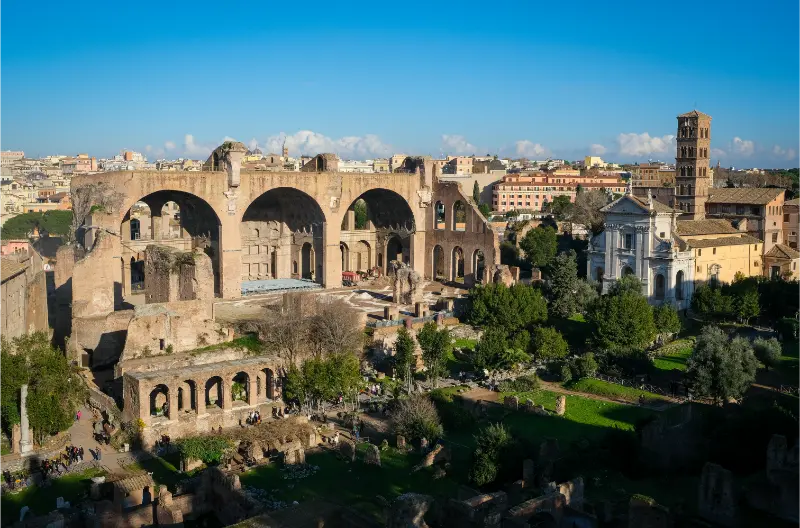
Temple of Venus and Rome is one of the places where the Roman Forum becomes much easier to understand once you know what you are looking at. Its value is not simply that it is old: it helps explain the scale of Rome’s largest ancient temple, its back-to-back cells and one of the best transitions between the Colosseum and Forum landscapes. Because the Forum contains dozens of structures in a relatively small area, a focused guide is often more useful than trying to absorb every ruin from a map label.
This article is designed for an independent visit in 2026. It explains the history, the details that survive, the best viewpoints, access and ticket logic, and how to connect the monument with nearby sites. For the wider route, start with our Roman Forum guide and keep the official opening information bookmarked because seasonal closing times and access to smaller interiors can change.
Temple of Venus and Rome at a glance
| Location | Velia ridge between the Colosseum valley and the Roman Forum |
| Why see it | the scale of Rome’s largest ancient temple, its back-to-back cells and one of the best transitions between the Colosseum and Forum landscapes |
| Time to allow | About 10–25 minutes for the monument itself; longer when combined with nearby Forum sites |
| Ticket | Within the Roman Forum/Palatine archaeological area; some interiors or SUPER sites can have additional access rules |
| Best approach | Read the site together with the monuments immediately around it rather than as an isolated stop |
Why Temple of Venus and Rome is worth your time
The strongest reason to stop here is context. The monument sits in Velia ridge between the Colosseum valley and the Roman Forum, so within a few steps you can compare different periods and functions of ancient Rome. A temple can be understood beside a basilica, a political platform beside an arch, or a private interior beside the vast palace landscape of the Palatine. That contrast is what turns a visit from a checklist into a readable city.
Many first-time visitors concentrate on the largest surviving structures and walk past lower remains. That is understandable, but it creates a distorted picture of the Forum. Ancient importance does not correlate with the height of what survives. Some of the most consequential institutions are now represented by foundations, podiums or fragments, while later monuments happen to stand taller.
History of Temple of Venus and Rome
Emperor Hadrian began the Temple of Venus and Rome in AD 121 on a monumental platform overlooking the Colosseum valley. The design honored Venus Felix and Roma Aeterna in two adjoining cells facing opposite directions. The project was inaugurated in the 130s and completed under Antoninus Pius around the middle of the second century.
The temple’s scale was exceptional. More than a hundred meters long, surrounded by colonnades and elevated above the surrounding routes, it asserted Rome’s identity in architectural form. Hadrian’s project also required reorganizing the area associated with Nero, including moving the famous colossal statue that had given the Colosseum its later name.
A major fire damaged the building in late antiquity, and Maxentius restored it in the early fourth century, introducing the vaulted apses and other features visible today. In later centuries the cell toward the Forum became closely connected with the church now known as Santa Francesca Romana. The surviving monument is therefore a combination of Hadrianic ambition, Maxentian reconstruction and later reuse.
A useful way to keep the chronology straight is to separate three questions: when the site first became important, which phase produced most of the remains visible today, and how the building was reused or dismantled later. Those dates are not always the same. The Forum is a layered archaeological landscape in which Republican foundations, imperial rebuilding and late-antique reuse often occupy the same footprint.
What to see on site
The twin-cell concept
Stand where you can understand that Venus and Roma occupied cells oriented in opposite directions. This unusual arrangement is the key to the whole design. One side engaged the Colosseum valley while the other faced toward the Forum, turning the temple into a hinge between two of ancient Rome’s most important spaces.
The coffered apse and marble floor
The restored cell of Roma gives the best sense of interior scale. The great apse and reconstructed sections of colored marble pavement help visitors move beyond the idea of ancient temples as plain white ruins. The original experience depended on color, polished stone and controlled vistas.
The terrace toward the Colosseum

When accessible, the platform provides one of the most instructive views of the Colosseum. Instead of treating it only as a photo stop, use the viewpoint to understand how the Flavian amphitheater, Nero’s former landscape and Hadrian’s temple were layered into the same valley.
How to read the monument in the Forum
Start by locating Temple of Venus and Rome on the open square or Palatine slope before focusing on details. Ask what it faced, which street or processional route passed it, and which neighboring buildings were visible from its entrance. The Forum was designed through relationships. Sightlines toward the Curia, Via Sacra, major temples and basilicas were part of how power and ritual were experienced.
Then look at levels. Modern visitors walk across surfaces created by excavation and restoration, while the ancient ground level changed over many centuries. Podiums, steps and buried foundations can therefore seem oddly disconnected. Comparing elevations helps explain why some doors now appear too high, why a podium dominates one side, or why later paving cuts across earlier structures.
Finally, look at material rather than only form. Travertine, tuff, brick, concrete, white marble and colored stones belong to different construction choices and restoration phases. Not every visible block was originally exposed, and some elements were reassembled during modern excavation. Archaeology is evidence plus interpretation, not a perfectly preserved snapshot.
Tickets, opening hours and access in 2026
The temple is within the PArCo archaeological area, but individual cells or terraces can close temporarily for conservation or events. A temporary summer 2026 closure affected the terrace and Cella of Venus, so checking the official notice board remains sensible even after that specific closure period has ended.
For the wider archaeological area, the official Parco archeologico del Colosseo currently lists the Roman Forum–Palatine as opening at 9:00. From 29 March to 30 September 2026 the PArCo closes at 19:15 with last admission at 18:15; autumn and winter closing times become earlier. Ticketing rules also distinguish the standard Colosseum–Forum–Palatine ticket from Forum Pass SUPER and Full Experience options. Always recheck the official page for the date of your visit rather than relying on a screenshot or an old blog timetable.
Check official Roman Forum and Palatine opening times and tickets before departure. The official ticket portal opens availability according to the PArCo sales calendar, and temporary closures can affect a single room or monument without closing the whole Forum.
Best route to combine with nearby sights
A practical cluster for this stop includes Colosseum, Roman Forum and Palatine guide, Roman Forum guide, Santa Francesca Romana guide and Basilica of Maxentius guide. These links are more useful than crossing the archaeological area repeatedly. Try to move geographically: finish one side of the Forum, then continue toward the Palatine or the Colosseum rather than returning to the same square several times.

If you enter from Largo della Salara Vecchia, you reach the central Forum quickly and can build outward. If you enter near the Arch of Titus, the route naturally descends along the Via Sacra. The San Gregorio side is especially logical when your day emphasizes the Palatine. Choose the entrance around the rest of your itinerary rather than assuming there is one universally best gate.
Best time of day
Early morning is usually the easiest time to read low archaeological remains because the Forum is quieter and temperatures are more manageable. Late afternoon can produce better side light on columns, inscriptions and reliefs, but remember that closing times vary seasonally and the archaeological area begins clearing before the final closure.
In summer, shade is limited. Carry water, wear a hat and treat the Forum as an outdoor archaeological walk rather than a museum with continuous climate control. In winter, stone paths can be slippery after rain and low sun can make some east–west views difficult, although the cooler temperature often makes a long visit more comfortable.
Photography and viewpoints
For a useful photograph of Temple of Venus and Rome, take one contextual frame before trying close details. Include a neighboring monument or part of the Forum square so the image explains location. A second tighter frame can then focus on columns, masonry, inscription or painting. This two-image approach is more informative than collecting ten near-identical close-ups.
A phone camera is enough for most visitors, but a modest optical zoom helps with inscriptions and details behind barriers. Avoid stepping into restricted areas or leaning over ancient masonry for a different angle. The barriers are part of conservation, and many fragile surfaces are more vulnerable than they look.
Accessibility and practical comfort
The Roman Forum contains uneven ancient paving, slopes, steps and long stretches without shade. The PArCo provides accessible routes and several accessible entrances, but not every archaeological surface or small interior is step-free. Visitors with reduced mobility should consult the official accessibility map and choose the entrance that best matches the monuments they most want to see.
For everyone else, footwear matters more than people expect. Smooth soles are a poor choice on worn stone. A light bag, refillable water bottle and compact sun protection make a bigger difference than carrying a large guidebook. Download the site map before arrival in case mobile reception is inconsistent among the ruins.
Common mistakes to avoid
- Looking only for tall ruins and assuming low foundations are unimportant.
- Trying to identify every stone without first understanding the overall plan.
- Using an old screenshot for opening hours instead of checking the official PArCo page.
- Crossing the Forum repeatedly instead of grouping nearby monuments into one route.
- Spending the entire visit behind a camera and missing the spatial relationship between buildings.
A simple one-hour Forum micro-itinerary
If you have only about an hour inside the central Forum, use Temple of Venus and Rome as one anchor rather than your only destination. Spend the first 10–15 minutes orienting yourself in the square, then give this monument a focused look. Continue to two nearby buildings with different functions—one political and one religious if possible—and finish at a higher viewpoint or the Via Sacra so you can look back over the ground you have just crossed.
With two to three hours, slow down and include the Palatine or Forum Museum. That extra time changes the quality of the visit because artifacts and elevated viewpoints help reconstruct buildings that are difficult to understand from foundations alone. If you also plan to visit the Colosseum, avoid overloading the same half-day with too many timed interiors.
FAQ about Temple of Venus and Rome
Do I need a separate ticket for Temple of Venus and Rome?
Usually you encounter the monument within the Roman Forum–Palatine ticketed area. However, some interiors and designated SUPER sites operate under specific ticket products or schedules. Check the official listing for the exact component you want to enter.
How long should I spend here?
Ten to twenty-five minutes is enough for most travelers who already understand the basic history. Add more time if an interior is open, if you are using an audio guide, or if you are photographing inscriptions and architectural details.
Is it suitable for children?
Yes, especially if you give the stop one clear story rather than a long lecture. Children often respond well to myths, political drama, ancient games, vivid wall paintings or the idea of reconstructing a vanished building from a few surviving clues.
Can I visit it without the Colosseum?
Yes. Forum-focused ticket options exist, and many travelers benefit from giving the Forum and Palatine their own time rather than treating them as an afterthought after the Colosseum. Check the current official ticket products before buying.
What should I read before going?
Start with the Roman Forum overview, then read only one or two detailed monument guides. Too much information before arrival becomes difficult to retain. A short mental map and a few strong stories are more useful than memorizing dozens of dates.
Final tips
Temple of Venus and Rome rewards a slower look because it fills a specific gap in the story of the Forum. Give yourself enough time to understand where it sits, identify two or three surviving features and connect it with the surrounding monuments. That is enough to transform the site from a label on a map into a piece of ancient Rome that you can actually read.
Before you go, check the official PArCo opening page, download the archaeological map and decide whether your ticket needs access to SUPER interiors. Once inside, resist the urge to race from famous landmark to famous landmark. The Forum becomes memorable when the spaces between those landmarks start to make sense.