Circus Maximus Rome: History, What to See and Visiting Tips
The Circus Maximus can be confusing on a first visit because its historical importance is far greater than the amount of monumental architecture still standing. In antiquity, this enormous valley between the Palatine and Aventine hills was Rome’s principal venue for chariot racing and mass entertainment. Today, much of the space reads as an open archaeological landscape rather than a preserved stadium.
That does not make it disappointing if you arrive with context. Rome’s official tourism portal describes the Circus as roughly 600 meters long and 140 meters wide and connects the valley with chariot racing, political ceremonies and major public events. Understanding the original scale before you walk it is the key to appreciating what remains.
What the Circus Maximus was
The valley’s association with public gatherings stretches back to Rome’s early traditions, while permanent monumental development grew over centuries. By the imperial period, the Circus was a vast entertainment complex built around a long racing track, central barrier and tiers of seating capable of holding an enormous crowd.
Chariot races were not a niche sport. Teams identified by colors attracted intense loyalty, and successful charioteers could become famous figures. The Circus therefore combined sport, spectacle, social identity, politics and imperial display.
How chariot racing worked
Teams raced laps around the central divider, with turning points creating some of the most dangerous moments. Speed, collisions and tactical position made the event dramatic. Popular retellings often simplify the races into constant crashes, but they also required skill, training and strategy from drivers and teams.
The hardest part of imagining a race is understanding the turns. Drivers had to bring their teams around the end of the central barrier while other chariots crowded into the same space. Standing in the valley and looking along its length makes that danger easier to picture than reading the dimensions alone. If you are visiting with children, ask them to imagine how many horses, wheels and spectators would have filled what now looks like a quiet stretch of grass. The contrast between the present landscape and the ancient spectacle is one of the strongest reasons to stop here.
Why so little survives above ground
The Circus changed repeatedly after antiquity. Materials were reused, the area became partly agricultural or industrial in later periods, and the monumental seating disappeared. Archaeological excavation has revealed structures at the curved end and other sectors, but the site cannot be experienced like the Colosseum with standing tiers all around you.
What to see today
Walk the length of the valley to understand scale. At the eastern curved end, archaeological remains and the Torre della Moletta provide stronger visual anchors. From parts of the Aventine and Palatine edges, you can better read how the Circus sat between the hills.
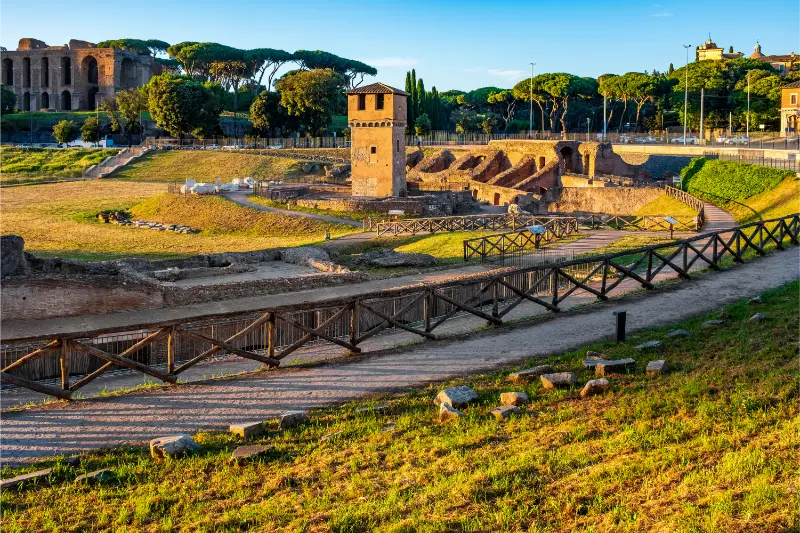
Do not judge the visit only from one photograph taken from the center. The most useful views often come from the edges, where the relationship with the Palatine becomes obvious.
The Circus is not a conventional archaeological park where every surviving element comes with its own clearly marked room or enclosure. Begin by finding the eastern curved end, then walk far enough along the valley to appreciate the elongated shape. The Palatine rises directly above one side, which helps explain why imperial residences could overlook major public events. Photographing only the central field can make the site look emptier than it feels. A wider view that includes the surrounding slopes and the remains at the end communicates the scale far better.
Circo Maximo Experience in 2026
Rome’s official tourism information lists the Circo Maximo Experience throughout 2026 as an immersive augmented- and virtual-reality route of about 40 minutes, organized in stages and using a headset. Because operating days, time slots and ticket conditions can change, consult the current official tourism listing before planning around it.
The reconstruction is particularly useful here because the ancient architecture is difficult to visualize from the open field alone. It should be treated as interpretation, not a substitute for the archaeology itself.
Torre della Moletta
The medieval Torre della Moletta is a reminder that the Circus valley did not stop existing after the Roman Empire. Later structures and uses accumulated over the ancient site. When access is available, the tower area can also help you understand the shape and dimensions of the Circus from a different perspective.
Is the Circus Maximus free?
The broad open area can be experienced as a public landscape, while specific archaeological sectors, exhibitions or immersive experiences may use ticketed access. Large events can also temporarily restrict parts of the site. Check current arrangements if you want more than a general walk through the valley.
How long to spend
For a simple walk and exterior interpretation, 30–45 minutes may be enough. Allow longer if you use the immersive experience, explore archaeological sectors or combine the Circus with the Aventine. It is usually better as part of a neighborhood route than as the only destination of a half-day.
Best viewpoints
The Aventine side offers useful perspectives and connects naturally with the Orange Garden and keyhole area. The Palatine side gives the strongest relationship with imperial Rome. Our Aventine Hill guide can help you build the southern side into a longer walk.
For visitors who cannot spend long on their feet, it is worth choosing a viewpoint before arriving rather than attempting the full length of the valley. The Circus is exposed in warm weather, and the open ground offers limited shade in the middle of the day. An early stop followed by the Aventine is often more comfortable than arriving after hours of sightseeing in the Forum. Check whether concerts or temporary installations are planned, because barriers and stages can change both the walking route and the view. Even a brief visit works well when you know what you are looking at.
Combine it with the Baths of Caracalla
The Baths of Caracalla are one of the best nearby pairings because they provide the monumental standing ruins that the Circus lacks. Walking between them creates a strong ancient-Rome half-day with less crowd pressure than the Colosseum and Forum.
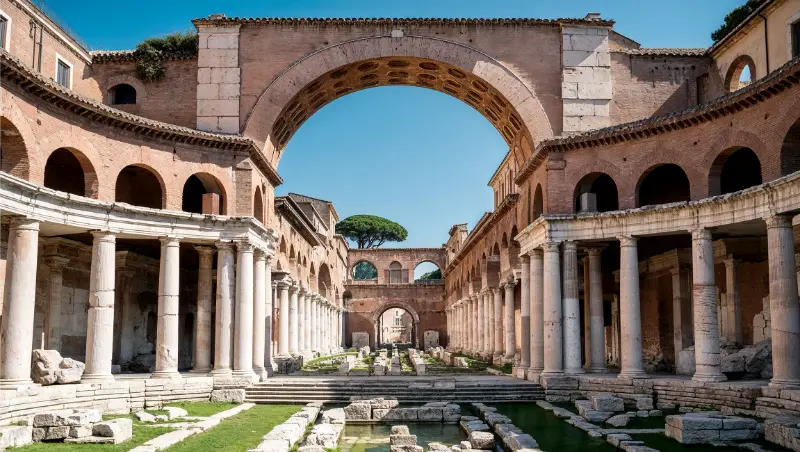
At the baths, the surviving walls help you picture the scale of imperial building projects. The two sites make an interesting contrast when visited on the same morning.
Combine it with the Aventine
From the Circus, climb toward the Aventine for the Orange Garden, Santa Sabina and the famous keyhole area. This gives the day a mix of archaeology, churches, greenery and views. The climb is noticeable, so reverse the route if downhill walking is easier for you.
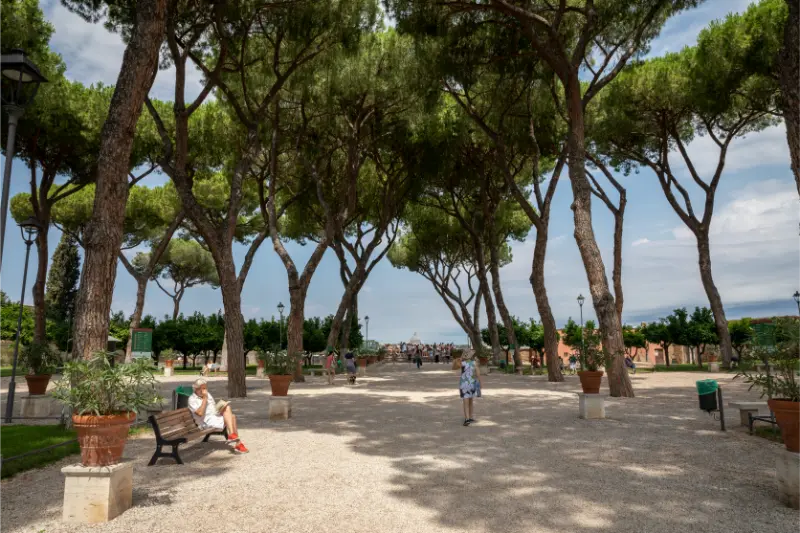
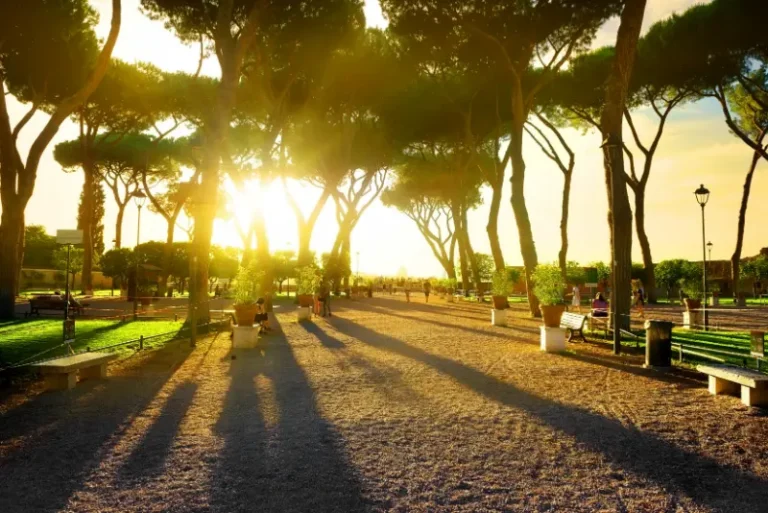
The Orange Garden is a welcome place to pause after walking through the exposed Circus valley. From its terrace, you can also take in one of the classic views across Rome.
Combine it with the Jewish Ghetto
Walking northwest from the Circus leads toward the Theatre of Marcellus and Jewish Ghetto. This route connects different historical layers without relying on public transport. See our Jewish Ghetto guide for food and historical context.
A practical two-hour route
| Stage | Plan |
|---|---|
| 1 | Start near the eastern archaeological end and understand the original stadium shape |
| 2 | Walk the long axis of the Circus |
| 3 | Pause for views toward the Palatine |
| 4 | Climb the Aventine for Santa Sabina and the Orange Garden |
| 5 | Return by Metro B at Circo Massimo or continue toward another nearby district |
Best time to visit
Early morning and late afternoon are best in warm weather because the valley is exposed. Sunset light can make the Palatine edge particularly attractive. Midday in summer offers little shade, while rainy days reduce the appeal of a long open walk.
Circus Maximus with children
Children who already know stories of chariot racing may enjoy the scale and open space, especially if the immersive experience is operating. Without interpretation, however, the site can look like a large field. Give them a simple explanation of laps, teams and the central barrier before arriving.
Accessibility
The open valley is generally easier to understand from broad paths than many steep archaeological sites, but surfaces, temporary event infrastructure and access to specific archaeological sectors can vary. Check current accessibility information if step-free routing is important.
Events and temporary closures
The Circus Maximus is still used for concerts and major public events. Set-up and dismantling can affect access even outside the event date. If the site is central to your plans, check the city’s current event calendar a few days before visiting.
Common mistakes
- Expecting a complete stone stadium like the Colosseum
- Walking only across the middle without seeing the curved archaeological end
- Visiting at midday in peak summer heat
- Ignoring the relationship with the Aventine and Palatine
- Assuming the immersive experience runs at every hour
- Forgetting that concerts and events can restrict access
Frequently asked questions
Is Circus Maximus worth visiting?
Yes when combined with the Aventine, Baths of Caracalla or a wider Ancient Rome route. It is less visually complete than the Colosseum, but historically essential.
How much of the ancient Circus survives?
The overall valley and archaeological remains preserve the scale and parts of the structure, but most of the monumental seating and decoration do not survive above ground.
Can I see Circus Maximus without a ticket?
You can experience the broad site and views without treating it as a conventional ticketed stadium, while specific archaeological or immersive experiences may require admission.
How to visualize the racecourse before you arrive
Look at a reliable reconstruction showing the long central barrier, turning posts and seating. Then, once on site, stand near one end and trace the oval route with your eyes. The open space suddenly becomes legible. Without that preparation, many visitors walk straight across the valley and leave wondering why the site was famous.
Try comparing a reconstruction of the central barrier with the present-day valley before leaving the hotel. The ancient Circus contained more than a bare track: spectators occupied monumental seating, and processions, political display and religious traditions were woven into the events. On site, look from one end toward the other and identify where the long straight sections and tight turns must have been. That simple exercise makes the archaeology more legible without requiring a guided tour. It also helps you explain the place to someone who sees only grass and scattered walls at first glance.
A strong Ancient Rome day without the Colosseum
Start at the Baths of Caracalla, walk toward the Circus Maximus, climb the Aventine for a break and finish near the Theatre of Marcellus and Jewish Ghetto. This route provides monumental ruins, landscape and neighborhood life while avoiding the most crowded Colosseum/Forum circuit. It is particularly useful for a second trip or a day when Colosseum tickets are unavailable.
Why the empty space is historically useful
The surviving openness is actually one of the Circus Maximus’s strongest teaching tools. Because later monumental seating has largely disappeared, you can read the full valley and understand the relationship between the racecourse, Palatine and Aventine more easily than inside a closed museum. Walk slowly enough to compare the width of the site with modern stadiums and imagine the logistical challenge of moving spectators, animals, teams and officials through the complex. That exercise turns a seemingly sparse archaeological area into a clear demonstration of the scale of Roman mass entertainment.
Final advice
The Circus Maximus becomes interesting when you stop asking “where is the stadium?” and start reading the entire valley as the stadium. Walk its length, look toward the Palatine, use reconstruction or interpretation to restore the missing architecture, then climb the Aventine or continue to the Baths of Caracalla. In context, the apparent emptiness becomes evidence of just how large ancient Rome’s entertainment culture was.