National Etruscan Museum Rome: Villa Giulia Tickets and Visiting Guide
The National Etruscan Museum at Villa Giulia is the best place in Rome to understand the civilization that shaped central Italy before Rome became an imperial power. The museum is housed in a Renaissance villa near Villa Borghese and displays funerary objects, jewelry, terracottas, temple decoration and some of the most famous Etruscan works in Italy. It is particularly valuable because it changes the usual Rome story: instead of starting with emperors, you encounter the cultures, cities and artistic traditions that surrounded early Rome. In 2026 the museum is open Tuesday through Sunday and continues to combine its permanent collection with temporary displays and special access initiatives.
At a glance
| Best for | Etruscan history, archaeology, jewelry and ancient art |
| Address | Piazzale di Villa Giulia 9 |
| 2026 hours | Tuesday–Sunday 8:30–19:30; last entry 18:30 |
| 2026 full ticket | €13 |
| Suggested time | 2–3 hours |
Why the Etruscan Museum changes how you understand Rome
The Etruscans are often reduced to a paragraph before the story of the Roman Republic begins. Villa Giulia corrects that imbalance. The collections show sophisticated cities, religious practices, trade networks, craftsmanship and funerary traditions that developed across Etruria and interacted with Greeks and other peoples of the Mediterranean. Understanding this world makes early Rome feel less isolated and more connected to a complex regional landscape.
The museum is also useful for travelers planning Etruscan day trips. If you intend to visit Cerveteri or Tarquinia, coming here first gives you visual vocabulary for tomb painting, sarcophagi, bucchero pottery, votive objects and temple decoration.
The Sarcophagus of the Spouses and other highlights
The Sarcophagus of the Spouses is the museum’s best-known work and one of the great images of Etruscan art. The reclining couple feels unusually social and expressive compared with many formal ancient funerary monuments. Spend time looking at gestures, facial expression and the way the two figures share the couch. The work is not simply beautiful; it opens questions about identity, status and how the Etruscans represented family and the afterlife.
Other highlights include the Apollo of Veii and temple sculpture, the Pyrgi Tablets, intricate gold jewelry and finds from major Etruscan centers. Do not rush directly from masterpiece to masterpiece. The smaller objects often explain daily life, religion and craft skill more clearly than monumental pieces.
Villa Giulia: a Renaissance setting for an ancient collection
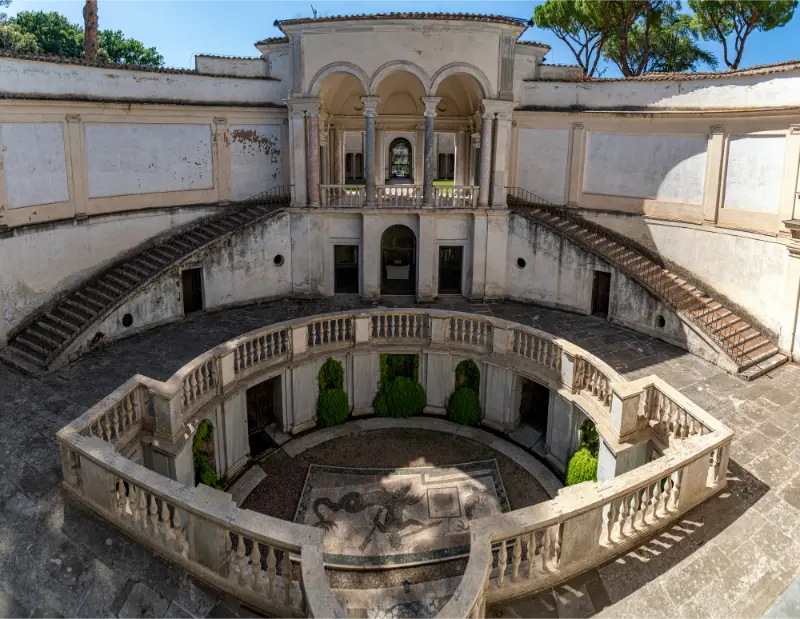
The building was created in the sixteenth century as a papal villa and is worth attention in its own right. Courtyards, loggias and the famous nymphaeum create a very different atmosphere from a conventional archaeological museum. The architecture gives the visit changes of pace, with outdoor and semi-outdoor spaces interrupting long sequences of display rooms.
Because the museum is larger than it initially appears, use the building itself to structure your visit. Take breaks in the courtyard, then return to the collection. This makes a two- or three-hour stay much easier than trying to absorb every room continuously.
2026 opening hours, tickets and current notices
The official ETRU visitor page currently lists opening Tuesday–Sunday from 8:30 to 19:30, with last admission at 18:30 and rooms closing at 19:00. The full ticket is €13 and the statutory reduced ticket is €2 for eligible visitors. Free-entry days include the first Sunday of the month and specific national cultural dates, subject to current rules.
In 2026 Villa Poniatowski, the museum’s second venue, remains affected by PNRR works, with reopening planned for autumn 2026. The museum also warns that individual rooms can close temporarily and that some objects may be on loan. Check the latest notices before traveling, especially if a specific artifact is the main reason for your visit.

How to get there and what to combine nearby
Villa Giulia is near the northern edge of Villa Borghese. The official museum information lists tram connections and Metro A Flaminio, followed by a walk. For most visitors, the most pleasant approach is to combine public transport with a stroll through the park rather than treating the museum as an isolated destination.
Afterward, you can continue to Villa Borghese, Piazza del Popolo or Santa Maria del Popolo. That creates a full day with archaeology, greenery and Renaissance-Baroque art without excessive transit.
How to fit this into your Rome itinerary
If you have four or five days in Rome, place Villa Giulia on a morning when you want a serious museum but not the intensity of the Vatican. Arrive early, spend two hours with the collection, then have lunch near Flaminio or in the park before continuing to Piazza del Popolo.
If Etruscan history is a major interest, make the museum the first part of a three-stage sequence: Villa Giulia in Rome, Cerveteri for tomb architecture and Tarquinia for painted tombs and its local museum. Seeing all three reveals how museum objects and archaeological landscapes complement one another.
Common mistakes to avoid
- Allocating only 45 minutes to a large and dense collection.
- Skipping smaller objects and looking only for the Sarcophagus of the Spouses.
- Assuming Villa Poniatowski is fully open during 2026 works.
- Visiting without checking temporary room closures or special free-entry-day restrictions.
Frequently asked questions
How much is the Etruscan Museum in Rome in 2026?

The official visitor page currently lists €13 for a full ticket and €2 for the statutory reduced ticket.
When is it closed?
Monday is the normal weekly closing day, along with 25 December and 1 January unless a special opening is announced.
Is it good for children?
It can be, especially for school-age children interested in archaeology. Choose a few memorable objects rather than attempting every room.
Is the museum inside Villa Borghese?
It is beside the Villa Borghese area rather than deep inside the park, making the two easy to combine.
Final thoughts
Villa Giulia broadens the story of Rome in the best possible way. Instead of treating the city as if it emerged fully formed, the museum reveals the cultures, technologies and visual traditions around it. The collection is important enough for specialists but accessible enough for curious first-time visitors. Give it a proper morning, then use the surrounding park and Piazza del Popolo to keep the rest of the day relaxed.
A more realistic way to plan the visit
Travelers researching National Etruscan Museum Rome often make the day harder than it needs to be by optimizing every minute. Rome works better with buffers. Security lines, church services, public-transport gaps, weather and simple fatigue can all shift the schedule. Keep at least thirty minutes of uncommitted time around this stop, save the official page on your phone, and choose one nearby alternative in case access changes. This is especially useful in the historic center, where a closed door rarely means a wasted hour because another church, square, café or museum is usually within walking distance.
A second useful principle is to decide in advance what would make the stop successful for you. Art lovers may want time to study individual works; families may need shorter sections and a food break; photographers may care most about light and exterior views. Building the visit around your own priority is more effective than copying a generic two-hour schedule. It also reduces the temptation to rush through rooms or streets simply because an online list says they are mandatory.
Practical comfort, accessibility and timing
Rome rewards comfortable footwear and realistic pacing. Historic paving can be uneven, churches may have steps, museums can involve long standing periods and neighborhood walks may be hotter than expected. Carry water, but remember that food and drink are often restricted inside cultural sites. Travelers with reduced mobility should confirm the current accessible entrance before arrival, because the most picturesque historic doorway is not always the step-free route.
Morning generally gives you more energy and more flexibility if something changes. Late afternoon can be excellent for atmosphere, but it also increases the risk of arriving close to last entry or during liturgical activity. For food topics, the logic reverses: follow normal Roman meal rhythms rather than chasing snacks continuously. Whatever the subject, the goal is the same—leave enough space to notice the city around the main attraction rather than treating Rome as a sequence of isolated pins on a map.
Who should prioritize this experience
National Etruscan Museum Rome is most rewarding when it matches the reason you came to Rome rather than appearing as another obligation on a long list. First-time visitors should prioritize it when the subject strongly interests them or when it sits naturally beside attractions already planned for the same area. Repeat visitors can give it more space because they are less pressured by the Colosseum–Vatican–Trevi circuit. Families should decide whether the visual story is immediate enough for children, while serious art, history and food travelers can slow the pace and compare details instead of rushing onward.
Season also changes the experience. Summer heat makes shaded interiors and early starts more valuable, while winter and rainy days can make museums, churches and food-focused stops especially attractive. Spring and autumn bring comfortable walking weather but also heavy visitor demand. There is rarely one universally perfect hour. The better rule is to check current access, place the stop where it makes geographic sense, and keep the rest of the day flexible enough that a queue or temporary closure does not become a crisis.
What makes the experience genuinely memorable
The strongest travel memories usually come from one or two details noticed properly: the expression on a sculpture, the scale of a nave, the texture of an old street, the contrast between two recipes, or the moment a neighborhood changes character at sunset. Before leaving, pause and identify what surprised you. That small habit makes museums and churches feel less like inventory, and it prevents food exploration from becoming a race to photograph famous dishes. Rome is unusually generous to travelers who pay attention to context.