Santa Maria dell’Anima Rome: German National Church, Art and Visiting Guide
Santa Maria dell’Anima is one of the best places in Rome to see how international the city was long before mass tourism. A few steps from Piazza Navona, the church grew from a medieval hospice serving pilgrims from German-speaking and Low Countries communities and became an important national church. Its architecture and monuments connect Roman art with northern European patrons, clergy and travelers.
The most famous historical figure inside is Pope Adrian VI, the Utrecht-born pontiff whose short sixteenth-century reign ended after only about a year. His funerary monument is a key reason to visit, but the church offers more than a single tomb. Its façades, chapels and artworks show how foreign communities created institutional anchors in Rome while participating fully in the artistic language of the papal capital.
| Planning point | Useful detail |
|---|---|
| Location | Via di Santa Maria dell’Anima 66, just west of Piazza Navona |
| Access | Active church and community institution. Turismo Roma advises using the church contacts for current visiting arrangements and Mass times. |
| Cost | Ordinary church entry is generally free when open. |
| Suggested time | 35–55 minutes |
| Best for | Renaissance art, European communities in Rome, papal history and Piazza Navona walks |
Why Santa Maria dell’Anima is worth visiting
Santa Maria dell’Anima works best when you treat it as part of Rome rather than as a box to tick. Its value comes from the way art, architecture, worship and the surrounding streets reinforce one another. Because it is less crowded than the city’s headline monuments, you can usually spend more time observing materials, inscriptions and spatial details instead of following a fixed tourist flow.
For travelers building a deeper itinerary, Santa Maria dell’Anima also provides useful contrast. Rome’s major basilicas show imperial scale and papal ceremony; smaller churches often reveal guilds, foreign communities, confraternities, neighborhood devotion and the practical history of local worship. That human scale is one reason these sites become memorable after the first trip.
History and context
The story begins in the fourteenth century with a hospice and oratory for pilgrims from northern Europe. What started as charitable accommodation gradually developed into a more formal religious institution serving a linguistically and culturally connected community in Rome.
Around the Jubilee of 1500, the church was rebuilt on a grander scale. Its early sixteenth-century form reflects the confidence of the institution and the importance of national churches in a city filled with diplomats, clerics, artists and pilgrims from across Europe.
The building suffered during periods of political turmoil, including the Sack of Rome and later French occupation. Restorations returned it to worship, and it continues to serve the German-speaking Catholic community. That continuity is central: this is not a former national church turned into a museum, but a living institution with centuries of community memory.
What to see
The façade near Piazza Navona
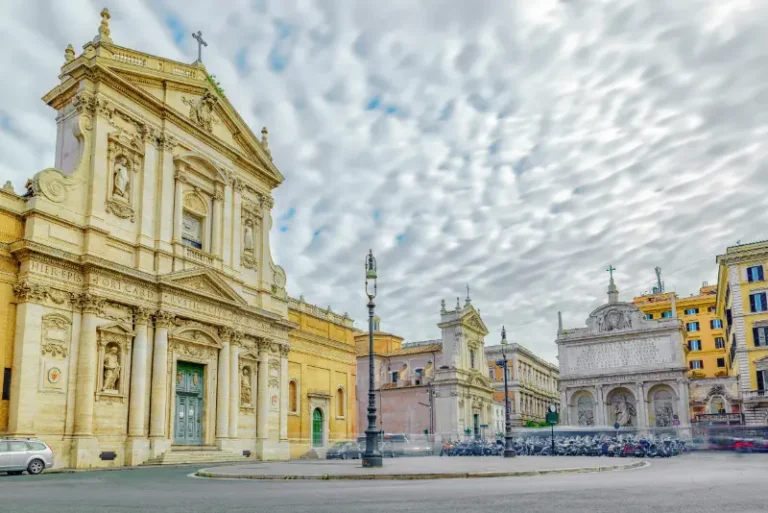
The tall Renaissance façade is easy to miss because the surrounding streets are narrow and Piazza Navona attracts most attention. Step back as far as the street allows and look at the vertical organization, then compare it with the more theatrical Baroque façades elsewhere in the neighborhood.
The location itself is meaningful. National churches often clustered in strategic central areas close to pilgrimage routes and papal institutions. Santa Maria dell’Anima’s position shows how foreign communities were woven into the urban core rather than confined to peripheral quarters.
The tomb of Pope Adrian VI
The funerary monument of Adrian VI is the church’s most famous work. Designed by Baldassarre Peruzzi, it presents the pope within an elaborate program of virtues and historical imagery. Adrian’s northern European origin gives the monument a special resonance inside this particular church.
Spend time with the lower relief and surrounding figures rather than only reading the name. Renaissance tombs were carefully constructed statements about character, office and memory. They transformed burial into political and moral narrative.
Chapels and transnational patronage
The side chapels demonstrate how patrons from different regions commissioned works in Rome while participating in Italian artistic culture. This is where the idea of a “national church” becomes tangible: identity was expressed through dedications, tombs, heraldry and artistic commissions.
Instead of trying to memorize every artist, choose two chapels and compare them. Look at how painting, sculpture and architecture work together and how patron coats of arms or inscriptions identify the people behind the decoration.
A living German-speaking church
Santa Maria dell’Anima remains connected with German-speaking Catholic life in Rome. That living function shapes the visitor experience: services, community events and pastoral activities are not secondary to tourism.
Approach the building as a church first and an art destination second. This mindset helps explain why visiting hours can be less standardized than at a museum and why silence, dress and respect around liturgy matter.
How to plan your visit
Because no fixed tourist timetable should be assumed, check the church’s current information close to your visit. Its position makes this easy: if access is temporarily restricted, Piazza Navona, the Pantheon area and several other churches are minutes away, so you do not lose the day.
A mid-morning visit fits well into a historic-center walk. Avoid arriving during a service simply to photograph the interior. If you are interested in Pope Adrian VI or the German presence in Rome, give yourself enough time to read the monuments rather than making the church a five-minute detour.
After leaving Santa Maria dell’Anima, spend a few minutes outside without immediately opening a map. Look at street width, building height, paving and the direction of pedestrian movement. The relationship between a church and its surroundings often explains why an entrance is modest, why a façade is viewed at an angle or why a bell tower dominates from one street but disappears from another. Rome’s sacred buildings were shaped by dense neighborhoods, not isolated museum plazas.
A useful way to visit Santa Maria dell’Anima is to separate the experience into three passes. First read the architecture from the entrance without stopping for details. On the second pass, choose two or three works that explain the site’s history. Finally, return toward the door and look back at the space from the opposite direction. This simple method prevents a richly decorated Roman church from becoming a blur of names and helps you remember the relationship between structure, decoration and neighborhood context.
Practical tips before you go
- Check current access shortly before visiting, especially because liturgies, maintenance and special events can change normal routines.
- Dress for an active place of worship: shoulders and knees should be covered, and hats should normally be removed inside.
- Use silent camera settings and avoid flash unless staff or posted rules explicitly allow it.
- Do not place an inflexible timed attraction immediately after the visit; allow a small buffer for unexpected closures or ceremonies.
- Read one or two key historical points before entering so the architecture and artworks have context rather than becoming a list of unfamiliar names.
If the doors are closed when you arrive, do not force the itinerary. Santa Maria dell’Anima sits in an area with other worthwhile sights, so use the nearby route below and return later if practical. This is often a better strategy in Rome than waiting outside an active church whose schedule has changed.

What to see nearby
Santa Maria dell’Anima combines naturally with Piazza Navona, Pantheon, Santa Maria della Pace, historic center walking route. These nearby pages are already part of MyRomeTrip and can help readers turn one church visit into a coherent half-day rather than a disconnected detour.
Begin at Piazza Navona, visit Santa Maria dell’Anima and then move to Santa Maria della Pace. Continue east toward the Pantheon. This short route compares national identity, Renaissance patronage and Baroque urban design while keeping walking distances minimal.
Who will enjoy this stop most?
The church is particularly rewarding for travelers interested in papal history, German-Italian connections and the international communities of Renaissance Rome. It also suits anyone who has already visited the obvious churches around Piazza Navona and wants a quieter, more specific story.
First-time visitors with only a few hours in Rome do not need to replace the Colosseum, Pantheon or Vatican with Santa Maria dell’Anima. The better approach is to add it when geography already brings you nearby. Repeat visitors, art lovers and travelers who enjoy slower city exploration will usually get the greatest value from the stop.
Photography, accessibility and respectful visiting
The surrounding streets are paved and busy, while the historic entrance may include thresholds. Visitors who depend on step-free access should contact the church for the current accessible route. Photography policies can change with services and events; always follow posted instructions.
One more practical approach is to spend the first five minutes inside Santa Maria dell’Anima without taking photographs. Let your eyes adjust, identify the main axis and notice which details attract your attention naturally. Photograph afterward. This reduces screen time in a sacred space and usually results in better images because you understand the room before framing it.
Official information and changing access
For current access, services and special closures, consult the official or municipal information page: visitor information for Santa Maria dell’Anima. Hours published online can change, particularly around feast days, restoration campaigns and liturgical events, so readers should verify details close to the day of the visit.
FAQ
What is Santa Maria dell’Anima famous for?
It is the historic church of the German-speaking Catholic community in Rome and contains the tomb of Pope Adrian VI.

Who was Adrian VI?
Adrian VI was a pope from Utrecht who reigned briefly in the early sixteenth century. His monument is one of the church’s principal artworks.
Is the church close to Piazza Navona?
Yes. It is only a short walk from the western side of Piazza Navona.
Do I need a ticket?
Ordinary church entry is generally free, but current visiting access should be checked because it is an active religious institution.
Final tips
Santa Maria dell’Anima is the kind of place that makes a Rome itinerary feel more personal. It does not require the logistics of a major museum, but it rewards context, patience and respectful attention. Pair it with nearby sights, keep the timing flexible and focus on a few details rather than trying to memorize every name. That approach is often the difference between simply entering another church and actually understanding why the building belongs to the story of Rome.