Bridges of Rome: The Most Beautiful Tiber Bridges and a Riverside Walking Route
Rome’s bridges are more than ways to cross the Tiber: they are a timeline of the city. Ancient stone bridges, papal reconstructions, nineteenth-century crossings and modern structures connect neighborhoods that feel very different on opposite banks. Walking from bridge to bridge is one of the easiest ways to understand how Rome grew around its river.
A bridge route also works beautifully on a second visit because it links famous sights without requiring museum reservations. You can move from the Jewish Ghetto and Tiber Island to Trastevere, Campo de’ Fiori, Castel Sant’Angelo and the Vatican while keeping the river as your guide. Combine this page with our Rome walking guide if you want to build a longer day on foot.
| Bridge | Best reason to stop | Area | Good time |
|---|---|---|---|
| Ponte Fabricio | Best-preserved ancient Roman bridge | Jewish Ghetto / Tiber Island | Morning |
| Ponte Sisto | Classic pedestrian crossing to Trastevere | Campo de’ Fiori / Trastevere | Late afternoon |
| Ponte Sant’Angelo | Angels, Castel Sant’Angelo and Vatican views | Borgo / historic center | Sunrise or evening |
| Ponte Milvio | Ancient crossing with local evening life | North Rome | Late afternoon |
| Ponte Cestio | Tiber Island connection | Trastevere | Any time |
Why the Tiber matters to Rome
The Tiber shaped settlement, trade, defense and movement long before modern traffic. Rome’s relationship with the river has changed dramatically, especially after the high embankments and flood defenses of the modern era, but bridges still reveal the old logic of the city: where roads converged, where neighborhoods faced one another and where ceremonial routes crossed the water.
Do not judge a bridge only by decoration. Some of the most important crossings are visually restrained because their value lies in age, engineering or continuity of use. Others became urban stages where sculpture, fortress architecture and river views were deliberately combined.
Ponte Fabricio: ancient Rome still in daily use
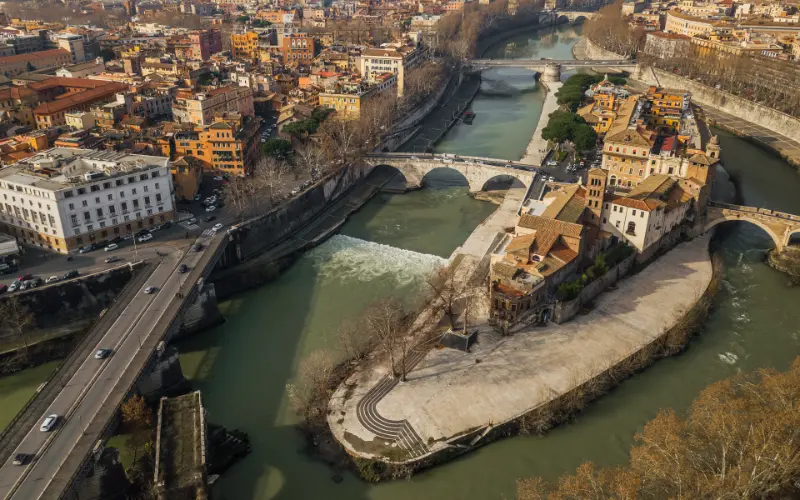
Ponte Fabricio dates to 62 BC and connects the left bank near the Jewish Ghetto with Tiber Island. Rome’s tourism office describes it as the best-preserved Roman bridge and the oldest still in use. Walking across it is therefore not just scenic; you are using infrastructure that has served the city for more than two millennia.
Read the inscriptions on the arches and notice the four-faced stone herms that gave the bridge its popular name, Ponte dei Quattro Capi. Pair the crossing with our Jewish Ghetto guide and continue across the island toward Trastevere.
Ponte Fabricio is especially interesting because the bridge is still part of ordinary pedestrian movement. Cross it slowly and notice how different it feels from a wide modern traffic bridge. From the island approach, look back toward the riverbanks and imagine how important reliable crossings would have been before embankments and motor roads reshaped the river. The bridge is best appreciated together with Tiber Island, not as a detached photo stop. If the light is good, take one photograph along the bridge and another from the riverbank to show its arches and relationship to the water.
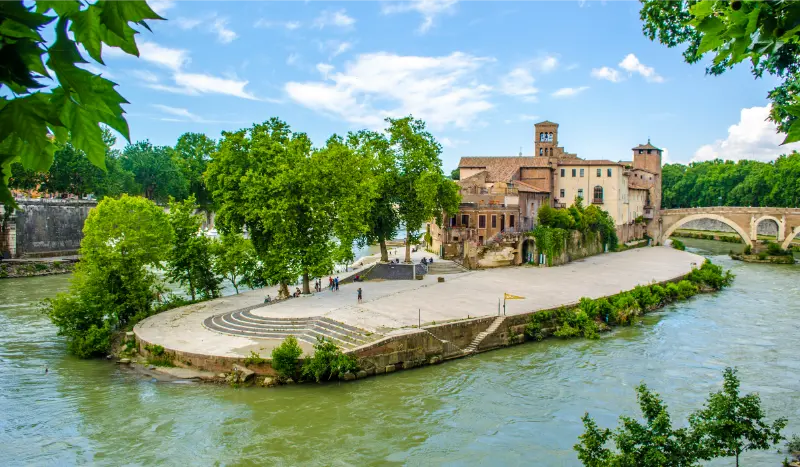
Ponte Cestio and Tiber Island
Ponte Cestio links Tiber Island to the Trastevere bank. Its ancient origins are close in date to Ponte Fabricio, although the structure has been heavily restored and rebuilt over the centuries. Seeing the two bridges together makes the island feel like what it has always been: a strategic stepping point in the river.
Slow down on the island rather than treating it as a corridor. Look upstream and downstream, then compare the different profiles of the bridges. The change in river width, embankments and traffic helps explain why each crossing feels distinct.
Ponte Sisto: the pedestrian favorite
Ponte Sisto was rebuilt for the Jubilee of 1475 under Pope Sixtus IV, replacing an earlier crossing. Today it is one of the most enjoyable pedestrian bridges because it connects the Campo de’ Fiori side directly with Piazza Trilussa and Trastevere.
Late afternoon is especially attractive when people move toward Trastevere for aperitivo and dinner. From the bridge you can see the river curve and, in the distance, the dome of St Peter’s. Continue with our Trastevere guide rather than ending the walk at the first restaurant beside the bridge.
Ponte Sant’Angelo: sculpture and ceremony
Few bridges in Europe have a more theatrical setting than Ponte Sant’Angelo. The ancient Pons Aelius was built by Hadrian to connect the city with his mausoleum. In the Baroque period, the line of angel sculptures transformed the approach into a ceremonial route toward the fortress and Vatican area.

Visit early if you want clear photographs, because the bridge can become crowded. At night the reflections and illuminated Castel Sant’Angelo create a different atmosphere. Our Castel Sant’Angelo guide explains how the mausoleum became fortress, papal refuge and museum.
The most memorable way to approach Ponte Sant’Angelo is on foot, letting the castle appear beyond the line of statues. When the bridge is crowded, it is easy to focus only on getting across; instead, step to one side where it is safe and take in the view along the balustrade. The stone angels belong to the bridge’s Baroque transformation, while the crossing itself has much older origins. This mixture is what makes it special. For photography, the city-side approach frames the castle dramatically, while views from the embankment explain the bridge’s arches and its place in the river landscape.
Ponte Milvio: history beyond the center
Ponte Milvio is associated with one of the decisive episodes of late Roman history: Constantine’s victory over Maxentius near the bridge in AD 312. The crossing has been rebuilt and modified, but its strategic position on the northern approach to Rome remains easy to understand once you see the roads and river together.
The surrounding area is now also part of contemporary local nightlife, which makes the bridge a good destination for travelers who want history without staying entirely inside the postcard center. It requires more deliberate transport planning than Ponte Sisto or Ponte Fabricio.
Modern bridges and a changing city
Rome’s bridge story did not end in antiquity or the Renaissance. Nineteenth- and twentieth-century bridges reflect new roads, expanded neighborhoods and a capital city growing far beyond the old walls. Contemporary crossings such as Ponte della Musica show that the Tiber remains part of Rome’s modern urban design.
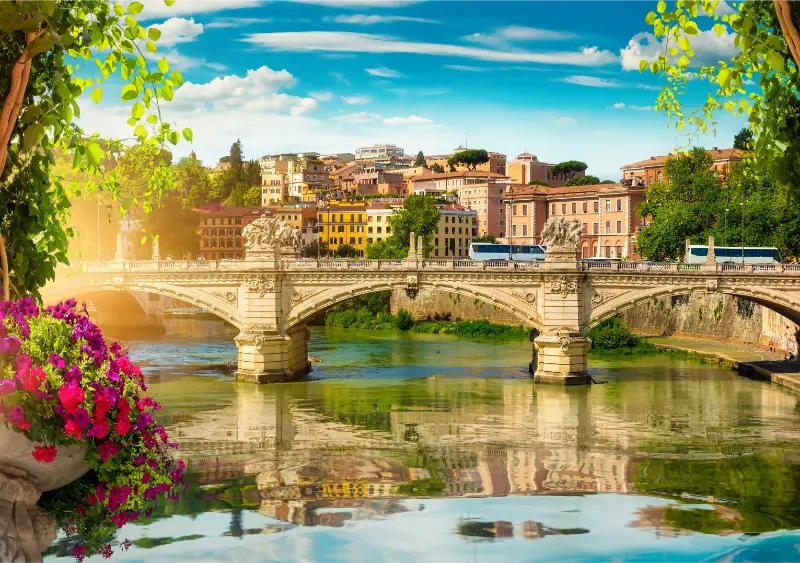
Including one modern bridge in a walking or cycling day prevents the river from becoming a museum piece. Rome is still building connections across the same waterway that shaped its earliest history.
Best bridge views for photography
Ponte Sant’Angelo is strongest for monumental composition; Ponte Sisto for atmosphere and evening pedestrians; Ponte Fabricio for ancient stonework; and the Tiber Island area for layered river views. The best photograph is not always from the bridge itself. Walk fifty or one hundred meters along the embankment and look back.
Blue hour can be particularly effective because river reflections become stronger while the sky still holds color. For broader technique and locations, use our Rome photography guide.
Walking beside the Tiber safely
The upper embankment roads are busy, and riverside cycle or pedestrian paths can have access points separated by long distances. After heavy rain, lower paths may be wet or temporarily affected. Use marked entrances and do not climb barriers for a closer river photo.
At night, choose busy routes if you are unfamiliar with the area and keep normal city awareness around phones and bags. The river itself is not a substitute for a transport plan: know where your next bridge, bus stop or taxi pickup is before you become tired.
Do not assume that a riverside path works like a continuous sightseeing promenade. Some stretches are pleasant and accessible, while others involve stairs, isolated sections or detours back to street level. After heavy rain, lower paths can be muddy or closed, and the embankment walls can make it harder to leave the route quickly. For a first visit, stay mostly on street level and descend only for a section you have checked. Carry water in warm weather, and choose established crossings rather than attempting a long detour along the wrong riverbank. A shorter route with several good stops is better than a forced march.
A beautiful half-day bridge route
Start near the Jewish Ghetto, cross Ponte Fabricio to Tiber Island and Ponte Cestio to Trastevere. Walk north through Trastevere, cross Ponte Sisto toward Campo de’ Fiori, then continue through the historic center to Ponte Sant’Angelo. This sequence connects ancient, papal and Baroque Rome in a manageable distance.
If you want a longer day, continue north toward the Vatican or use public transport to Ponte Milvio. Do not force every bridge into one walk. A route is successful when the river gives structure to the day, not when you collect the highest number of crossings.
Start around the Jewish Ghetto and Tiber Island so that Ponte Fabricio and Ponte Cestio set the historical context. Continue toward Ponte Sisto if you want to move between the center and Trastevere, then follow the river north toward Ponte Sant’Angelo. The route is flexible: you can finish at the castle, cross into Prati or leave time for a meal along the way. The river bends, so distances that appear direct on a small map can feel longer in practice. Keep one or two bridges as optional extras and allow time to stop on the banks rather than only crossing them.
How the river changes the experience of nearby neighborhoods
Crossing a bridge on foot creates a clear psychological transition. The Jewish Ghetto and Trastevere sit only minutes apart across Tiber Island, yet their street patterns, evening rhythms and monuments feel different. Ponte Sisto performs the same role between the Campo de’ Fiori side and Piazza Trilussa, making the river a threshold rather than an obstacle.
Use those transitions deliberately in an itinerary. Plan lunch on one bank and sunset on the other, or visit a museum before crossing into a neighborhood for dinner. This prevents the day from becoming a sequence of isolated attractions because the walk itself explains how districts relate to one another.
The Tiber also offers breathing space. Rome’s historic center can feel visually dense; reaching the river suddenly opens the horizon. Stop on a bridge for a few minutes before continuing. That small pause is often more restorative than adding another café stop.
Common mistakes to avoid
- Treating Tiber Island only as a shortcut between two bridges.
- Visiting Ponte Sant’Angelo only at midday when crowds are highest.
- Assuming every bridge is ancient because Rome is ancient.
- Walking long stretches of embankment without checking the next exit point.
- Ignoring modern bridges that explain the city’s expansion.
- Trying to combine Ponte Milvio with a central walk without allowing extra transport time.
Frequently asked questions
What is the oldest bridge in Rome still in use?
Ponte Fabricio, built in 62 BC, is the best-preserved ancient Roman bridge and the oldest still in use.
Which bridge is best for a walk to Trastevere?
Ponte Sisto is the classic pedestrian connection between the historic center and Trastevere.
Which bridge has the best view of Castel Sant’Angelo?
Ponte Sant’Angelo provides the most direct monumental approach and one of the best river views of the fortress.
Can I walk several bridges in one route?
Yes. Ponte Fabricio, Ponte Cestio, Ponte Sisto and Ponte Sant’Angelo can be linked in an excellent half-day walk.
Final advice
Use the Tiber as a line rather than a barrier. A bridge-focused walk turns familiar neighborhoods into one connected story and lets ancient engineering, papal Rome and modern city life appear in the same afternoon.