
Pincio Rome: Terrace, Sunset Views and Walk Above Piazza del Popolo
The Pincio is one of Rome’s best free viewpoints and one of the easiest places to add a moment of open space to a crowded historic-center day. The terrace looks directly over Piazza del Popolo toward the domes and rooftops of central Rome, while the promenade behind it leads naturally into Villa Borghese.
Many visitors climb up, take one sunset photograph and leave. The Pincio is better when you understand it as a nineteenth-century public promenade designed by Giuseppe Valadier, with curving ramps, busts, fountains, an ancient obelisk and links to the surrounding park. Give it enough time to walk, not just stand at the balustrade.
Pincio at a glance
| Area | Pincian Hill above Piazza del Popolo, beside Villa Borghese |
| Best for | sunset, free views, couples, families and easy central walks |
| Suggested time | 45–90 minutes; longer with Villa Borghese |
| Cost | Free; public promenade |
| Best moment | Late afternoon through sunset |
Why it deserves a separate stop
Rome has higher viewpoints, but few combine access, location and urban drama as effectively. You can reach the terrace directly from Piazza del Popolo without a ticket and then continue into a major park, which makes it practical for almost any itinerary.
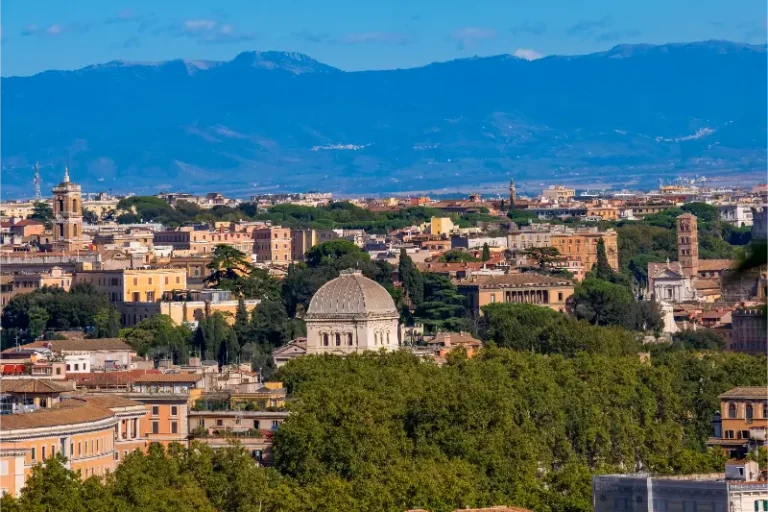
The viewpoint also helps orient first-time visitors. From the balustrade you can identify St Peter’s dome, Monte Mario and the mass of the historic center, then understand how Piazza del Popolo anchors the northern entrance to the Tridente.
History and context
The Pincian Hill was associated with gardens in antiquity, including elite horti. The modern public promenade took shape in the nineteenth century, when Valadier and earlier Napoleonic-era planning transformed the slopes above Piazza del Popolo into an urban leisure space.
The design was meant for movement and display: carriage routes, terraces, fountains and formal perspectives. The result remains one of Rome’s most successful transitions between a monumental square and landscaped parkland.
What to see and notice
The main terrace
The balustrade above Piazza del Popolo is the headline viewpoint. Arrive before sunset if you want a front-row position, but also return a few minutes after the sun disappears: the city’s domes and façades often become more legible in the softer light.
Valadier’s ramps
Approaching from Piazza del Popolo is part of the experience. The ramps and curves reveal the square gradually and show how landscape architecture can frame a city. If mobility or steep slopes are a concern, approach through Villa Borghese instead of climbing directly from below.
The Antinous obelisk
The obelisk on the Pincio was dedicated by Emperor Hadrian to Antinous and later moved here. It gives the promenade an ancient focal point even though the surrounding park design is much later. Read it as another example of Rome reusing and relocating monuments across centuries.
Busts and promenade
Rows of busts commemorate figures from Italian history and culture. You do not need to identify every person; together they reveal the nineteenth-century idea of a civic pantheon built into a public park.
Connection to Villa Borghese
Do not stop at the viewpoint. Walk north and east into Villa Borghese for shaded paths, the lake area and museum options. The terrace is one edge of a much larger green system.
A practical walking route
A good route starts below in Piazza del Popolo and finishes inside Villa Borghese.

- Spend ten minutes in Piazza del Popolo to understand the square before climbing.
- Take the landscaped ramps toward the Pincio, stopping at intermediate viewpoints rather than rushing to the top.
- Pause at the main terrace and identify major landmarks on the skyline.
- Walk past the obelisk and bust-lined avenues.
- Continue into Villa Borghese, or descend toward the Spanish Steps if that fits your itinerary better.
If you arrive at sunset, plan your exit before it is fully dark if you are unfamiliar with the park. The central areas are busy, but navigation is easier when you know which direction leads toward your next neighborhood.
When to go
Late afternoon is the classic choice because the light falls across the city in front of the terrace. Arrive 30–45 minutes before sunset rather than exactly at sunset, especially on weekends.
Morning is excellent for runners, families and anyone who values calm over golden light. The terrace is always accessible according to Turismo Roma, but events can temporarily occupy parts of the promenade.
How to combine it with nearby Rome
Below the hill, Piazza del Popolo offers churches, fountains and an obelisk. To the south, the Spanish Steps can be reached by walking along the upper edge near Villa Medici.
For a slower afternoon, combine the Pincio only with Villa Borghese. This is one of the easiest ways to build a low-cost half day in central Rome.
Practical tips that make the visit better
Bring water in hot weather; the climb is short but exposed in places.
If someone in your group struggles with stairs or steep grades, enter from Villa Borghese and approach the terrace from above.
Sunset crowds concentrate at the center of the balustrade. Moving a little along the terrace often produces a calmer view with nearly the same skyline.
Cyclists and rental vehicles may use parts of the broader park network, so stay aware on shared paths.
Common mistakes to avoid
- Arriving at sunset with no time to explore the promenade.
- Assuming the Pincio is a separate ticketed attraction.
- Climbing with heavy luggage.
- Ignoring Villa Borghese after reaching the terrace.
- Leaving immediately after sunset when the changing twilight can be the most atmospheric part of the visit.
A simple itinerary around this stop
A simple 90-minute plan starts at Piazza del Popolo, climbs slowly to the terrace, explores the obelisk and busts, then exits through Villa Borghese.

For a romantic evening, walk the Pincio before sunset and descend toward Piazza di Spagna afterward for dinner. For families, reverse the order and use the terrace as the finale to time spent in the park.
Sunset without the stress
Rome sunset times change dramatically through the year. Check the actual sunset for your date and arrive well in advance, especially in spring and summer when the terrace becomes a social gathering place. The best plan is to make the Pincio the end of a nearby walk, not a race across town at the last minute.
Cloudy weather is not a failure. The viewpoint remains useful for orientation, and dramatic clouds can produce better photographs than a clear sky. If rain is heavy, shorten the terrace stop and use nearby museums as backup.
Families and accessibility
Families appreciate the open space, nearby park paths and ability to leave whenever children have had enough. Bring a light layer in cooler months because exposed viewpoints can feel windier than the streets below.
For step-free or lower-gradient access, approach from Villa Borghese rather than climbing the monumental ramps from Piazza del Popolo. Conditions can change during events, so use current city accessibility information if a wheelchair route is essential.
Official information and current access
Turismo Roma lists the Pincio promenade as always accessible and explains its Valadier design, viewpoints and connections with Piazza del Popolo and Villa Borghese on the official Turismo Roma page for the Pincio terrace and promenade.
Opening conditions, security arrangements, religious services, restoration work and special events can change with little notice. Check the official source shortly before your visit rather than relying on an old screenshot or a timetable copied by a third-party site.
FAQ
Is the Pincio free?
Yes. The terrace and public promenade are free.
What time is best for the Pincio?
Late afternoon and sunset are most dramatic, while morning is quieter.
Can you reach it without climbing from Piazza del Popolo?

Yes. Approach through Villa Borghese for a gentler route.
How long should I spend?
Around 45 minutes for the terrace and promenade; 90 minutes or more if you continue into the park.
Is the Pincio the same as Villa Borghese?
They connect directly, but the Pincio is the historic hill and promenade overlooking Piazza del Popolo, while Villa Borghese is the larger park beside it.
Planning this stop well
Rome rewards geographic planning. Before leaving your hotel, group this stop with places that sit in the same part of the city and keep only one or two timed reservations in the day. Moving repeatedly between distant neighborhoods wastes energy and makes delays feel more stressful than they need to be.
Allow a margin for churches, security controls, temporary closures and simple discoveries. A doorway, small exhibition or street scene may deserve ten minutes you did not schedule. Building that flexibility into the day produces a more realistic itinerary than trying to hit every saved map pin.
For lunch and dinner, read current menus and recent information rather than following a years-old recommendation blindly. Rome’s restaurant scene changes, while the best choice also depends on where you happen to be when you are hungry. Walking a few streets away from the most famous square often improves both atmosphere and value.
Carry a refillable bottle, sun protection in warm months and a compact layer in cooler seasons. Central Rome involves more outdoor time than many travelers expect, even on museum-heavy days, because the streets and squares between attractions are part of the experience.
If accessibility is important, verify the exact route rather than judging from distance alone. Cobblestones, steps, steep ramps, security barriers and historic thresholds can make a short walk more demanding than a longer modern street. Official accessibility information should take priority over general travel descriptions.
Is it worth adding to your Rome itinerary?
The Pincio belongs in almost every first-time Rome itinerary because it is free, central and genuinely useful as both viewpoint and route. It is more than a sunset platform: the urban design explains how nineteenth-century Rome created public space around ancient and papal monuments.
Pair it with nearby sights rather than making a special cross-city trip. Its strength is how effortlessly it fits into a walk between Piazza del Popolo, Villa Borghese and Piazza di Spagna.