
St Paul Outside the Walls Rome: Basilica, Tomb, Cloister and 2026 Guide
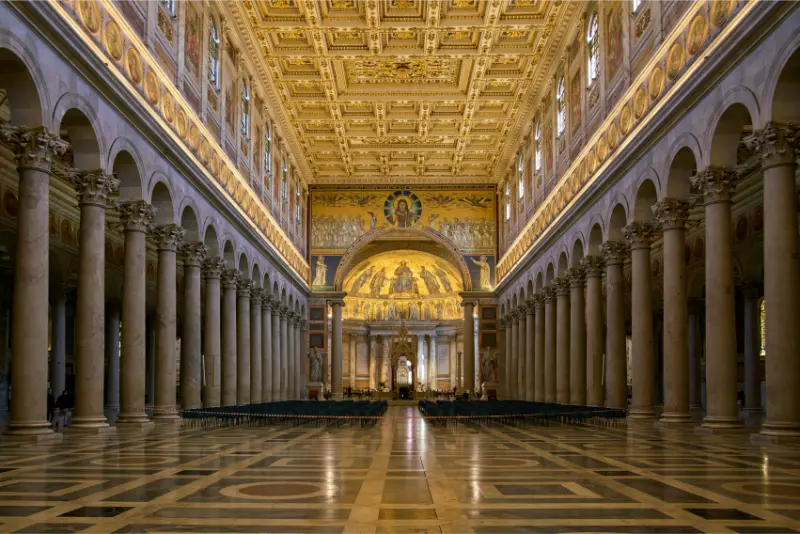
St Paul Outside the Walls is one of Rome’s four papal basilicas and one of the city’s most impressive sacred interiors, yet it often feels calmer than St Peter’s. The enormous nave, portrait medallions of the popes, medieval mosaics, monumental quadriportico and the traditional tomb of Saint Paul create a visit that can stand beside Rome’s headline churches without the same intensity of crowds.
The basilica lies south of the historic center near the Ostiense district, close to Metro B. That makes it easy to reach independently and easy to combine with modern and industrial-era Rome. The official basilica currently lists daily opening from 07:00 to 19:00 with free admission, while the cloister has separate hours and a modest ticket.
| Planning point | Useful detail |
|---|---|
| Address | Piazzale San Paolo 1, Rome |
| Current opening pattern | The basilica is currently open daily 07:00–19:00; the cloister is generally open daily 08:00–18:00 with last entry around 17:30. |
| Tickets / cost | Basilica admission is free. The cloister currently costs €4 full price, with reduced categories available. |
| Suggested time | Allow 60–90 minutes, or up to two hours with the cloister and a slow visit. |
| Best for | Major papal basilicas, mosaics, Christian history and monumental architecture. |
Why this basilica matters
The church developed above the burial place traditionally identified with the apostle Paul, who was martyred in Rome. An early sanctuary was enlarged under the emperors of late antiquity and became one of the great pilgrimage basilicas of the Christian world. Its position beyond the ancient city walls explains the traditional English name “Outside the Walls.”
A devastating fire in 1823 destroyed much of the ancient basilica. The nineteenth-century reconstruction aimed to restore its monumental form, incorporating surviving elements and donations from around the world. The result is not a frozen fourth-century building, but a powerful monument to continuity, loss and restoration.
The nave, papal portraits and mosaics
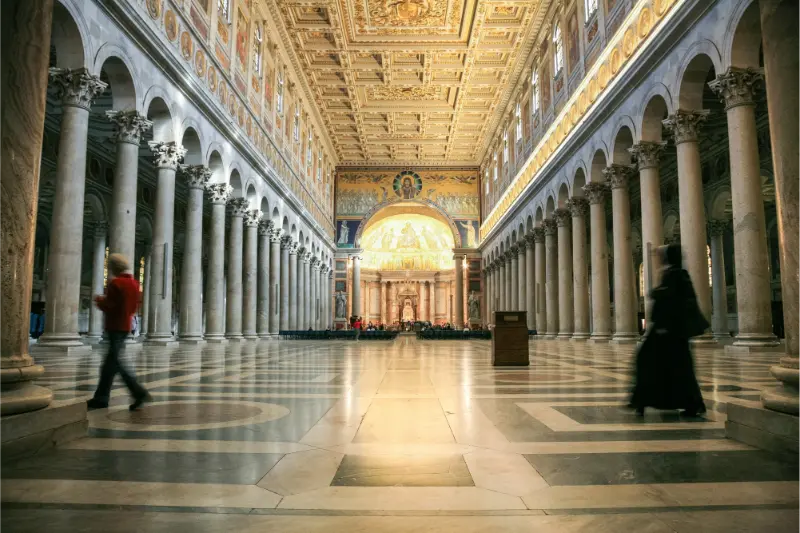
The first impression is scale. Long rows of columns create a vast axial space leading toward the confessio and apse. High above, the sequence of papal portraits has become one of the basilica’s most recognizable features. Rather than trying to inspect every detail, spend time first understanding the architecture as a whole.
At the far end, the apse mosaic and triumphal-arch decoration connect the rebuilt basilica with medieval artistic traditions. The surviving and restored mosaics help explain why Rome’s great churches cannot be understood only through Renaissance and Baroque art; their visual identity is also profoundly late antique and medieval.
The tomb of Saint Paul and the main altar
The area around the papal altar is the spiritual center of the basilica. Archaeological work has strengthened scholarly understanding of the ancient burial monument beneath the church, while the site remains a major focus of devotion. Visitors should distinguish between what archaeology can demonstrate and what belongs to long-standing religious tradition.
Even nonreligious travelers benefit from pausing here because the tomb explains the entire location of the basilica. The building is not simply placed in a convenient urban square: centuries of architecture accumulated around a remembered burial place that drew pilgrims from across Europe.
The cloister
The medieval cloister is one of the most beautiful parts of the complex and is easy to miss if you leave after the nave. Twisted columns, mosaic inlay and the quiet garden provide a very different scale from the basilica. The official site currently lists a €4 full-price ticket, making it an inexpensive addition for travelers interested in medieval decorative arts.
Give the cloister at least twenty minutes. Look closely at column pairs and Cosmatesque details rather than walking one lap only for photographs. Its intimacy is precisely what balances the monumental character of the church.
How to combine it with Ostiense
After the basilica, continue toward Ostiense for a completely different Rome. The district mixes industrial architecture, street art, nightlife and twentieth-century infrastructure. Centrale Montemartini is an especially good pairing because ancient sculpture is displayed inside a former power station.
You can also link the visit with Porta San Paolo and the Museo della Via Ostiense or Garbatella. This creates a full day that moves from early Christianity to industrial and residential Rome without returning repeatedly to the historic center.
How to get there
The easiest route depends on where you are staying, but do not judge the journey only by straight-line distance on a map. Rome combines metro, bus, tram and walking, and the final approach to St Paul Outside the Walls Rome can be part of the experience. Use live transit information on the day because diversions, road works and strikes occasionally affect surface transport.

If you are using taxis or ride-hailing, enter the full address rather than only the attraction name, especially for churches and archaeological complexes with more than one entrance. Travelers with reduced mobility should check the official accessibility information before departure because historic paving, stairs, underground sections and monastic buildings can create barriers that are not obvious from a map.
Best time to visit
For most travelers, the best time is early in the day or in the later afternoon outside the hottest summer hours. Churches are usually quietest between major liturgies; open-air sites are more comfortable when the sun is lower; neighborhood walks work best in daylight. On Sundays and religious feast days, worship takes priority and tourist access may be reduced even when the building itself is open.
Rome changes dramatically by season. From June to September, heat and strong sun can make exposed archaeological areas tiring, so carry water and use shaded breaks. In winter, shorter daylight matters more for parks, cemeteries and street-art walks. Spring and autumn usually provide the easiest balance, but they can also bring school groups and special events.
How long should you allow?
A realistic visit is allow 60–90 minutes, or up to two hours with the cloister and a slow visit. The most common planning mistake is to budget only the time spent inside the headline space and forget the approach, security, a possible queue, a closed chapel, a guided-tour start time or simply the desire to sit and look. Add buffer time if this is a priority sight rather than something you would be happy to skip.
If you are building a full sightseeing day, pair this stop with one or two nearby places rather than crossing Rome repeatedly. The city rewards geographic clustering: you save transport time, reduce fatigue and notice connections between neighborhoods that disappear when every attraction is treated as a separate destination.
A sensible nearby itinerary
The most natural nearby extensions are Ostiense, Centrale Montemartini, Garbatella. Choose the combination that fits your interests rather than trying to include all of them automatically. A strong half-day usually contains one main site, one secondary stop and time for coffee or lunch.
When you link the places on foot, check the terrain rather than only the distance. Rome’s hills, cobblestones and busy road crossings can turn a short route into a slower walk than expected. In hot weather, use public transport for the least interesting segment and save your energy for the historic areas themselves.
Tickets, reservations and changing information
Use the official website or official visitor page shortly before your visit. Opening hours, admission rules and temporary closures can change for restoration, religious celebrations, staff availability or special events. The information in this guide reflects the current 2026 situation, but a same-week check is always the safest habit.
Do not buy an expensive third-party ticket simply because a search result makes the site look sold out. First establish whether the attraction actually requires advance booking. Many Rome churches are free, some municipal museums sell ordinary tickets at the door, and several specialist spaces operate only by guided visit. Paying more does not necessarily buy better access.
Who will enjoy this stop most?
This stop is particularly strong for travelers interested in major papal basilicas, mosaics, christian history and monumental architecture. It is also useful for repeat visitors who already know the Trevi Fountain–Colosseum–Vatican circuit and want a more layered picture of the city. First-time visitors can include it too, but only if the subject genuinely interests them; Rome has too much to see for obligation-driven sightseeing.
Families should consider the attention span of children rather than the prestige of the monument. Outdoor archaeology and street art often work well with school-age children, while long church or cemetery visits may need a clear story or scavenger-hunt approach. For any underground space, check age, mobility and temperature considerations before promising the visit.
Visitor etiquette and practical mistakes to avoid
- Check current opening information on the same week as your visit, not months in advance.
- For churches, avoid sightseeing during Mass and dress with shoulders and knees appropriately covered.
- Do not photograph worshippers, mourners or residents without permission.
- Carry water in warm weather, but never eat inside churches, chapels or protected archaeological areas.
- Use the exact entrance address; large complexes and parks may have several gates.
- Leave a time buffer so a short queue, service or temporary closure does not disrupt the entire day.

FAQ
Is St Paul Outside the Walls Rome worth visiting?
Yes if you are interested in major papal basilicas, mosaics, christian history and monumental architecture. It offers a different layer of Rome from the major headline attractions and works especially well when combined with nearby sights.
Do I need to book in advance?
Not always. The requirement depends on the specific space, guided tour or temporary exhibition. Check the official page shortly before travel and book only when the site actually requires or strongly recommends it.
How much time should I plan?
Allow 60–90 minutes, or up to two hours with the cloister and a slow visit. Add extra time if you are combining the stop with a guided underground visit, a cloister, a museum section or a longer neighborhood walk.
Can I visit with children?
Usually yes, but the experience depends on the child and the site. Outdoor spaces tend to be easier, while quiet churches and cemeteries require respectful behavior. Underground sites may have stairs and narrow passages.
What should I see nearby?
The strongest nearby choices are Ostiense, Centrale Montemartini, Garbatella. Keep the day geographically compact rather than crossing the city after every stop.
Final planning advice
St Paul Outside the Walls Rome is most rewarding when you treat it as part of Rome’s wider urban story rather than an isolated checklist item. Read a little before arrival, verify the current access rules, give the site enough time and then continue through the surrounding neighborhood. That combination of context and slow observation is what turns a lesser-known stop into one of the memorable parts of a Rome trip.


One Comment