Temple of Concord Rome: History, Ruins and Roman Forum Visiting Guide
Temple of Concord is a politically charged sanctuary of Concordia that stood beside the Forum’s most important civic institutions. It is easy to pass a site like this while concentrating on the Colosseum or the largest Forum ruins, but a focused stop adds a layer of Roman history that the headline monuments cannot provide on their own. This guide explains what the place was, what survives, what to look for and how to fit it into a realistic visit in 2026.
The practical advice below is written for an independent visit. Opening patterns, conservation closures and ticket products can change, especially for smaller archaeological interiors. Use this article to understand the site, then confirm the latest conditions on the official page before leaving your hotel.
Temple of Concord at a glance
| Location | western end of the Roman Forum, below the Capitoline Hill and beside the Temple of Vespasian and Titus |
| Why see it | a politically charged sanctuary of Concordia that stood beside the Forum’s most important civic institutions |
| Time to allow | 15–25 minutes for the monument and its immediate context |
| Access | Viewed within the Roman Forum archaeological area; there is no normally accessible temple interior |
| Best strategy | Combine it with nearby monuments and understand the surrounding urban landscape rather than treating it as an isolated photo stop |
Why Temple of Concord is worth seeing
The main reason to stop at Temple of Concord is that it fills a gap in the story of ancient Rome. Famous monuments show imperial scale; smaller sites often explain how government, religion, infrastructure or daily movement actually worked. Here, the crucial idea is a politically charged sanctuary of Concordia that stood beside the Forum’s most important civic institutions. Once you understand that function, the surviving walls, columns, paving or underground spaces become evidence rather than anonymous ruins.
Rome rewards visitors who compare neighboring sites. A temple beside a basilica, a prison beside a triumphal route, or a Renaissance garden above an imperial palace can reveal more than any monument considered alone. Keep looking outward while you visit: where is the Capitoline, where is the Forum floor, which road passes the site, and what later structure occupies the same ground? Those questions make the city readable.
History of Temple of Concord
The Temple of Concord is one of the best places in the Forum to see how religion and politics overlapped in ancient Rome. Ancient tradition connected an early sanctuary of Concordia with the settlement of the long struggle between patricians and plebeians in the fourth century BC. The surviving archaeological story is more complicated than that tradition, but the idea behind the cult is clear: concord was not simply a private virtue. It was a public political ideal that Roman leaders repeatedly claimed after periods of conflict.
A major Republican rebuilding was carried out by Lucius Opimius in 121 BC after the violent death of Gaius Gracchus and his supporters. That reconstruction made the language of “concord” deeply political. A temple dedicated to harmony after civil bloodshed could be read as reconciliation, propaganda or both. The building also became a place where the Senate could meet, which brought the abstract idea of concord directly into the machinery of government.
The most important imperial rebuilding was undertaken by Tiberius, who restored the temple and dedicated it in AD 10 in association with his brother Drusus. Ancient authors describe a rich interior containing Greek works of art and precious objects. The Tiberian phase was unusually broad in plan because the available space at the foot of the Capitoline was constrained by neighboring monuments and the rising slope behind it.
The temple declined with the rest of the Forum in late antiquity and the Middle Ages. Much of its marble was reused, leaving a low but substantial podium and fragments rather than a standing cella. That can make the site easy to overlook, yet its position between the Capitoline, the Arch of Septimius Severus and the Temple of Vespasian and Titus is exactly what makes it valuable for understanding the western end of the Forum.
Why “Concord” was political, not sentimental
Modern visitors may hear “concord” and imagine a generic celebration of peace. In Roman public language, Concordia could be invoked when elite factions, social orders or political rivals were supposed to return to cooperation. That made the cult useful after conflict but also controversial: the winner could define “harmony” on his own terms. The Opimian rebuilding after the suppression of Gaius Gracchus is the clearest example of that tension.
The temple as an art collection
Ancient literary references suggest that the imperial temple contained celebrated Greek works of art. Roman sanctuaries often functioned as repositories of prestige objects, and the Temple of Concord appears to have been especially rich. When you look at the bare podium today, remember that the ancient experience involved architecture, cult images, sculpture, metalwork and color—not exposed foundations.
What to see on site
The broad podium
The surviving podium is the key to understanding the temple’s unusual proportions. Stand back far enough to see how the building had to fit between the Capitoline slope and the open Forum. The plan was wider than many Roman temples, an adaptation to a difficult and prestigious urban site.
The relationship with the Tabularium
Look uphill behind the temple toward the massive substructures associated with the Tabularium. The vertical layering is striking: the Forum floor, the temple platform and the monumental architecture on the Capitoline all belonged to one dense civic landscape.
Temple of Vespasian and Titus next door
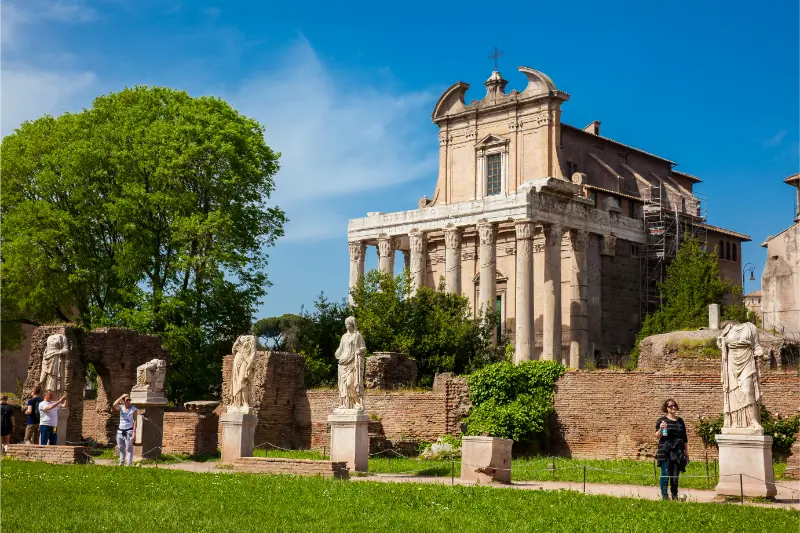
The three standing columns of the neighboring Flavian temple provide a useful visual contrast. One sanctuary survives mostly as a platform, the other as a dramatic column group. Comparing them is a reminder that survival is accidental and does not measure ancient importance.
The western Forum sightline
From near the Arch of Septimius Severus, look back across the site toward the Temple of Saturn and central Forum. The Temple of Concord occupied a strategic point where political, religious and triumphal monuments crowded together.
Tickets, opening hours and access in 2026
The temple is an outdoor archaeological monument within the Roman Forum. It does not function as a separately entered attraction, so plan to understand it from the paths and viewpoints allowed on the day of your visit.

For the Roman Forum and Palatine, the official PArCo currently lists the archaeological area as opening at 9:00. For the period from 29 March to 30 September 2026, the published schedule gives last admission at 18:15 and park closure at 19:15; closing times become earlier later in the year. Ticket products differ in whether they include the Colosseum and SUPER interiors. Always check the official PArCo opening-times and ticket page for your exact date.
For official background and current visitor information, consult the Parco archeologico del Colosseo website.
How to combine it with nearby sights
A logical route combines this stop with Roman Forum guide, Temple of Saturn guide, Arch of Septimius Severus guide, Rostra guide. These are not random recommendations: they create a compact cluster in which each monument explains a different function or historical layer. Move through them geographically instead of crossing the archaeological area repeatedly.
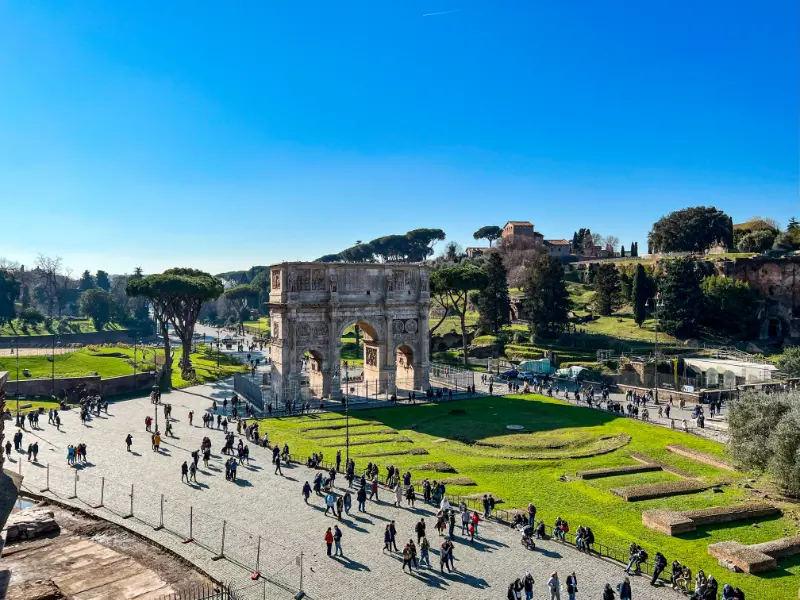
If you have only two hours for the Forum or Palatine, choose a limited number of focused stops and one elevated overview. If you have half a day, add a museum or SUPER interior, take a short break, and allow time to look back over areas you have already crossed. The second view is often when the plan of ancient Rome finally becomes clear.
A practical route step by step
Start by locating Temple of Concord from a wider viewpoint. Do not begin with a close-up. Identify the nearest hill, major street or neighboring public building. Then approach the surviving structure and spend five minutes on the overall plan before reading labels. Next, choose two details from this guide and find them in person. Finally, turn around and connect the site visually with the next monument on your route.
This sequence sounds simple, but it prevents the most common failure of an archaeological visit: collecting names without spatial understanding. Roman architecture was designed around approach, elevation, processions and sightlines. A monument’s relationship to the Forum square or palace court can be as informative as the fragment standing in front of you.
How to plan the stop inside a larger Rome itinerary
Do not treat a small ancient monument as if it were a stand-alone half-day attraction. Rome works best in geographic clusters. On the Forum and Palatine, move in one direction and connect buildings that shared streets, sightlines or palace functions. This reduces backtracking on uneven ground and makes the history easier to remember. A focused stop of twenty minutes can be more rewarding than an hour spent repeatedly checking a map.
Best time of day
Early morning is usually best for orientation, cooler temperatures and quieter paths. Late afternoon can give stronger side light on brick, marble and carved details, but the archaeological park closes earlier in autumn and winter. In summer, shade is limited. Carry water, use sun protection and avoid scheduling the most exposed Palatine or Forum walking during the hottest part of the day if you are sensitive to heat.
Photography without losing the context
Take one wide photograph first, including a recognizable neighboring structure or the line of the hill. Then make one or two detail images. This simple sequence produces a far more useful visual record than a series of tight photos that become impossible to identify later. A modest phone zoom is helpful for inscriptions and decoration behind barriers, but never cross ropes or climb ancient masonry for an angle.
Accessibility and footwear
The Forum and Palatine combine modern paths with slopes, steps, cobbles and uneven ancient surfaces. The PArCo provides accessible routes, lifts in selected zones and accessibility information, but not every ruin or underground interior is step-free. Check the official accessibility map if mobility is a concern. For everyone else, shoes with good grip are more valuable than heavy hiking footwear; smooth soles can be uncomfortable on worn stone after rain.
How much historical detail do you really need?
You do not need to memorize every emperor and reconstruction date. Before arriving, learn three things: what the place was for, which phase created most of what you see, and what neighboring monument helps explain it. Once those anchors are clear, inscriptions, materials and later alterations become meaningful rather than overwhelming. This approach is especially effective in the Forum, where hundreds of years of rebuilding overlap in a small space.
Common mistakes to avoid
- Assuming that the tallest surviving ruin was automatically the most important building in antiquity.
- Using an old screenshot for hours or access rules instead of checking the official site shortly before the visit.
- Trying to see every monument in one pass and ending up remembering none of them clearly.
- Ignoring ground levels, podiums and foundations because they look less dramatic than columns or arches.
- Following a map so closely that you stop looking at relationships between roads, hills and neighboring buildings.
- Wearing slippery shoes or carrying too much gear on an archaeological route with uneven surfaces and limited shade.
FAQ about Temple of Concord
Is Temple of Concord included in the Roman Forum or Palatine ticket?

Viewed within the Roman Forum archaeological area; there is no normally accessible temple interior Check the exact ticket description on the official PArCo site before purchase because SUPER interiors and special routes can have different rules.
How long should I spend at Temple of Concord?
15–25 minutes for the monument and its immediate context. The important point is to leave enough time to view the monument in relation to its surroundings rather than photographing it and immediately moving on.
What is the most important thing to notice at Temple of Concord?
A politically charged sanctuary of concordia that stood beside the forum’s most important civic institutions. Use that idea as your anchor and let the smaller architectural details support it.
Can I visit Temple of Concord with children?
Yes for most families, but the value depends on preparation. Give children one visual challenge—find a column type, a mosaic, a curved wall or a view—rather than expecting them to follow a long chronology. Heat and uneven paths are usually the bigger practical issues.
What should I combine with Temple of Concord?
Stay in the same archaeological cluster. The internal links in this guide point to nearby monuments that can be reached without repeatedly crossing the Forum or Palatine.
Is Temple of Concord worth it?
Yes—especially if your goal is to understand ancient Rome rather than simply photograph its largest landmarks. Temple of Concord rewards a slower look because it has a clear historical role: a politically charged sanctuary of Concordia that stood beside the Forum’s most important civic institutions. Give it enough time to identify the main surviving features and connect them with the surrounding city.
Before you go, check the official visitor information, download or save a map and decide whether your ticket needs SUPER access. Once inside, keep the day realistic. Ten well-understood monuments will give you a stronger memory of Rome than thirty labels seen at a run.