San Giovanni a Porta Latina Rome: Medieval Frescoes, Romanesque Church and Guide
San Giovanni a Porta Latina is one of Rome’s most atmospheric medieval churches and one of the easiest to miss. Set behind a quiet forecourt near the Aurelian Walls, it combines a Romanesque bell tower, an early medieval well, reused ancient columns and a remarkable twelfth-century fresco cycle inside the nave.
The church is also tied to the tradition of Saint John the Evangelist’s attempted martyrdom near the Latin Gate. The small octagonal chapel of San Giovanni in Oleo stands nearby and adds a second architectural stop, with a later intervention by Francesco Borromini.
| Planning point | Useful detail |
|---|---|
| Location | Via di Porta Latina, 17, near the Aurelian Walls and the Appian Way approach |
| Access | San Giovanni a Porta Latina is an active church. Turismo Roma publishes liturgical times but recommends confirming them; the nearby San Giovanni in Oleo is normally visitable on request through the basilica. |
| Suggested time | 45–70 minutes, plus time for nearby San Giovanni in Oleo when accessible |
| Best for | Medieval frescoes, Romanesque architecture, quiet sacred spaces and walkers connecting the city walls with the Appian Way |
Why this place is worth adding to your Rome itinerary
San Giovanni a Porta Latina is most rewarding when it fits the geography of your day. Rome becomes tiring when every attraction requires a cross-city transfer, but this stop sits within a cluster of places that share history, streets and landscape. That makes it useful both for first-time visitors who want a richer route and repeat visitors looking beyond the most photographed monuments.
The strongest reason to visit is context. Major Roman sights can sometimes feel isolated when they are seen only through ticket lines and headline artworks. Smaller churches, archaeological fragments, fountains and parks reveal how the city actually developed: buildings were rebuilt, materials were reused, neighborhoods changed function and older structures remained embedded in everyday life.
History and context
The basilica was probably founded in late antiquity, with evidence pointing to a fifth-century origin. It was rebuilt and restored several times, including major work in the early Middle Ages and a consecration or restoration phase around the end of the twelfth century.
The dedication refers to Saint John the Evangelist. According to a long-standing tradition, he was brought to Rome and immersed in boiling oil near Porta Latina but miraculously survived. The nearby chapel of San Giovanni in Oleo commemorates the event.
Twentieth-century restoration uncovered the extensive medieval fresco cycle in the central nave, revealing one of the most important surviving groups of Roman painting from the twelfth century. The discovery restored much of the church’s medieval character after later alterations.
The visible monument therefore belongs to more than one period. That is typical of Rome and worth embracing. Instead of searching for a single ‘original’ appearance, notice what each phase added and why later communities chose to preserve, alter or reinterpret what came before.
What to see
The twelfth-century fresco cycle
The central nave preserves dozens of scenes from the Old and New Testaments. Turismo Roma describes forty-six different scenes, making the cycle one of the most substantial examples of medieval wall painting in the city before the age of Pietro Cavallini.
Walk slowly along both sides of the nave and read the paintings as a sequence. Individual scenes can be difficult to identify without preparation, so reviewing a basic plan beforehand can greatly improve the visit.
Romanesque bell tower and portico
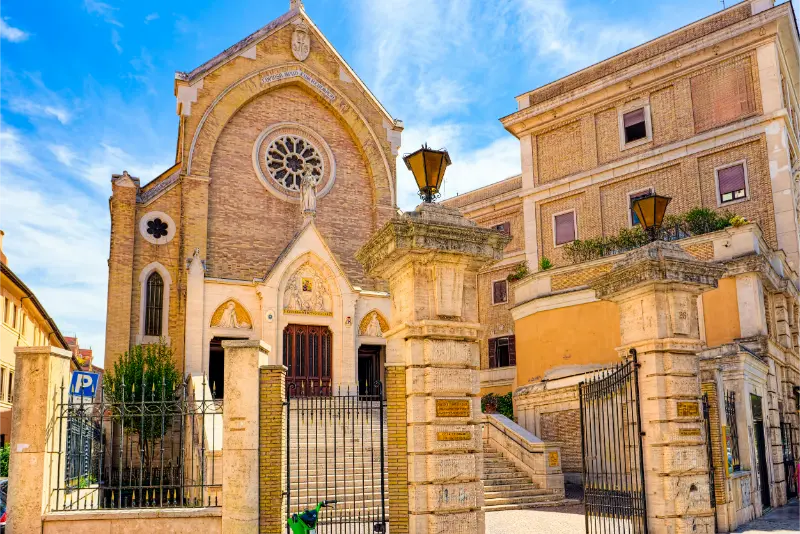
A five-arched portico fronts the church, while the tall square bell tower rises beside it with elegant upper openings. Together they create one of Rome’s most convincing Romanesque ensembles outside the major basilicas.
The exterior deserves at least ten minutes. Step into the forecourt and compare the scale of the tower, portico and surrounding walls; the calm setting is part of what makes the site memorable.
The ninth-century well and reused columns
The courtyard includes an early medieval well with an inscription, while the interior uses ancient marble columns and capitals. These details show how the church grew within a landscape already full of Roman material.
Look closely at differences between the columns instead of expecting a matching set. Reuse was a defining feature of medieval Roman architecture and gives the nave its varied texture.
San Giovanni in Oleo
The small octagonal oratory near Porta Latina commemorates the traditional site of Saint John’s attempted martyrdom. Its Renaissance design was later modified by Borromini, who worked on the upper part in the seventeenth century.
Current information says the chapel is visitable on request through San Giovanni a Porta Latina. If it matters to you, arrange access rather than assuming the doors will be open when you pass.
How to plan your visit
Because San Giovanni a Porta Latina is an active religious or cultural site rather than a purpose-built tourist attraction, access can change for services, maintenance, ceremonies and special events. Check the official source shortly before visiting and avoid placing an inflexible timed reservation immediately afterward.
Dress and behave for the setting. In active churches, shoulders and knees should be covered, hats normally removed and conversations kept quiet. Photography rules can change from chapel to chapel, so use a silent camera and avoid flash unless signs or staff clearly permit it.
A short amount of preparation improves the visit enormously. Read the basic historical sequence before entering, then choose two or three details to look for rather than trying to memorize every artist and date. Rome’s layered buildings are easier to understand when you compare periods instead of treating the interior as a checklist.
For most travelers, 45–70 minutes, plus time for nearby San Giovanni in Oleo when accessible is a realistic amount of time. The goal is not to stretch the visit artificially but to leave enough margin to look closely, deal with a temporary closure or simply sit for a few minutes without watching the clock.
Getting there and moving around
The location is Via di Porta Latina, 17, near the Aurelian Walls and the Appian Way approach. In central Rome, walking is often the most useful final connection because buses can be affected by traffic and street diversions. If you use public transport, check the current route on the day rather than relying on an old screenshot.
If the doors are closed when you arrive, do not wait indefinitely unless you have confirmed a reopening time. Use the nearby itinerary below and return later if practical. This flexible approach is far less frustrating than building a full day around the assumption that every active church will operate like a museum.

A practical nearby itinerary
Visit San Giovanni a Porta Latina and the nearby gate, continue toward the Museo delle Mura at Porta San Sebastiano, then walk or cycle onto the Appian Way. This turns a quiet church stop into a coherent route about roads, walls and early Christianity.
Useful MyRomeTrip guides for the same area are Museo delle Mura, Appian Way, Baths of Caracalla and Celio district. Keeping these stops together reduces transport time and makes the historical relationships much easier to understand.
Practical tips before you go
- Check current access on the official website or municipal tourism page shortly before leaving.
- Respect worship and private prayer; sightseeing should stop during services unless visitors are explicitly invited to remain.
- Wear comfortable shoes: even central Rome involves cobblestones, slopes, stairs and uneven surfaces.
- Carry water in warm weather and avoid scheduling the most exposed outdoor walking at midday in summer.
- Keep valuables secure in crowded transport and around major nearby attractions.
- Use internal links and an offline map to keep the day geographically compact rather than crossing Rome repeatedly.
- Leave a small buffer before your next timed ticket; ceremonies, queues, traffic and temporary closures are normal parts of a Rome itinerary.
For the latest access information, use the official or municipal visitor information. External opening times are the part of a Rome guide most likely to change, so verifying them near your travel date is more reliable than relying on a timetable copied far in advance.
Where to stay for this part of Rome
You do not need to choose a hotel beside every attraction, but location matters if you prefer walking. For a first trip, a central base that reduces daily transfers is usually more valuable than saving a small amount on a room far outside the areas you plan to explore. Repeat visitors can be more adventurous and choose a neighborhood that matches evening plans, food preferences or transport needs.
Before booking, open the property on a map and test the real walking route to the transport stop or district you expect to use. Rome has hills, rivers, railway lines and large archaeological zones that can make two places look closer on a map than they feel on foot.
Who will enjoy this stop most?
This stop is especially good for travelers interested in medieval frescoes, romanesque architecture, quiet sacred spaces and walkers connecting the city walls with the appian way. It is also useful for visitors who have already seen Rome’s essential monuments and want places where history can be read without the pressure of a major-ticket attraction.
First-time visitors with only one or two days should still protect time for the Colosseum, Roman Forum, Pantheon, Trevi area and Vatican according to their priorities. The better strategy is to add this place when it lies naturally on the route rather than replacing a must-see solely for the sake of finding something ‘hidden’.
Frequently asked questions
What is San Giovanni a Porta Latina famous for?
It is especially known for its twelfth-century fresco cycle, Romanesque bell tower, quiet forecourt and connection with the tradition of Saint John the Evangelist.
Can you visit San Giovanni in Oleo?
Current municipal information states that it can be visited on request through San Giovanni a Porta Latina, so arrange access if it is a priority.
How old is the church?

Its origins probably go back to late antiquity, with major medieval rebuilding and restoration phases that shaped the church seen today.
Can I combine it with the Appian Way?
Yes. It makes an excellent starting point for a route toward Porta San Sebastiano, the Museo delle Mura and Via Appia Antica.
Final advice
San Giovanni a Porta Latina rewards curiosity more than speed. Give the main historical layer a few minutes of attention, then look for the later additions that changed how the place was used. That habit—reading Rome as a sequence rather than a single period—is one of the best ways to make lesser-known sites memorable.
Keep the rest of the day simple. One strong nearby cluster, a relaxed meal and enough time to walk between places usually creates a better Rome experience than stacking attractions from opposite sides of the city. Check current access, arrive with context and leave room for the unexpected discoveries that make Rome worth exploring on foot.