Fontanone dell’Acqua Paola Rome: Gianicolo Fountain, Views and Visiting Guide
The Fontanone dell’Acqua Paola is one of Rome’s most theatrical fountains and one of the defining landmarks of the Janiculum. Its five great arches, granite columns and broad basin form a monumental backdrop above Trastevere, with views that make the stop as much about landscape as architecture.
Unlike the Trevi Fountain, the Fontanone is not embedded in a dense shopping district. Reaching it usually involves a climb, and that effort is part of the experience. The reward is a quieter setting where water, stone, sky and the panorama of Rome work together.
| Planning point | Useful detail |
|---|---|
| Location | Via Garibaldi on the Janiculum, above Trastevere |
| Access | The monumental front is freely visible at all times. Turismo Roma states that access to the small garden behind follows reservation arrangements and specific calendars, so check current details if the garden is important to you. |
| Suggested time | 20–40 minutes for the exterior and views; longer when a booked garden visit is available |
| Best for | Panoramic walks, Baroque fountains, sunset light, architecture and visitors exploring the Janiculum |
Why this place is worth adding to your Rome itinerary
Fontanone dell’Acqua Paola is most rewarding when it fits the geography of your day. Rome becomes tiring when every attraction requires a cross-city transfer, but this stop sits within a cluster of places that share history, streets and landscape. That makes it useful both for first-time visitors who want a richer route and repeat visitors looking beyond the most photographed monuments.
The strongest reason to visit is context. Major Roman sights can sometimes feel isolated when they are seen only through ticket lines and headline artworks. Smaller churches, archaeological fragments, fountains and parks reveal how the city actually developed: buildings were rebuilt, materials were reused, neighborhoods changed function and older structures remained embedded in everyday life.
History and context
Pope Paul V Borghese restored the ancient Aqua Traiana system as the Acqua Paola in the early seventeenth century to improve the water supply to the Janiculum and areas across the Tiber. The monumental fountain was built between about 1610 and 1614 as the terminal display of the revived aqueduct.
Architects Giovanni Fontana and Flaminio Ponzio were central to the design, with sculptural work also involving Ippolito Buzio. Materials were reused from ancient monuments, including granite columns associated with the earlier Constantinian basilica of Saint Peter and marbles from classical sites.
The appearance changed later in the seventeenth century when Carlo Fontana replaced the original smaller basins with the large unified pool that defines the fountain today. The result became an influential model for later monumental fountains in Rome.
The visible monument therefore belongs to more than one period. That is typical of Rome and worth embracing. Instead of searching for a single ‘original’ appearance, notice what each phase added and why later communities chose to preserve, alter or reinterpret what came before.
What to see
The five-arched façade
The great façade resembles a triumphal arch more than a conventional street fountain. Five openings are framed by columns, while the upper inscription and Borghese heraldry turn the water project into a statement of papal power.
Stand far enough away to see the whole elevation before approaching the basin. The design depends on proportion, and close-up photographs alone can make the architecture feel flatter than it does in person.
Reused ancient materials
The fountain incorporates marble and granite reused from ancient and early Christian buildings. This practice was common in Rome and gave new papal monuments a deliberate material connection with the city’s past.
Look at the color differences in the columns and stonework. Spolia is not a minor footnote here; it is part of the visual richness that makes the façade feel older and more layered than a single seventeenth-century construction campaign.
The panorama and Janiculum light
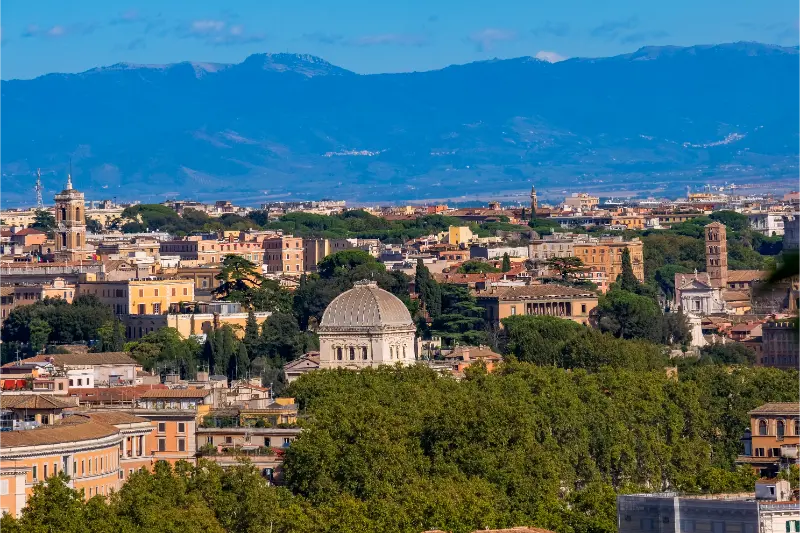
The terrace around the Fontanone opens toward the city and is especially attractive in softer morning or late-afternoon light. The view is not identical to the main Janiculum belvedere, so both are worth seeing on the same walk.
At sunset, allow time rather than arriving for a single photograph. The changing light on the water and pale stone is the main experience, and crowds can vary substantially by season and day.
The garden behind the fountain
A small garden lies behind the monumental front. According to current municipal tourism information, access is more controlled than the freely visible exterior and can require advance booking according to a specific calendar.
Treat the garden as a bonus rather than the only reason to come. The exterior fountain and panorama are already worthwhile, and a Janiculum itinerary remains strong even when the garden is unavailable.
How to plan your visit
A visit to Fontanone dell’Acqua Paola works best when weather and daylight are part of the plan. In warm months, early morning and late afternoon are usually more comfortable than the middle of the day. Carry water, use sun protection and wear shoes that can handle uneven paving or unpaved paths.
Rome’s outdoor archaeological landscapes can change temporarily because of maintenance, events, storms, vegetation work or safety measures. Check recent official notices before traveling across the city for one specific access point, and keep an alternative nearby stop in mind.
Do not judge the visit only by the number of formal monuments. Open-air sites often make more sense when you slow down and observe topography, sight lines and the relationship between infrastructure and modern neighborhoods. A map helps, but the landscape itself is the main exhibit.
For most travelers, 20–40 minutes for the exterior and views; longer when a booked garden visit is available is a realistic amount of time. The goal is not to stretch the visit artificially but to leave enough margin to look closely, deal with a temporary closure or simply sit for a few minutes without watching the clock.
Getting there and moving around
The location is Via Garibaldi on the Janiculum, above Trastevere. In central Rome, walking is often the most useful final connection because buses can be affected by traffic and street diversions. If you use public transport, check the current route on the day rather than relying on an old screenshot.
For parks and open-air monuments, the nearest transport stop is only the beginning of the journey. Allow time for the walk from the station or bus stop to the useful entrance, and save an offline map if mobile coverage or signage becomes inconsistent.
A practical nearby itinerary
Climb from Trastevere or Villa Sciarra to the Fontanone, continue toward the main Janiculum viewpoint and Garibaldi monuments, then descend by Sant’Onofrio toward the Vatican side or return through Trastevere.
Useful MyRomeTrip guides for the same area are Janiculum Hill, Trastevere, Villa Sciarra and Museo della Repubblica Romana. Keeping these stops together reduces transport time and makes the historical relationships much easier to understand.
Practical tips before you go
- Check current access on the official website or municipal tourism page shortly before leaving.
- Wear comfortable shoes: even central Rome involves cobblestones, slopes, stairs and uneven surfaces.
- Carry water in warm weather and avoid scheduling the most exposed outdoor walking at midday in summer.
- Keep valuables secure in crowded transport and around major nearby attractions.
- Use internal links and an offline map to keep the day geographically compact rather than crossing Rome repeatedly.
- Leave a small buffer before your next timed ticket; ceremonies, queues, traffic and temporary closures are normal parts of a Rome itinerary.
For the latest access information, use the official or municipal visitor information. External opening times are the part of a Rome guide most likely to change, so verifying them near your travel date is more reliable than relying on a timetable copied far in advance.
Where to stay for this part of Rome
You do not need to choose a hotel beside every attraction, but location matters if you prefer walking. For a first trip, a central base that reduces daily transfers is usually more valuable than saving a small amount on a room far outside the areas you plan to explore. Repeat visitors can be more adventurous and choose a neighborhood that matches evening plans, food preferences or transport needs.
Before booking, open the property on a map and test the real walking route to the transport stop or district you expect to use. Rome has hills, rivers, railway lines and large archaeological zones that can make two places look closer on a map than they feel on foot.
Who will enjoy this stop most?
This stop is especially good for travelers interested in panoramic walks, baroque fountains, sunset light, architecture and visitors exploring the janiculum. It is also useful for visitors who have already seen Rome’s essential monuments and want places where history can be read without the pressure of a major-ticket attraction.

First-time visitors with only one or two days should still protect time for the Colosseum, Roman Forum, Pantheon, Trevi area and Vatican according to their priorities. The better strategy is to add this place when it lies naturally on the route rather than replacing a must-see solely for the sake of finding something ‘hidden’.
Frequently asked questions
Is the Fontanone dell’Acqua Paola free?
Yes, the monumental front and public viewpoint can be enjoyed freely. The small garden behind follows separate visiting arrangements.
Is it the same as the Acqua Paola fountain in Piazza Trilussa?
No. Piazza Trilussa has another fountain connected with the Acqua Paola system. The famous Fontanone del Gianicolo is the monumental five-arched fountain on Via Garibaldi.
When is the best time to visit?
Morning is peaceful, while late afternoon and sunset are attractive for light and views. Summer midday can be hot because of the climb.
How long should I spend there?
Twenty to forty minutes is enough for the fountain and view, but most visitors should combine it with a longer Janiculum walk.
Final advice
Fontanone dell’Acqua Paola rewards curiosity more than speed. Give the main historical layer a few minutes of attention, then look for the later additions that changed how the place was used. That habit—reading Rome as a sequence rather than a single period—is one of the best ways to make lesser-known sites memorable.
Keep the rest of the day simple. One strong nearby cluster, a relaxed meal and enough time to walk between places usually creates a better Rome experience than stacking attractions from opposite sides of the city. Check current access, arrive with context and leave room for the unexpected discoveries that make Rome worth exploring on foot.