Piazza Colonna Rome: Marcus Aurelius Column, Palazzo Chigi and Central Walk
Piazza Colonna is one of those central Roman spaces that many visitors cross without fully seeing. It sits directly beside Via del Corso, close to the Pantheon and Trevi routes, yet the square contains a major ancient monument, the Column of Marcus Aurelius, surrounded by buildings that represent modern Italian political and commercial life.
A short stop here can connect several historical layers at once: imperial propaganda on the spiral reliefs, a Renaissance fountain, Palazzo Chigi as the seat of the Italian Prime Minister and the historic shopping gallery beside the square.
Piazza Colonna at a glance
| Area | Historic center on Via del Corso |
| Best for | Roman history, political architecture and quick central sightseeing |
| Suggested time | 30–60 minutes |
| Cost | Free public square; interiors are not generally open as attractions |
| Best moment | Morning or early evening |
Why it deserves a separate stop
The Column of Marcus Aurelius is the main reason to pause. From street level you cannot read every scene, but the changing depth of the carving and the repeated military episodes are visible enough to understand how the monument told a continuous story upward.
The square also makes an excellent orientation point. It sits midway along Via del Corso, so it can break a shopping walk and provide a direct route toward the Pantheon or Trevi Fountain.
History and context
The column dates to the late second century and commemorates the wars of Marcus Aurelius. Its spiral narrative is often compared with Trajan’s Column, but the carving is generally deeper and more dramatic, designed for stronger visual impact from below.
During later restoration, the ancient statue at the summit was replaced with a statue of Saint Paul. The surrounding square developed over centuries, and today its political importance comes from Palazzo Chigi, home of the Presidency of the Council of Ministers.
What to see and notice
Column of Marcus Aurelius
Walk around the column rather than looking from one side. Changes in sunlight make different reliefs visible, and moving around the base helps you understand the spiral composition. The internal staircase is not a public tourist attraction, so plan to study the monument from outside.
Palazzo Chigi
Palazzo Chigi gives the square its modern institutional character. Security measures and official activity can change how close you can approach certain areas. Treat barriers as functional rather than as an inconvenience and avoid blocking entrances for photographs.
The fountain
The fountain designed by Giacomo della Porta introduces the sound and scale of water into an otherwise formal political square. It is easy to overlook because the column dominates attention, but it helps balance the urban composition.
Galleria Alberto Sordi
The historic covered gallery beside the square adds a commercial layer to the visit. Even if you are not shopping, step inside when open to see the architecture and understand how the Corso developed as a modern retail axis.
Palazzo Wedekind and the edges of the square

Look beyond the two obvious landmarks. Palazzo Wedekind and other façades frame the space and help explain why Piazza Colonna works as an enclosed urban room rather than simply a widening of Via del Corso.
A practical walking route
Piazza Colonna is best visited as part of a central walk rather than as a standalone destination.
- Approach along Via del Corso and enter the square from the shopping axis.
- Circle the Column of Marcus Aurelius slowly, viewing the reliefs from different angles.
- Look across to Palazzo Chigi and note any security restrictions.
- Step into Galleria Alberto Sordi if open, then return to the square.
- Continue west toward the Pantheon or east toward Trevi Fountain.
Because everything is close, the temptation is to hurry. Give the column at least ten focused minutes; it is one of the most significant Roman monuments that can be seen for free from a normal public square.
When to go
Morning offers easier movement and clearer views before the Via del Corso shopping crowds peak.
Early evening is atmospheric when the surrounding streets are active. Political events, demonstrations or security operations can temporarily alter access, so be flexible.
How to combine it with nearby Rome
The most efficient triangle is Piazza Colonna, Pantheon and Trevi Fountain. All are close enough to walk without transport.
If you are already using Via del Corso as a north-south route, Piazza Colonna is the ideal midpoint pause before continuing toward Piazza del Popolo or Piazza Venezia.
Practical tips that make the visit better
Do not expect to climb the column or tour Palazzo Chigi as part of a normal sightseeing visit. The value is in the public square and exterior monuments.
Security may be more visible here than in other tourist squares. Follow police instructions and do not leave bags unattended.
The reliefs are easier to appreciate with binoculars or a phone zoom, but avoid staring only through a screen; the monument’s scale matters as much as individual scenes.
If you want coffee or food, walk one or two blocks away from the busiest Corso frontage for more choice.
Common mistakes to avoid
- Crossing the square without looking at the column reliefs.
- Expecting public access inside Palazzo Chigi.
- Standing in controlled security zones for photos.
- Trying to “complete” both Trevi and Pantheon in a rushed ten-minute loop.
- Ignoring the gallery and surrounding architecture because the column is famous.
A simple itinerary around this stop
A 45-minute visit can include the column, fountain and gallery, then continue to the Pantheon.
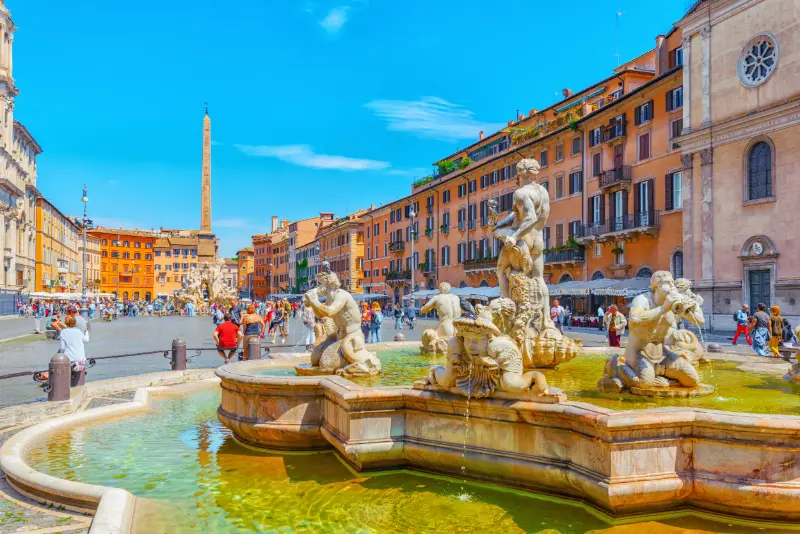
For a two-hour walk, start at Trevi Fountain, pass through Piazza Colonna, continue to the Pantheon and finish in Piazza Navona. This sequence keeps movement logical and gives each stop a distinct character.
How to read the column
The relief spirals upward, so you are not expected to follow every episode from street level. Instead, identify repeated visual language: marching troops, fortified camps, battle scenes, the emperor addressing soldiers and supernatural interventions. This gives you the monument’s message without needing binocular-level detail for every figure.
Compare the style mentally with Trajan’s Column if you have seen it. The later relief tends to use deeper carving and stronger contrasts, helping scenes remain legible from below.
Political Rome around the square
Modern government buildings make this area feel different from purely touristic piazzas. Demonstrations, press activity and security perimeters can appear with little notice. That is part of the square’s living role, not an exception to its identity.
If access routes are blocked, do not force your planned line. Central Rome offers many parallel streets, and a short detour will usually reconnect you with Pantheon, Trevi or the Corso quickly.
Official information and current access
Turismo Roma provides the history of the Column of Marcus Aurelius, Palazzo Chigi, the fountain and surrounding palaces on the official Turismo Roma page for Piazza Colonna.
Opening conditions, security arrangements, religious services, restoration work and special events can change with little notice. Check the official source shortly before your visit rather than relying on an old screenshot or a timetable copied by a third-party site.
FAQ
Is Piazza Colonna free?
Yes. It is a public square.
Can you climb the Column of Marcus Aurelius?
Not as a normal public tourist visit. The column is appreciated from the square.
What is Palazzo Chigi?
It is the seat of the Presidency of the Council of Ministers, making the square an active institutional area.
How long should I stay?
Thirty minutes is enough for a focused visit; allow longer if you add the gallery or nearby monuments.
What is nearby?
The Pantheon, Trevi Fountain and Via del Corso are all within easy walking distance.
Planning this stop well
Rome rewards geographic planning. Before leaving your hotel, group this stop with places that sit in the same part of the city and keep only one or two timed reservations in the day. Moving repeatedly between distant neighborhoods wastes energy and makes delays feel more stressful than they need to be.
Allow a margin for churches, security controls, temporary closures and simple discoveries. A doorway, small exhibition or street scene may deserve ten minutes you did not schedule. Building that flexibility into the day produces a more realistic itinerary than trying to hit every saved map pin.
For lunch and dinner, read current menus and recent information rather than following a years-old recommendation blindly. Rome’s restaurant scene changes, while the best choice also depends on where you happen to be when you are hungry. Walking a few streets away from the most famous square often improves both atmosphere and value.
Carry a refillable bottle, sun protection in warm months and a compact layer in cooler seasons. Central Rome involves more outdoor time than many travelers expect, even on museum-heavy days, because the streets and squares between attractions are part of the experience.
If accessibility is important, verify the exact route rather than judging from distance alone. Cobblestones, steps, steep ramps, security barriers and historic thresholds can make a short walk more demanding than a longer modern street. Official accessibility information should take priority over general travel descriptions.
Is it worth adding to your Rome itinerary?
Piazza Colonna is a high-value stop precisely because it requires little time or money. An ancient imperial monument stands inside the contemporary political center, and that collision of eras is quintessentially Roman.
Do not make a special journey from the outskirts only for the square; add it to a Via del Corso, Pantheon or Trevi walk and it becomes one of the easiest worthwhile stops in the center.