Galleria Sciarra Rome: Art Nouveau Courtyard Near Trevi Fountain
A few minutes from the Trevi Fountain, Galleria Sciarra is one of those Roman spaces that feels hidden even though it sits in the middle of the historic center. The covered courtyard was created during the transformation of Rome after it became the capital of Italy, and its richly painted walls make it one of the city’s most distinctive examples of late nineteenth-century decorative architecture.
It is not a conventional museum with a ticket desk and galleries. The pleasure is in stepping into the courtyard, looking upward at the iron-and-glass roof and slowly reading the painted cycle devoted to ideals and roles associated with women in the culture of the period. Because access can depend on the working use of the building, it is wise to treat it as a bonus stop rather than the only purpose of a journey.
Quick facts
| Area | Trevi / Via del Corso | Short walk from Trevi Fountain |
| Period | Late 19th century | Rome after national unification |
| Style | Roman Liberty / eclectic | Decorated covered courtyard |
| Visit length | 15–30 minutes | Longer for architecture lovers |
Why it is worth visiting
Galleria Sciarra gives you a visual language that is often missing from first-time Rome itineraries. Instead of ancient marble or Baroque stone, you see a modernizing capital experimenting with iron, glass, commercial circulation and a decorative program designed for an urban passage.
Its location makes it especially easy to add without sacrificing another major sight. If Trevi is crowded, the gallery can provide a quieter architectural pause and a reminder that Rome continued to reinvent itself in the decades after 1870.
Rome after 1870 and the creation of the gallery
After Rome became the capital of unified Italy, the city entered a period of rapid construction and modernization. The Sciarra property between Via del Corso, Via Marco Minghetti and Via delle Vergini was reorganized to connect the activities associated with Prince Maffeo Barberini-Colonna di Sciarra. The covered passage belongs to this moment of ambitious post-unification urban change.
The project is associated with architect Giulio De Angelis, while the decorative cycle is linked to painter Giuseppe Cellini. The result combines architecture, applied decoration and a glass-covered courtyard in a way that feels very different from the Renaissance palaces nearby. That contrast is one of the best reasons to visit.
The painted cycle and its female figures
The walls are covered with elegant figures representing virtues, social ideals and stages or roles in female life as imagined by late nineteenth-century culture. The imagery can be admired simply for its line and color, but it also becomes more interesting when read as a historical document about gender, morality and bourgeois society.
Do not look only at individual figures. Notice how painted architecture, floral details and ornamental bands create a continuous environment around the courtyard. The decoration was conceived as part of the space rather than as framed paintings hung after construction.
The iron-and-glass roof
The roof is crucial to the atmosphere. Filtered daylight enters from above and makes the courtyard feel both interior and exterior, a typology familiar from nineteenth-century European galleries and commercial passages. In Rome, where travelers often focus on stone façades, this kind of structure feels unexpectedly modern.
Photographers should experiment with looking upward from different corners rather than standing only in the center. The best compositions often combine painted walls, structural ironwork and the geometry of the glazed roof.
How to combine Galleria Sciarra with Trevi Fountain
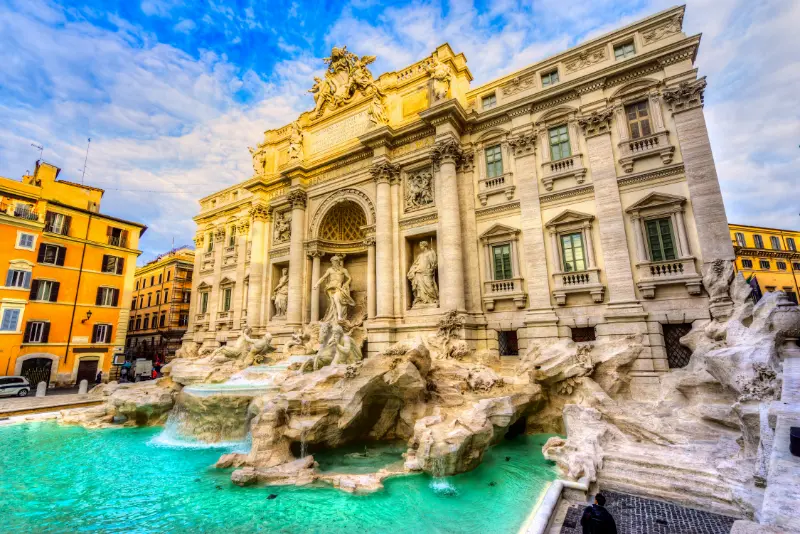
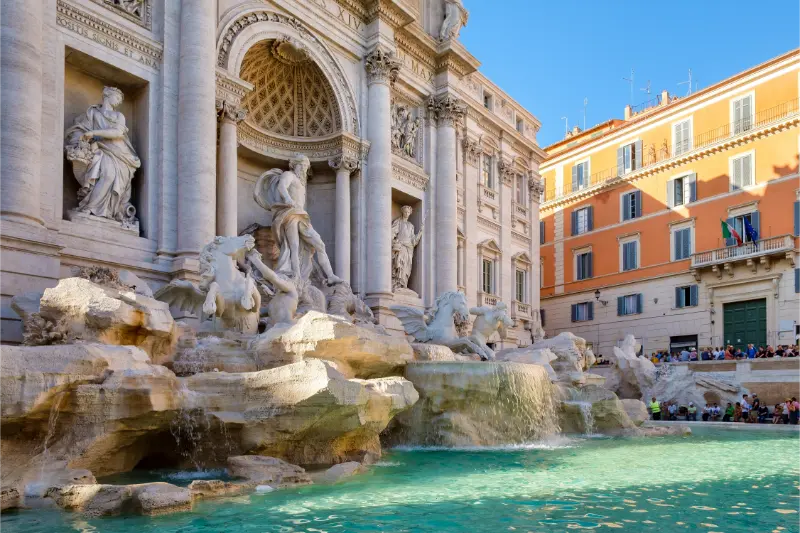
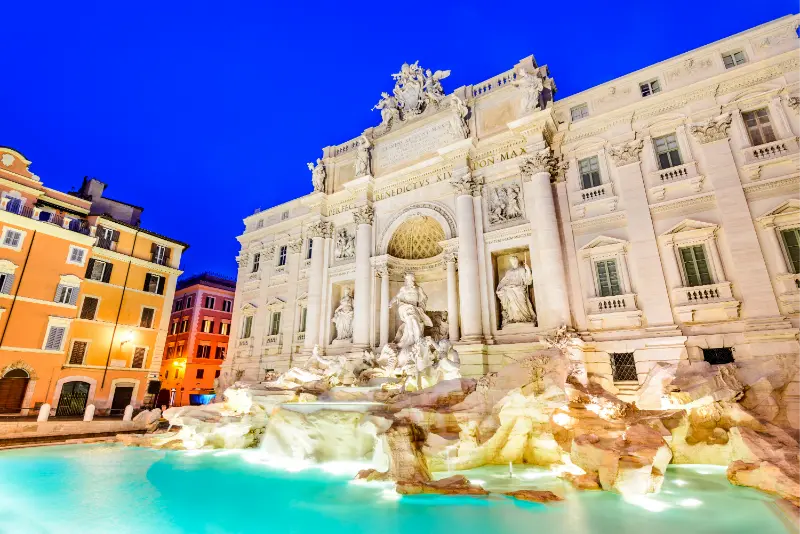
The obvious pairing is Trevi Fountain. Visit Trevi early in the morning if you want lower crowds, then walk to Galleria Sciarra when access is possible. From there you can continue toward Via del Corso, the Pantheon or Piazza Colonna.
For a more thematic day, use our architecture guide and hidden courtyards and cloisters to build a route around spaces that many visitors pass without noticing.
Is it really Art Nouveau?
Galleria Sciarra is often described through the Italian term Liberty and through the broader language of Art Nouveau, but Rome’s late nineteenth-century architecture does not always fit a single international label neatly. It mixes historicist references, decorative painting and modern construction techniques.
Rather than worrying about the perfect stylistic category, look at what makes the courtyard of its era: the integration of art and architecture, flowing decorative motifs, idealized figures and the sense of a modern urban passage created for a newly capital city.
Planning your visit
Access to the courtyard is not identical to entering a public museum, and the building can be affected by work schedules or temporary restrictions. Go during ordinary daytime hours and be prepared for the possibility that access is limited.
There is no reason to reserve an entire hour unless you are drawing, photographing or studying the decoration. Most visitors can appreciate the space in 15 to 30 minutes, which is why it works so well as a flexible stop between central sights.
Nearby places to combine with it
- Trevi Fountain for the classic Baroque landmark
- Rome for architecture lovers for a broader style-based itinerary
- Hidden courtyards and cloisters for quieter central spaces
- Rome for art lovers if you want to connect decorative art with museums and churches
How to fit it into a Rome itinerary
Galleria Sciarra works best as a focused stop rather than as the only reason to cross the city. Build it into a neighborhood day so that travel time becomes part of the sightseeing instead of an interruption. The most efficient plan is to pair it with two or three nearby places that share the same area or theme, then leave enough margin for a coffee, a church that catches your eye, or a temporary closure that changes the order of the day.
For a first trip, avoid stacking too many timed entrances around Galleria Sciarra. Rome rewards walking between major sights, but queues, security checks, heat and uneven pavements make rigid schedules fragile. If you have a fixed booking here, keep the hour before and after relatively light. That approach is especially useful in summer and on weekends, when even short central routes can take longer than expected.
Who will enjoy this place most?
This stop is strongest for architecture lovers, photographers, repeat visitors and anyone looking for a quick hidden stop near Trevi Fountain. It is also a good choice for repeat visitors who already know Rome’s headline monuments and want to understand another layer of the city. Travelers with only one or two days should compare it against their highest priorities, while visitors staying four days or longer can usually include it without sacrificing the Colosseum, Vatican Museums or the historic-center essentials.
Families should judge the visit by attention span rather than by prestige. A place can be fascinating for adults yet feel abstract to younger children if there is little open space or hands-on interpretation. Couples and solo travelers, by contrast, often appreciate the slower pace and the chance to spend time on details that disappear in the busiest attractions.
Photography, clothing and practical comfort
Bring comfortable shoes even if the visit itself is indoors or compact. Rome’s surrounding streets are usually part of the experience, and stone paving can be tiring after several hours. In summer, carry water and plan shaded breaks; in winter, remember that underground or historic interiors can feel cool even when the street is mild.
Photography rules can change by exhibition, restoration phase or event. Do not assume that flash, tripods or commercial equipment are permitted. If photography matters to you, check the current rules before arrival and be ready to enjoy the visit without a camera. For churches or religious spaces nearby, keep shoulders and knees reasonably covered.
Common mistakes to avoid
The first mistake is arriving with old opening information. Smaller Roman sites often have more variable access than the Colosseum or Vatican Museums, so a blog post from several years ago can be misleading. The second is treating the stop as isolated from its neighborhood. The streets around Galleria Sciarra usually add context and make the trip feel worthwhile even if the interior visit is shorter than expected.
Another mistake is overplanning the same day. A useful Rome itinerary has anchors and flexible spaces, not a reservation every hour. Leave time to walk, eat and change plans. If an entrance is unexpectedly unavailable, switch to the nearby alternatives listed in this guide rather than losing half a day trying to force the original schedule.
A simple half-day plan
- See Trevi Fountain early, before the heaviest central crowds.
- Walk to Galleria Sciarra and spend time on the painted courtyard and roof.
- Continue along Via del Corso toward Piazza Colonna and the Pantheon area.
- Finish around Piazza Navona or Campo de’ Fiori for lunch.
Official information and last checks
Rome’s official tourism portal has a useful historical description on its Galleria Sciarra page. Because the space is part of an active building complex, verify access locally and respect any barriers or work activity.
Final advice
Galleria Sciarra is not one of Rome’s biggest attractions, and that is exactly its strength. It adds another century to the city’s story and gives you an elegant pause only minutes from some of the most crowded streets in Europe.
Go for the painted walls, stay for the architecture, and then use the gallery as a bridge toward the rest of the historic center. It is the kind of small discovery that can make a tightly packed Rome itinerary feel more personal.