Quartiere Coppedè Rome: Architecture and Self-Guided Walk
Quartiere Coppedè is one of those places that makes Rome suddenly look like a different city. Around Piazza Mincio, villas and apartment buildings combine Liberty, Art Deco, medieval, Baroque, classical and fantastical details in a deliberately theatrical mix. It is small enough to explore in under an hour, but rich enough to reward anyone who enjoys architecture and photography.
Despite the common name, Coppedè is not an official administrative district. It is a compact architectural ensemble within the Trieste-Salario area, designed principally by Gino Coppedè in the early twentieth century. That distinction matters because travelers sometimes expect a large neighborhood full of attractions when the core sight is actually a concentrated group of streets and buildings.
Why Coppedè looks so unusual
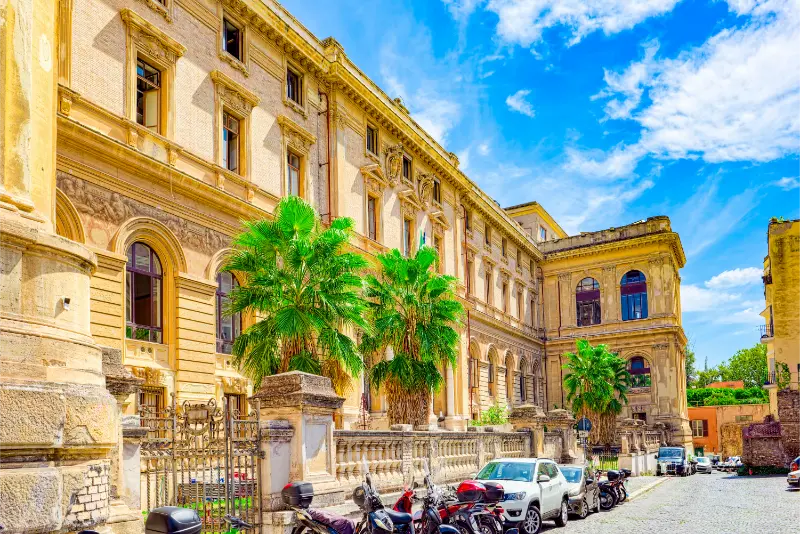
Gino Coppedè approached architecture almost like stage design. Instead of committing to one historical style, he combined towers, arches, mosaics, sculpted animals, coats of arms, painted decoration and unexpected materials. The result can feel medieval in one detail, Florentine Renaissance in another and Art Nouveau a few meters later.
Turismo Roma describes the ensemble as 26 small palaces and 17 villas between Via Salaria and Via Nomentana, developed between 1915 and 1927. Coppedè died before the project was fully completed, and work continued under Paolo Emilio Andrè. The area therefore belongs to the Rome of the early twentieth century rather than the ancient or Baroque city most visitors know.
Start at the arch of the Palazzi degli Ambasciatori
Approach from Via Tagliamento and Via Dora. The monumental arch connecting the Palazzi degli Ambasciatori acts like a theatrical entrance. Look underneath for the large wrought-iron chandelier. It is one of the most photographed details, but the real effect comes from the transition: ordinary city traffic gives way to a small enclosed world of ornament.
Piazza Mincio and the Fountain of the Frogs
Piazza Mincio is the center of the ensemble. The Fontana delle Rane, or Fountain of the Frogs, occupies the middle and helps organize the surrounding façades. Walk around the fountain rather than photographing it from one side; the background changes completely depending on which building you use as a frame.
Villino delle Fate
The Villino delle Fate is the most fairy-tale-like building in the group, with asymmetrical volumes, arches, fresco-like decoration and multiple materials. It is private property, so the visit is exterior only. This is an important etiquette point: Coppedè is a residential area, not an open-air museum where doorways and courtyards can be entered freely.
Palazzo del Ragno
The Palazzo del Ragno takes its name from the spider motif on its façade. Its decoration mixes references that feel exotic, medieval and modern at once. Rather than trying to decode every symbol, compare its geometry with the Villino delle Fate: one feels heavier and more monumental, the other lighter and more fragmented.
A self-guided 45-minute route
- Enter through the arch at Via Dora
- Pause under the chandelier
- Walk into Piazza Mincio
- Circle the Fountain of the Frogs
- Study the Villino delle Fate from public sidewalks
- Continue to Palazzo del Ragno
- Explore one or two surrounding residential streets
- Return toward Piazza Buenos Aires
The route is intentionally short. Coppedè works best as a focused architectural walk rather than an all-day destination. Combine it with another nearby area instead of stretching the visit artificially.
Best time for photography
Early morning gives you fewer parked cars, less traffic and softer light. Late afternoon can also work, but shadows become stronger around the narrow streets. A phone camera with a wide-angle option is useful because façades are tall and close. Avoid standing in the roadway to fit an entire building into the frame.
How to get there
The official Turismo Roma page for Quartiere Coppedè places the core around Piazza Mincio between Via Salaria and Via Nomentana. Tram and bus connections serve the surrounding area. From the historic center, public transport is normally more efficient than walking the entire way unless you deliberately build Coppedè into a long urban route.
What to see nearby
- Villa Torlonia
- Santa Costanza and Sant’Agnese fuori le Mura
- Piazza Buenos Aires
- Villa Ada
- Trieste-Salario residential streets
- Porta Pia and the Nomentana area
Villa Torlonia is the easiest major companion sight because it adds gardens, architecture and museums without repeating Coppedè’s visual language. Santa Costanza is another strong choice if you want late-antique architecture and mosaics.
How long to spend
| Plan | Suggested time |
|---|---|
| Core Coppedè walk | 30–45 minutes |
| Photography-focused visit | 60–75 minutes |
| Coppedè + Villa Torlonia | Half day |
| Coppedè + Trieste neighborhood lunch | 2–3 hours |
Coppedè in films
The area’s dreamlike atmosphere attracted filmmakers, including Dario Argento, who used Coppedè locations in his cinema. Knowing this can add context, but the architecture is more interesting than hunting for exact camera positions. Look instead at how the buildings create a sense of controlled unreality through oversized symbols, asymmetry and surprising historical references.
Where to eat and take a break
The core of Coppedè is residential and not packed with tourist restaurants. That is an advantage. Walk toward Piazza Buenos Aires, Corso Trieste or the surrounding streets for cafés and neighborhood dining. Check recent opening hours because small businesses change more often than monuments.
Common mistakes
- Expecting a large official neighborhood called Coppedè
- Entering private buildings or courtyards
- Standing in the street for photographs
- Visiting at peak traffic and expecting empty views
- Leaving after only seeing the fountain
- Planning an entire day around the area without nearby sights
Who should visit?
Coppedè is ideal for repeat visitors, architecture enthusiasts, photographers and travelers looking for unusual Rome. It also fits the spirit of our hidden gems in Rome guide: interesting enough to justify the journey, but compact enough that it should be paired with another destination.
FAQ
Is Quartiere Coppedè free?
Yes. The streets and Piazza Mincio are public. Individual buildings are generally private and should be viewed from outside.
How much time do I need?
Around 45 minutes is enough for a first walk. Allow longer if you photograph architecture carefully.
Is it worth going on a first trip to Rome?
If you have four or more days, yes. With only two days, prioritize the historic center and major ancient sites first.
How to explore without turning the neighborhood into a checklist
A neighborhood guide works best as a framework, not a timed attraction list. Pick two or three anchors, then allow the connecting streets to do part of the work. Stop when a café, façade, market or small public space catches your attention. This is especially important outside the historic center, where the value often lies in transitions and ordinary urban life rather than a sequence of famous interiors.

Respecting residential Rome
Remember that many of the most photogenic streets are home to residents. Keep voices low in courtyards, avoid blocking entrances, do not photograph people at close range without permission and never enter private property because a gate happens to be open. The best way to experience local Rome is to behave as a considerate guest rather than treating the neighborhood as a film set.
When the area fits into an itinerary
Neighborhoods outside the core are most rewarding once you have enough time to slow down. On a two-day first trip, central monuments should usually come first. On a four- or five-day stay, one half-day in a less tourist-heavy district creates contrast and gives you a more complete sense of the city. Link the area with one nearby museum, church or park rather than crossing Rome several times in the same day.
A better two-hour rhythm
For a first exploration, two hours is often more useful than an ambitious half-day checklist. Spend the first twenty minutes reaching the main visual anchor, the next hour wandering through two or three connected streets, then use the final part for a coffee, bakery stop or nearby sight. This rhythm gives the area time to feel like a neighborhood rather than a collection of map pins. If you immediately rush to the next district, you miss the ordinary details — shopfronts, apartment entrances, street trees, local cafés and changes in building scale — that explain why the area feels different from central Rome.
What to notice between the landmarks
Pay attention to the spaces between the named attractions. Rome’s neighborhoods often tell their story through paving, rail infrastructure, courtyard design, industrial remnants, street signs and the relationship between ground-floor businesses and homes above. These are not “hidden gems” that require secret access; they are visible clues to how the district developed. A slower walk also helps you decide where to stop based on the atmosphere you actually find that day, rather than following an old list of businesses that may have changed ownership or opening hours.
Final planning advice
For Quartiere Coppedè Rome, build the day around the experience rather than around the number of attractions completed. Verify operational details, keep travel time realistic and leave a buffer before your next timed reservation. Rome rewards attention: the strongest visit is usually the one where you understand why a place matters, notice how it connects with the surrounding city and still have enough energy to enjoy what comes next.