Imperial Fora Rome: Complete Guide to Caesar, Augustus, Nerva, Peace and Trajan
Imperial Fora is five monumental complexes that show how Roman political space evolved from Julius Caesar to Trajan. It belongs to one of the most historically dense parts of Rome, where Republican, imperial, medieval and modern layers often occupy the same few hundred meters. A focused visit is worthwhile because the monument becomes much easier to understand once you know what role it played and how it connected with the surrounding forums.
This guide is written for an independent visit in 2026. Archaeological routes, conservation closures and ticket products can change, especially in the Imperial Fora. Use the historical sections to prepare your visit, then verify access on the official page before setting out.
Imperial Fora at a glance
| Location | between Piazza Venezia, Via dei Fori Imperiali and the Roman Forum |
| Why see it | five monumental complexes that show how Roman political space evolved from Julius Caesar to Trajan |
| Time to allow | 1.5–3 hours for the archaeological route, longer if you add Trajan’s Markets |
| Access | The official Imperial Fora archaeological route currently enters near Trajan’s Column and continues through sections of Trajan’s, Caesar’s and Nerva’s forums; routes can change with works and conservation. |
| Best strategy | See it as part of the surrounding archaeological cluster rather than as an isolated photo stop. |
Why Imperial Fora is worth seeing
The strongest reason to stop here is context. Five monumental complexes that show how roman political space evolved from julius caesar to trajan. Rome’s headline monuments can dominate an itinerary, but smaller or more fragmented sites often explain how imperial power actually worked: how people moved through civic space, how emperors used architecture to communicate legitimacy, and how later generations reused structures that were too useful or too massive to disappear.
This area also rewards comparison. Stand still for a moment and look beyond the individual ruin. Ask which forum lies on the other side, where the ancient street level ran, whether the building was religious or civic, and which later structures cut across it. The answers transform a collection of columns and walls into a readable city plan.
History of Imperial Fora
Rome did not build the Imperial Fora as a single master plan. They appeared over roughly a century and a half as successive rulers created new ceremonial, judicial and administrative spaces beside the older Roman Forum. Julius Caesar inaugurated the first new forum in 46 BC; Augustus followed with his forum, dedicated in 2 BC; Vespasian completed the Temple or Forum of Peace in AD 75; Nerva inaugurated the narrow forum that bears his name in AD 97; and Trajan opened the grandest complex in AD 112, with his commemorative column dedicated in AD 113.
This sequence matters because each forum was political architecture. Caesar used Venus Genetrix to connect his family with divine ancestry. Augustus placed Mars Ultor at the center of a program about vengeance, legitimacy and restored order. Vespasian displayed art and spoils within a garden-like sanctuary of Peace. Domitian and Nerva monumentalized the Argiletum, one of the city’s busiest passages. Trajan then created a huge complex financed by the Dacian campaigns and dominated by the Basilica Ulpia, libraries and the famous narrative column.

The modern street cuts visually through this archaeological landscape, so the most useful way to understand the area is to imagine the ancient spaces as adjoining but distinct courtyards, porticoes, temples and civic halls rather than one continuous field of ruins.
Architecture and what to look for
The Imperial Fora are best read as a chain. At the Forum of Caesar, the long piazza ended at the Temple of Venus Genetrix. The Forum of Augustus used a high fire-resistant boundary wall toward the Suburra and focused attention on the Temple of Mars Ultor. The Forum of Nerva was unusually long and narrow because it occupied the surviving corridor of the Argiletum. The Forum of Peace was greener and more open, with porticoes, water features and rooms that later became famous for the Forma Urbis marble plan. Trajan’s Forum expanded the scale again with an immense square, the Basilica Ulpia, libraries and Trajan’s Column.
Look for transitions rather than isolated objects: pavement levels, retaining walls, changes in marble, the way later streets cross ancient alignments, and the dramatic difference between a temple-front forum and Trajan’s vast civic architecture. Those contrasts make the whole district more intelligible.
What survives today
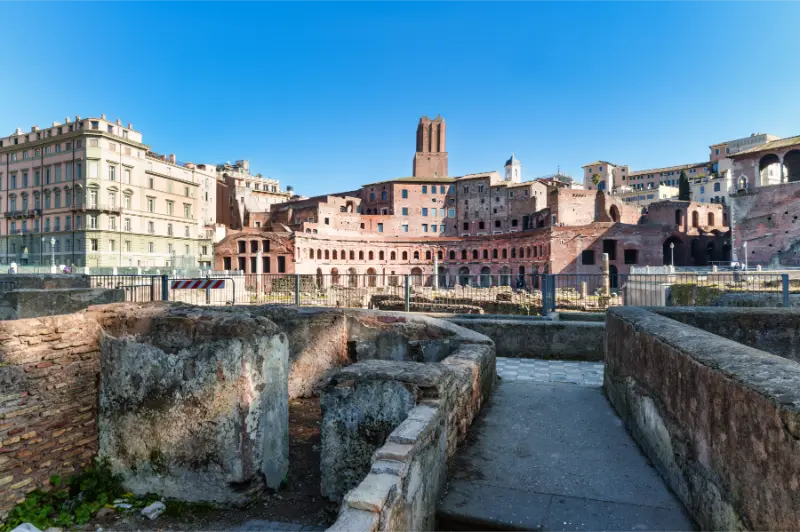
Today the visitor sees selected excavated portions rather than complete ancient plazas. The most legible landmarks include the Forum of Caesar, the high wall and Temple of Mars Ultor in the Forum of Augustus, the Colonnacce of Nerva, sections of the Templum Pacis, the Basilica Ulpia remains and Trajan’s Column. The archaeological path helps reconnect spaces that appear fragmented from street level.
Do not judge the importance of the monument only by the height of what remains. Many Roman complexes were stripped for marble, crossed by later streets or buried by centuries of building. Foundation lines, changes in paving and the relationship between surviving fragments can be more informative than a single complete façade. A reconstruction drawing on your phone can be especially useful here.
Tickets, opening hours and access in 2026
The official Imperial Fora archaeological route currently enters near Trajan’s Column and continues through sections of Trajan’s, Caesar’s and Nerva’s forums; routes can change with works and conservation. The official Imperial Fora area currently uses seasonal opening times and controlled admissions. For the period from 28 March to 30 September 2026, the published archaeological-area schedule is 09:00–19:15, with last admission one hour before closing; hours become shorter in autumn and winter. Individual monuments may have different access conditions or may be exterior-only.
Always confirm the latest conditions on the official visitor information page. Restoration work, special events, weather and archaeological operations can change a route with little notice. If a specific interior or special-access space is essential to you, check again on the morning of your visit.
How to visit it intelligently
Start around Trajan’s Column to understand the northern end of the system, continue through the official archaeological path when open, then compare the Forum of Caesar with the narrower Forum of Nerva. Afterward, walk the public edge of Via dei Fori Imperiali to study the Forum of Augustus and the Temple of Mars Ultor from a different angle. Finish either at the Roman Forum or at Trajan’s Markets, depending on your ticket and energy.
A useful rule in the Imperial Fora is to alternate close observation with wider views. Spend a few minutes on details—column bases, carved blocks, joints in the masonry—then step back to recover the overall axis of the forum. Without that rhythm, it is easy to photograph many fragments while losing the reason they were arranged in that particular place.
If you are visiting in summer, carry water and use shaded pauses strategically. The archaeological zones have exposed stretches, reflective stone and limited opportunities to sit exactly where you might want to. In cooler months the challenge is different: low sun can create dramatic views but also deep shadows across reliefs and inscriptions.
How to combine it with nearby sights
A compact route can combine Trajan’s Markets, Forum of Augustus, Forum of Caesar, Roman Forum. These are geographically and historically connected stops, so linking them saves walking and gives you a clearer chronological sequence than jumping across Rome between unrelated attractions.
If you have only half a day for ancient Rome, choose one archaeological ticketed area and supplement it with free exterior viewpoints. If you have a full day, add a museum such as Trajan’s Markets because original architectural fragments and reconstructions can make the ruins outside much easier to interpret.
A practical route step by step
- Begin from a wide viewpoint and identify the monument before moving closer.
- Read the ancient function first: temple, basilica, forum, tower or later residence.
- Find one surviving architectural detail that confirms the reconstruction—such as a column base, podium, wall, frieze or pavement line.
- Turn around and identify the nearest related monument rather than looking only at the object in front of you.
- Finish with a second viewpoint from a different elevation or street so the scale becomes clearer.
Best time of day
Early morning is usually the easiest time for orientation because Via dei Fori Imperiali and the viewpoints around Piazza Venezia are quieter. Light from the side also makes columns, reliefs and uneven masonry more legible. Late afternoon can be more atmospheric, particularly when warm light reaches brick and marble surfaces, but the area is often busier.
For archaeology, “best light” is not always the same as “best photo light.” A relief that looks flat at noon may suddenly become readable when the sun is low. If photography matters, revisit one or two details after walking the wider route rather than trying to capture everything on first contact.
Photography without losing the historical context
Use at least one wide photograph that shows the monument in relation to neighboring ruins and modern streets. Then take tighter images of a distinctive detail. This pairing is more useful later than a gallery of close-ups with no sense of location. For high monuments, optical zoom is more useful than digital zoom; for long forums, a slightly elevated viewpoint can reveal the plan better than ground-level panoramas.
Avoid climbing on ancient blocks or crossing barriers for a cleaner angle. Many apparently sturdy stones are archaeological fabric, and restricted areas can change as conservation work progresses. The official routes provide enough varied perspectives without leaving permitted paths.
Accessibility and footwear
Public street viewpoints around the Imperial Fora are generally straightforward, but archaeological routes can include uneven paving, ramps, changes of level and exposed surfaces. Comfortable shoes are more useful than formal footwear, even if your visit is short. Travelers with limited mobility should check the official accessibility information for the exact entrance and route operating on their date.
If someone in your group tires easily, divide the visit into short clusters. The area has several places where one traveler can pause while another studies a nearby ruin. This is usually better than trying to complete every forum in one continuous circuit.
How much historical detail do you really need?
You do not need to memorize every emperor or construction phase before visiting Imperial Fora. Remember three things: who created or transformed the site, what its primary function was, and one surviving feature that proves the reconstruction. That simple framework will let you recognize the monument in the wider landscape.
If you enjoy deeper history, add chronology only after you have the plan clear. Roman sites often have several rebuilds separated by fires, earthquakes, political changes and medieval reuse. Learning every date first can make a visit harder; understanding the spatial logic first makes the dates easier to retain.
Common mistakes to avoid
- Assuming every visible wall belongs to the same period.
- Relying on an old screenshot for opening hours or route access.
- Treating Via dei Fori Imperiali as if it followed an ancient street exactly.
- Spending all your time on one famous monument and missing the relationship with the neighboring forums.
- Using only close-up photos and losing the scale of the site.
- Skipping the official museum or reconstruction material when the surviving ruins are difficult to read.
FAQ about Imperial Fora
Do I need a separate ticket?
It depends on the exact monument and route. Some remains are visible freely from public streets, while closer archaeological access can be included in the Imperial Fora or related ticket products. Check the official page for your date.
How long should I allow?
1.5–3 hours for the archaeological route, longer if you add Trajan’s Markets. Add extra time if you enjoy archaeology, photography or plan to combine the stop with a museum.
Can I visit without a guide?
Yes. A guide can add detail, but an independent visit works well if you study a plan or reconstruction beforehand and use the surrounding monuments to orient yourself.
Is it suitable for children?
Yes for families interested in ancient Rome, but shorter focused stops work better than a long sequence of similar ruins. Give children one visual task, such as finding a relief, a giant column or the highest surviving wall.
Is it worth seeing if I already visit the Roman Forum?
Yes, because the Imperial Fora represent a later expansion of monumental Rome and explain how rulers from Caesar to Trajan reshaped political space beyond the older Forum.

Is Imperial Fora worth it?
Yes, especially if you want to understand Rome rather than simply collect famous sights. Five monumental complexes that show how roman political space evolved from julius caesar to trajan. The stop becomes much more rewarding when you connect it with the neighboring forums and allow the surviving fragments to explain the city’s changing political and architectural priorities.

For a first trip, prioritize the major monuments and use this site to deepen the route rather than overload it. For a repeat visit, it can become one of the most satisfying stops because you already recognize the surrounding city and can concentrate on details that are easy to miss the first time.