Leonardo Express Rome: Fiumicino Airport Train Guide
The Leonardo Express is Rome’s simplest airport train: a non-stop service between Fiumicino Airport and Roma Termini. For many travelers it removes the biggest uncertainty after a flight because there is no need to choose an intermediate station or change trains. It is not always the cheapest or most convenient option, however, especially if you are staying near Trastevere, Ostiense or Tiburtina. This guide explains exactly when the Leonardo Express makes sense and when the FL1 or another transfer may be better.
Quick facts
| Journey | Fiumicino Airport ↔ Roma Termini |
| Published travel time | 32 minutes |
| Current single fare | €14 |
| Typical frequency | Every 15 minutes |
| City BIT/Metrebus valid? | No |
Leonardo Express timetable and frequency
Trenitalia currently describes the service as a 32-minute non-stop connection with departures generally every 15 minutes. Its published page lists service windows beginning early in the morning and continuing into the late evening. Always verify the exact train for your date on the official Leonardo Express page, especially during engineering works, strikes or unusual events.
A 15-minute frequency means you normally do not need to obsess over a specific train after landing. Flight delays and baggage delivery are unpredictable, so flexibility is valuable. For the return journey to the airport, however, choose a train that gives you a comfortable margin before the airline’s check-in or bag-drop deadline.
Tickets, price and validation
The current single fare is €14. Trenitalia also advertises a mini-group fare for four people and other ticket products. City ATAC tickets and Roma Metrebus passes are not valid on the Leonardo Express. Buy through Trenitalia, at official machines/counters or use supported contactless channels where available.
If you buy a digital ticket, read the conditions shown at purchase because check-in or validation rules can depend on ticket type. With paper tickets, follow the validation instructions. The safest habit is to buy from an official channel rather than from a person offering “special” airport tickets in a station.
Where to find the train at Fiumicino
The airport railway station is inside the Fiumicino complex and is signposted from the terminals. Follow the train symbols rather than exiting to the taxi or bus areas. Allow walking time from baggage reclaim; Fiumicino is large and the distance depends on where your flight arrives.
At Termini, use the station signs and departure boards rather than assuming a fixed platform. Our Rome train stations guide explains how to orient yourself at Rome’s main station.
Luggage, children and accessibility
Trenitalia states that luggage has no weight or size surcharge on the Leonardo Express. Children under four travel free, and one child aged over four and under twelve can travel free for each paying adult under the published conditions. Trains provide dedicated seating and accessible toilets for passengers with reduced mobility.
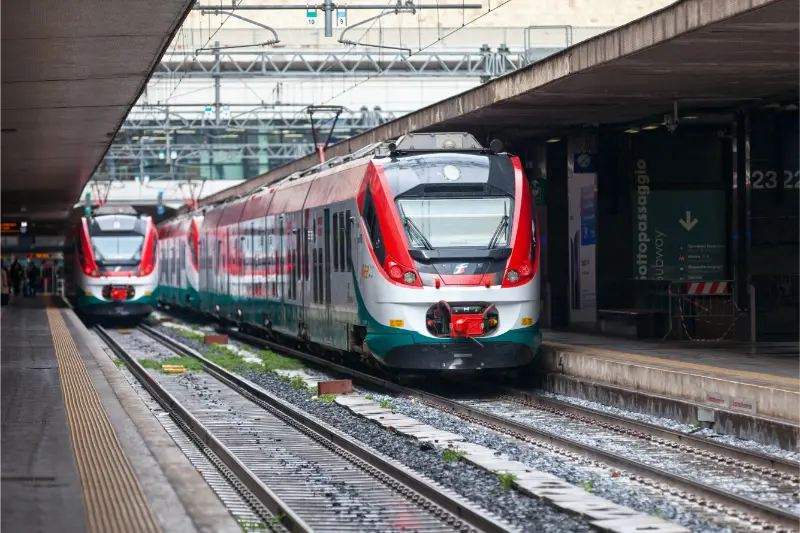
The fact that luggage is allowed does not mean you should leave valuables unattended. Keep passports, phones and wallets with you and position suitcases where you can monitor them without blocking aisles.
Leonardo Express versus the FL1 regional train
The Leonardo Express wins on simplicity if Termini is your destination. The FL1 can win on geography because it stops at useful stations such as Trastevere, Ostiense and Tiburtina. If your hotel is in Trastevere, traveling to Termini first can add unnecessary distance.
Use the Fiumicino Airport guide to compare the complete transfer. A route with one slightly slower train can still be faster door to door if it ends close to your accommodation.
What if there is a strike or disruption?
Rail transport can be affected by strikes, infrastructure works or operational changes. Check Trenitalia before leaving your hotel and again before committing to the station if a disruption is reported. Keep a taxi, coach or earlier train in mind for an airport departure.
Do not plan to reach Fiumicino at the minimum acceptable airport-arrival time. A transport buffer is particularly important on the day you fly. The Rome travel mistakes guide covers other timing errors that are easy to avoid.
Frequently asked questions
How much is the Leonardo Express?
Trenitalia currently lists the single fare at €14.
How long does it take?
The scheduled non-stop journey is 32 minutes between Fiumicino Airport and Roma Termini.

Does it run every 15 minutes?
Trenitalia advertises departures generally every 15 minutes, but check the live timetable for your date.
Can I use the Roma Pass or BIT?
Standard city Metrebus/ATAC tickets are not valid on the Leonardo Express.
Is it better than a taxi?
For one or two people staying near Termini, it is often simple and predictable. A taxi can be more convenient for groups or accommodations far from the station.
Plan the rest of your Rome trip
Continue planning with Fiumicino Airport guide, Rome train stations and Rome airport transfers. These guides work best together because Rome is easier to enjoy when transport, timing and sightseeing are planned as one itinerary rather than as separate decisions.
A simple planning strategy
The easiest way to use this information is to decide first what cannot move: a flight, a timed museum reservation, a train departure or a booked tour. Build the rest of the day around those fixed points. Rome rewards flexible planning because queues, traffic, heat, security checks and walking times can all change the rhythm of a day. Leaving a buffer is not wasted time; it is what keeps one delay from turning into a stressful chain of missed plans.
For most visitors, a good rule is to pair one demanding activity with one flexible activity. A museum reservation can be followed by a neighborhood walk; an airport transfer can be followed by an easy dinner near the hotel; a long Vatican morning can be followed by a slower afternoon across the river. This approach also gives you room to stop for coffee, water or an unexpected church without feeling that the itinerary is failing.
What to keep on your phone
Before leaving your accommodation, save the address of your hotel, a screenshot of any ticket or QR code, the route back, and the official page for the service you are using. Keep a payment card and some cash separate from your phone. If your battery is low, switch on power-saving mode before you need navigation. A small power bank is especially useful on days that involve airports, long museum visits or repeated use of digital tickets.
It is also worth saving the names of important places in Italian. Showing “Roma Termini”, “Aeroporto di Fiumicino”, “Basilica di San Pietro” or the exact metro station to staff can be faster than explaining the destination. Rome is a major international city, but a few precise names reduce misunderstandings when stations are crowded or when service changes require an alternative route.

How to avoid losing time
Do not schedule every transition at the shortest theoretical travel time. Walking through a large station, finding the correct platform, passing security or moving through a crowded square can add minutes that route planners do not show. At airports and the Vatican in particular, the distance between “arrival at the complex” and “arrival at the exact entrance” matters. Give yourself a realistic margin and use signs rather than following the crowd automatically.
If something changes, check the official operator first rather than relying on an old blog post or a screenshot from social media. Transport works, strikes, ceremonies and special events can alter normal patterns. The practical details in this guide are a planning baseline; the official service page should be the final check for the day you travel.
Choosing by neighborhood, not by landmark
Rome is large enough that the best transport choice often depends on the neighborhood where you are sleeping rather than the attraction you plan to visit first. A route that looks slightly slower on paper can be easier if it ends close to your hotel, while a nominally fast train to a major station can still require a second metro ride and a long walk with luggage. Compare the whole journey from terminal or platform to the accommodation door.
The same principle applies inside the city. Plan around the station or stop that minimizes awkward transfers, stairs and backtracking. This is particularly useful for families, travelers with large suitcases and anyone arriving after a long flight. Convenience has a real value on arrival day because fatigue makes small navigation problems feel much larger.
A final check before you leave
On the evening before a flight, train journey or major timed visit, check the official operator again and save the latest departure information. Charge your phone, place tickets and identification where you can reach them easily, and decide on a backup option if the primary route is disrupted. These small preparations take only a few minutes and are much more useful than trying to solve everything while standing in a crowded station.
If you are traveling with other people, make sure everyone knows the destination and meeting point in case the group becomes separated. One person should not be the only holder of every ticket, address and reservation detail. Sharing the essential information makes the day more resilient without adding complexity.