Parco Archeologico del Celio and Forma Urbis Museum: 2026 Visiting Guide
Parco Archeologico del Celio and the Museo della Forma Urbis are among the most useful newer additions to an archaeology-focused Rome itinerary. Opened to the public in its current form in 2024, the park displays architectural and epigraphic material in a green setting, while the museum presents surviving fragments of the enormous marble plan of ancient Rome known as the Forma Urbis.
The location is ideal: immediately beside the Colosseum zone but far calmer than the main entrances to the archaeological park. For travelers who have already seen the Forum, the Forma Urbis adds a different kind of understanding—less about one emperor or monument and more about the structure of the entire ancient city.
| Planning point | Useful detail |
|---|---|
| Address / location | Viale del Parco del Celio 20–22, Rome |
| Access | Park daily; museum Tue–Sun. Park hours vary with daylight; museum uses seasonal hours. |
| Tickets / cost | Park free; museum ticket required for non-residents, with current municipal concessions. |
| Suggested time | 60–90 minutes |
| Best for | Ancient topography, archaeology, a quieter stop beside the Colosseum |
What is the Forma Urbis?
The Forma Urbis Romae was a gigantic marble plan of the city created in the Severan period, generally dated to the early third century CE. The map was carved on many marble slabs and mounted on a wall in a building associated with the Forum of Peace. At full scale it measured roughly 18 by 13 meters and recorded streets, temples, houses, porticoes and other structures in remarkable detail.
Only a fraction survives, but even fragments are invaluable because they preserve plans of buildings that have disappeared or changed beyond recognition. The challenge has always been making broken pieces understandable to non-specialists. The modern museum addresses this by placing fragments in relation to a later large-scale map of Rome, allowing visitors to read position and urban context more intuitively.
The museum display
The surviving marble fragments are the star, but the installation is designed around comprehension rather than quantity. By seeing the pieces against a mapped floor, visitors can grasp how scholars attempt to locate fragments and reconstruct ancient topography. This is especially rewarding after walking the Forum, Palatine and imperial fora, when names and street relationships are already familiar.
Do not rush to photograph every fragment. Choose a few recognizable plans and study how walls, courtyards and streets are represented. The experience becomes far more interesting when you think of the map as an administrative and monumental object produced by the imperial city, not simply as an ancient tourist map.
The archaeological park
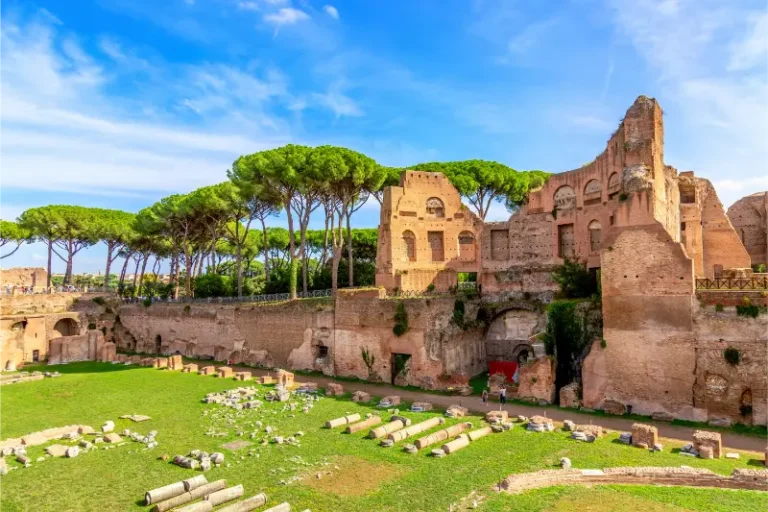
Outside, the park contains architectural and epigraphic material recovered during excavations and urban works in Rome, arranged in thematic groupings. The setting revives the historic function of the Celian antiquarium area and gives otherwise displaced fragments a readable context.
The park itself is free and works well even for travelers who do not enter the museum. It also provides a quieter transition between the Colosseum valley and the residential Celian Hill. In warm weather, plan around shade and carry water because much of the experience is outdoors.
2026 hours and tickets
The official Sovrintendenza information lists the archaeological park open daily from 07:00, closing at 17:30 during standard time and 20:00 during daylight-saving time, with closures on 25 December and 1 May. The Museo della Forma Urbis is open Tuesday through Sunday, 10:00–16:00 in standard time and 10:00–19:00 in daylight-saving time, with final admission one hour before closing.
Current 2026 non-resident museum prices are listed at €11 full and €6.50 reduced, while residents of Rome and the metropolitan area can enter free with valid proof of residence under the municipal scheme. Prices and concessions can change, so check the official page before purchase. The park remains free regardless of whether you add the museum.
How to combine it with the Colosseum
If you have a timed Colosseum, Roman Forum and Palatine ticket, use the Celio park as a flexible stop before or after rather than risking a late arrival at the main entrance. It is also an excellent choice on a second day devoted to less crowded ancient sites.
A balanced route is Parco Archeologico del Celio, Case Romane del Celio, Santa Maria in Domnica and Villa Celimontana. That keeps the day geographically compact and reveals the hill’s transformation from imperial structures to Christian and modern landscapes.
Why the site matters for understanding Rome
Most visitors experience ancient Rome monument by monument: Colosseum, Pantheon, Forum, baths. The Forma Urbis encourages a different question—how did those monuments fit into a living city of apartment blocks, shops, alleys, courtyards and public spaces? That shift from objects to urban systems is the museum’s greatest strength.
For students, repeat visitors and anyone who enjoys maps, this may be one of the most intellectually satisfying small museums in the city. It does not replace the major archaeological sites; it makes them easier to understand.
How to get there and plan the route
Central Rome is compact on a map but not always quick on foot. Choose the route based on the attractions immediately before and after this stop rather than on your hotel alone. Live public-transport information is useful because buses and surface routes can change with road works, demonstrations and special events. If you use a taxi, enter the full address rather than only the attraction name, especially for churches, parks and archaeological complexes with more than one entrance.
The best itineraries keep one district together. Nearby options include Colosseum, Celio, Villa Celimontana. Linking these stops reduces wasted travel time and gives you a better sense of how each monument fits into Rome’s urban fabric.
What to bring and common mistakes to avoid
- Check same-week access information when the site is religious, archaeological or subject to maintenance.
- Wear comfortable shoes: cobbles, stairs and uneven historic surfaces are common even in the center.
- Carry water in warm weather, but do not eat or drink inside churches and protected museum spaces.
- Avoid scheduling a minor site immediately before a fixed-time Colosseum, Vatican or gallery reservation.
- Do not rely on third-party ticket sellers before confirming whether the site actually requires a paid ticket.
- Keep photography respectful and follow local signs on flash, tripods and restricted areas.
Is it worth adding to a first trip?
For a first visit to Rome, Parco Archeologico del Celio makes sense when its subject matches your interests and it fits naturally into the neighborhood you are already exploring. It should not replace the Colosseum, Vatican or Pantheon for most first-time travelers, but it can make a busy sightseeing day feel more personal and less predictable.
Repeat visitors will get even more from the stop because they already understand the city’s basic geography. Smaller churches, specialized museums and neighborhood parks often become highlights on a second or third trip precisely because there is no pressure to race through them.
Why this stop adds depth to a Rome itinerary
Rome can be overwhelming because the city contains several different histories in the same street. A small monument often makes those layers easier to read than a vast museum does. Here, the useful approach is to identify one or two specific features before arrival, understand what period they belong to and then compare them with the surrounding neighborhood. That method turns a short visit into context for everything else you see during the trip.
It also helps to think in terms of connections rather than rankings. A site does not need to be one of Rome’s ten most famous attractions to deserve time. If it explains medieval reuse of an ancient building, the movement of goods through the city, a particular artistic commission or the evolution of a neighborhood, it can become the missing link between larger monuments. This is particularly true for travelers who have already visited Rome once and want a trip built around themes rather than a standard checklist.
Photography can support that way of looking. Instead of taking only a wide image, record a detail—a reused column, inscription, masonry joint, fountain figure or change in floor level—then photograph the surrounding street. The pair of images will often explain the site better later than a dozen identical façade shots. Where photography is restricted, take a few notes immediately after leaving while the details are fresh.
Finally, leave room for uncertainty. Religious buildings can close for services, archaeological routes can change after conservation work and public gardens respond to maintenance and weather. A resilient itinerary includes a nearby alternative and treats access updates as normal, not as a failure of planning. Rome is at its best when a closed door leads you to another church, courtyard, market or view a few streets away.
FAQ
Is Parco Archeologico del Celio worth visiting?
Yes, especially for travelers interested in ancient topography, archaeology, a quieter stop beside the colosseum. The strongest reason to visit is not simply adding another attraction to a list but seeing a part of Rome that explains the city from a different angle.
Do I need to book in advance?
It depends on the site. Active churches normally do not require a tourist reservation, while specialized archaeological monuments may use scheduled access. Museums can have capacity limits even when tickets are free. Check the current official information shortly before your visit.

How much time should I allow?
Plan about 60–90 minutes. Add extra time if you are combining the stop with a nearby museum, archaeological level, park or longer neighborhood walk.
What should I see nearby?
Good nearby choices are Colosseum, Celio, Villa Celimontana. Keeping the day geographically compact is usually more rewarding than crossing Rome after every attraction.
Is the site suitable for children?
It can be, but the answer depends on the child and the type of site. Parks and visible architectural features are easier for younger visitors; quiet churches and detailed museums work better when children have a simple story or visual goal to follow.
Final planning advice
Parco Archeologico del Celio is most rewarding when you treat it as part of a neighborhood rather than an isolated pin on a map. Verify current access, arrive with enough time to look carefully, then continue on foot to one or two nearby places. That slower pattern is one of the best ways to experience Rome beyond the headline attractions.