Santa Maria Maggiore Rome: Mosaics, Tombs and Visiting Guide
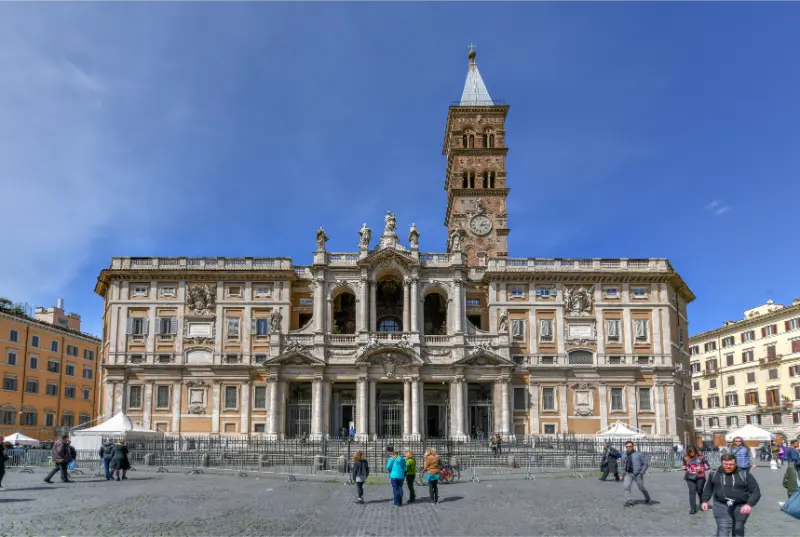
Santa Maria Maggiore is one of the most rewarding churches in Rome because it combines early Christian Rome, medieval mosaics, Renaissance chapels and Baroque interventions in a single building that still functions as a major place of worship. It is also unusually convenient: the basilica stands on the Esquiline, within walking distance of Termini, yet many first-time visitors rush past it on the way to the Colosseum or the historic center.
The best way to visit is not to treat it as a quick free stop. Give the nave and mosaics time, then decide whether you also want the museum complex and archaeological areas. If churches are a major part of your trip, combine this guide with our guide to the best churches in Rome so you can group nearby basilicas rather than crossing the city repeatedly.
Why Santa Maria Maggiore matters
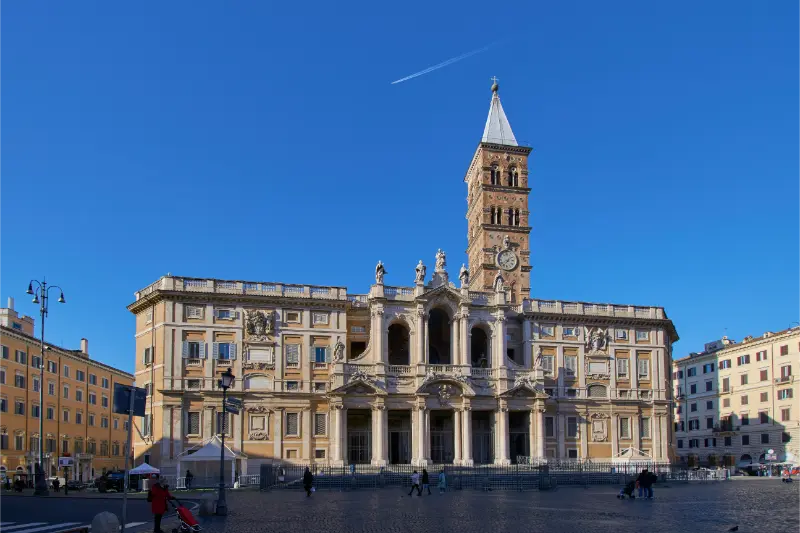
The present basilica preserves the essential form of the church built in the fifth century after the Council of Ephesus, when devotion to Mary acquired new prominence in Christian Rome. Later centuries changed the exterior, chapels, ceiling and apse, but the long nave still conveys the scale and clarity of an early basilica. That continuity is the reason Santa Maria Maggiore feels different from churches that were rebuilt almost entirely in the Baroque period.
Its artistic value is equally important. The mosaics along the nave and around the triumphal arch belong to the earliest surviving decorative programs in a major Roman church, while the apse mosaic by Jacopo Torriti represents a later medieval language. Looking at both in one visit makes the basilica a compact lesson in how sacred art changed over many centuries.
What to see inside the basilica
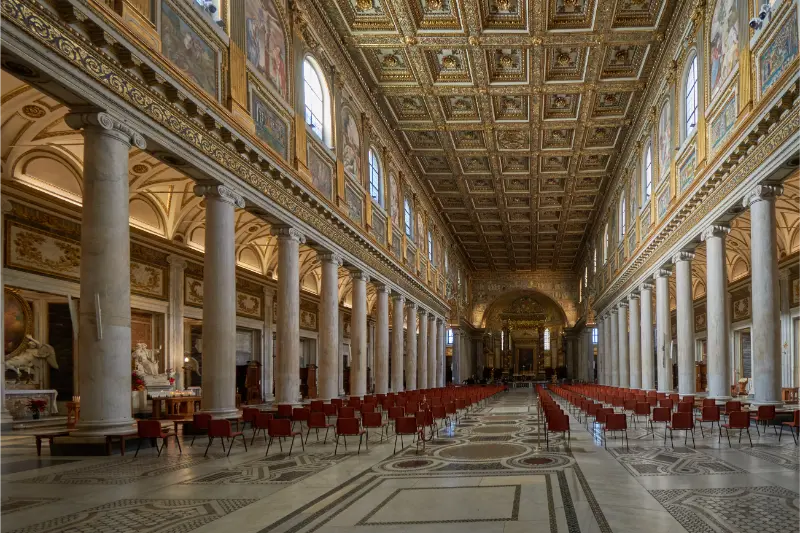
Begin by standing near the entrance and looking down the nave before approaching individual chapels. The rhythm of columns, the coffered ceiling and the bright apse create the overall composition; if you immediately move to details, it is easy to miss the architecture that ties the different periods together. Then look upward toward the fifth-century mosaic panels, which illustrate scenes from the Old Testament in a visual language very different from later Roman church decoration.
At the far end, the apse is one of the visual highlights. The medieval mosaic of the Coronation of the Virgin glows most clearly when the light is favorable, but even on a darker day the gold background and large figures are easy to read. Binoculars are unnecessary for most visitors, though a phone zoom can help you examine details after you have appreciated the work at normal distance.
The Sistine and Pauline chapels
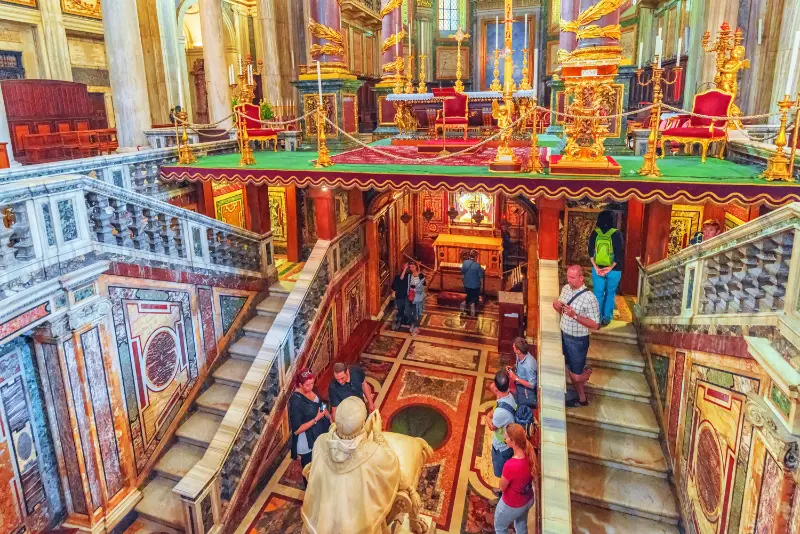
The two monumental side chapels create a dramatic change of scale and style. The Sistine Chapel of Santa Maria Maggiore — not to be confused with the Sistine Chapel in the Vatican Museums — was commissioned by Pope Sixtus V. Across the nave, the Pauline Chapel is associated with the revered icon known as Salus Populi Romani. These spaces are active devotional areas, so tourist movement can be limited during prayer or services.
Rather than trying to photograph every surface, choose a few elements to study: the colored marble, tomb monuments, painted decoration and the way the chapels project papal identity. They make more sense when viewed as complete architectural settings rather than as isolated artworks.
Bernini and the basilica
Gian Lorenzo Bernini is buried in Santa Maria Maggiore, making the church a useful addition to a trip focused on the Baroque master. His family tomb is comparatively modest, which surprises visitors who have just seen the theatrical scale of his work elsewhere. If this interests you, continue with our Bernini in Rome route to connect the basilica with Piazza Navona, St. Peter’s Square and other major sites.
The museum complex and extra areas
The basilica itself has free entry, while additional spaces in the museum complex require a ticket. The official basilica information lists the museum complex as open Monday to Saturday from 8:00 to 18:30, with last admission at 18:00, and Sunday from 12:30 to 17:00. Because hours and access can change for liturgical reasons, check the official Santa Maria Maggiore visitor information before planning a paid visit.
The additional circuit can include areas such as the Loggia of Blessings, museum collections and archaeological spaces depending on the ticket and current access. It is worthwhile for travelers who enjoy church history, architecture or less crowded museum experiences. If your schedule is tight, however, a thoughtful visit to the basilica itself is more valuable than racing through every paid section.
How much time to allow
| Visit style | Suggested time |
|---|---|
| Quick basilica visit | 30–40 minutes |
| Basilica at a relaxed pace | 60 minutes |
| Basilica plus museum complex | 90 minutes or more |
| Art-focused visit | Up to 2 hours |
These are planning ranges rather than strict limits. Security checks, Mass and special events can affect movement. A good rule is to avoid placing a timed museum reservation immediately after the basilica; churches are less predictable than ticketed attractions because worship always takes priority.
Dress code and behavior
Santa Maria Maggiore is a papal basilica, not simply a museum with free admission. Wear clothing suitable for a church, keep voices low and do not block chapels where people are praying. Photography rules can vary by area, and flash or tripods may be restricted. If staff close a section temporarily, assume there is a liturgical or operational reason rather than trying to bypass the barrier.
How to get there
The basilica is close to Roma Termini and can be reached on foot from the station in roughly ten minutes, depending on your exit. This makes it easy to visit on arrival day, departure day or as part of an Esquiline and Monti route. Our Rome train stations guide is useful if you are staying near Termini or connecting from another Italian city.
From the historic center, buses and walking can both work. If you are already at the Colosseum or in Monti, walking is often simpler than descending into the metro for such a short urban transfer. The streets rise gently toward the Esquiline, so allow extra time in summer heat.
What to combine with Santa Maria Maggiore
- Santa Prassede, a smaller church famous for early medieval mosaics
- Monti for lunch, cafés and neighborhood streets
- Domus Aurea or the Colosseum area for ancient Rome
- Baths of Diocletian and Palazzo Massimo near Termini
- San Giovanni in Laterano by a straightforward metro or bus connection
A particularly strong half-day is Santa Maria Maggiore, Santa Prassede and the Baths of Diocletian or Palazzo Massimo. This gives you early Christian art, medieval mosaics and ancient Roman material without spending the day in long outdoor queues.
When to visit
Early morning is usually the calmest period if you want to appreciate the nave before larger groups arrive. Late afternoon can be beautiful as well, but services may affect some spaces. Sundays and major feast days require more flexibility. The annual August celebration associated with the tradition of the miraculous snowfall is culturally important but naturally attracts more visitors.
Common mistakes to avoid
- Confusing the basilica’s Sistine Chapel with the Vatican one
- Assuming every part of the complex is free
- Visiting during a service and expecting unrestricted sightseeing
- Skipping the ancient mosaics because the Baroque chapels look more dramatic
- Trying to combine too many distant churches in one day
Frequently asked questions
Is Santa Maria Maggiore free to enter?
The main basilica has free entry. Additional museum and archaeological areas have separate ticketing and schedules.
Is it worth visiting on a first trip to Rome?
Yes, especially if you have three or more days. It offers a different historical layer from the Colosseum, Vatican and Baroque center and is easy to fit around Termini or Monti.
Can I visit before taking a train from Termini?
Yes if you have enough buffer for security, luggage storage and the walk back to the station. Do not leave it to the final half-hour before departure.
Final advice
Santa Maria Maggiore rewards travelers who slow down. Start with the architecture, study the mosaics, enter the major chapels respectfully and add the museum complex only if it matches your interests. Because the basilica sits between Termini, Monti and several other important churches, it is one of the easiest major monuments to integrate into a Rome itinerary without wasting travel time.
A useful Esquiline walking sequence
If you want to turn the basilica into a neighborhood experience, begin at Piazza della Repubblica or Termini, visit Santa Maria degli Angeli or Palazzo Massimo, then walk to Santa Maria Maggiore and continue a few minutes to Santa Prassede. From there, descend into Monti for lunch. The route works because each stop adds a different historical layer without repeated transport: imperial baths, ancient sculpture, early Christian basilica, medieval mosaics and a living neighborhood. Keep the sequence flexible around church services and museum opening days.
One last planning tip
For Santa Maria Maggiore Rome, keep the day geographically simple and verify only the details that can change: opening hours, tickets, temporary closures and transport. Protect enough time to look rather than simply move between pins. A focused visit with one nearby companion sight will usually feel richer than adding two extra attractions across Rome.