
Obelisks of Rome: Egyptian Monuments, History and a Self-Guided Route
Rome has more standing ancient obelisks than any other city, and they form one of the most unusual layers of the urban landscape. Some were carved in pharaonic Egypt and transported to imperial Rome, while others were made in Roman times in an Egyptianizing style. Centuries later, popes raised them again in piazzas and in front of major basilicas, turning ancient imperial trophies into markers of Christian and papal Rome.
This is a perfect theme for travelers who enjoy reading the city vertically. You can see major obelisks while visiting places already on a first itinerary, including Piazza del Popolo, the Pantheon area, Piazza Navona, St Peter’s Square and the Lateran. For broader context, combine the route with our Ancient Rome guide and Rome for architecture lovers.
| Obelisk | Where to see it | Why it matters | Easy pairing |
|---|---|---|---|
| Flaminio | Piazza del Popolo | Ancient Egyptian obelisk brought to Rome by Augustus | Pincian Hill and Via del Corso |
| Lateran | Piazza San Giovanni in Laterano | Tallest standing ancient Egyptian obelisk | Lateran Basilica |
| Agonale | Piazza Navona | Roman-period Egyptianizing obelisk on Bernini’s fountain | Pantheon area |
| Macuteo | Piazza della Rotonda | Small Egyptian obelisk in front of the Pantheon | Pantheon and Santa Maria sopra Minerva |
| Vatican | St Peter’s Square | Ancient obelisk with long Roman and papal history | St Peter’s Basilica |
Why there are so many obelisks in Rome
The official Rome tourism portal notes that Egyptian obelisks began arriving in Rome after Egypt came under Roman control. Emperors used them as symbols of conquest, solar imagery and imperial power. Some stood in circuses, sanctuaries or monumental complexes. See the official Rome obelisk overview for the city’s own historical introduction.
Their later history is just as important. Many fell, broke or disappeared under later building levels. Renaissance and Baroque popes recovered and re-erected them, often adding crosses, coats of arms and new inscriptions. The result is not a simple Egyptian collection but a visible conversation between pharaonic Egypt, imperial Rome and papal urban planning.
Flaminio Obelisk in Piazza del Popolo
The Flaminio Obelisk is one of the best places to start because Piazza del Popolo gives it space. Carved in Egypt and later brought to Rome by Augustus, it once stood in the Circus Maximus before being rediscovered and erected in the square in the late sixteenth century.
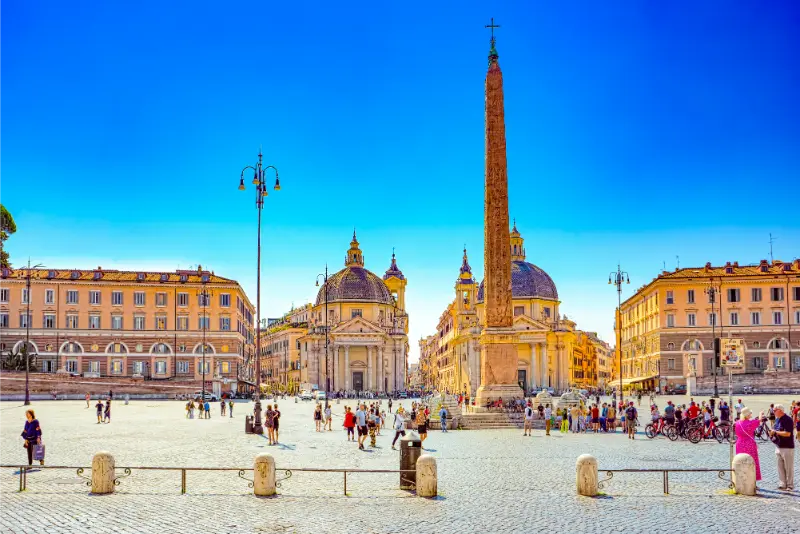
Look at it from several distances. Up close you can read the carved surfaces; from farther back you understand how the obelisk organizes the entire piazza and the long perspective of Via del Corso. Our Piazza del Popolo guide helps you combine it with the churches and the Pincian Terrace.
Begin your obelisk walk early in Piazza del Popolo, when the open space makes it easier to stand back and see the monument as part of the whole square. From a distance, the shaft organizes the perspective toward Via del Corso; close up, its carved surfaces invite a slower look. The surrounding churches and the Pincian terrace make this more than a quick photograph. If you are arriving by metro, emerge into the square and take a moment to orient yourself before choosing your route through the center. It is a good place to explain why ancient Egyptian monuments became important symbols in later Rome.
The Lateran Obelisk: the giant of Rome
The Lateran Obelisk is the tallest standing ancient Egyptian obelisk in the world. It was created in the age of Thutmose III and Thutmose IV, transported to Rome in late antiquity and eventually raised beside the Lateran complex. Its size is difficult to appreciate in photographs because the surrounding piazza and basilica are themselves monumental.
Give it a separate look before entering the basilica. The red granite, hieroglyphs and enormous base are easier to read when you are not rushing directly toward church security. Pair it with our San Giovanni neighborhood guide.
The Vatican Obelisk and St Peter’s Square
The Vatican Obelisk stands at the center of one of the world’s most famous ceremonial spaces. Unlike many ancient obelisks in Rome, it remained standing through the Middle Ages before Sixtus V ordered its relocation to the center of the new spatial plan that would later be framed by Bernini’s colonnades.

The monument works best as part of the geometry of the square. Stand near the outer colonnade and notice how the obelisk, fountains and basilica create a strong central axis. If this is part of a Vatican day, use our St Peter’s Basilica guide to plan the rest.
The Vatican Obelisk can be appreciated without entering the basilica or museums, which makes it useful even on a short visit. Rather than walking directly up to its base, first view it from the edge of St. Peter’s Square. Its position becomes more meaningful when the fountains, colonnade and long approach form a single composition. Remember that the square can be affected by security arrangements, religious ceremonies and large crowds. A photograph taken from the open perimeter often says more about its role in the space than a tight close-up, and the visit fits naturally into a walk through Prati.
Agonale Obelisk in Piazza Navona
The obelisk above Bernini’s Fountain of the Four Rivers is Roman in date but carved in an Egyptianizing language. That distinction matters because not every obelisk in Rome was transported from pharaonic Egypt. The Piazza Navona example shows how Roman rulers adopted Egyptian visual culture for their own political and religious messages.
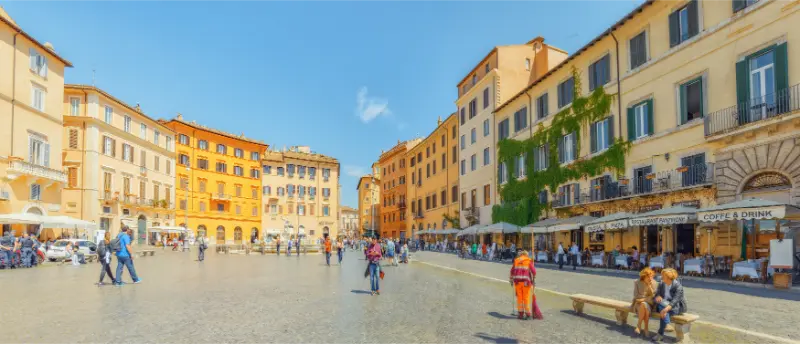
The seventeenth-century setting adds another layer. Bernini turned the ancient-looking shaft into the vertical climax of an extraordinary fountain composition. Read our Piazza Navona guide before visiting so you can see the square as the former Stadium of Domitian as well as a Baroque stage.
In Piazza Navona, the obelisk is not a standalone monument. It rises above Bernini’s Fountain of the Four Rivers, so the sculptural group and water are essential to the experience. Walk around the fountain and notice how the figures, animals and rock forms change as you move. Unlike the great Egyptian shafts brought to Rome in antiquity, this obelisk has a Roman history and is best understood as part of the city’s adoption of Egyptian visual language. It is worth giving this stop more time than its size on the map suggests, especially if you enjoy Baroque art.
Macuteo Obelisk at the Pantheon
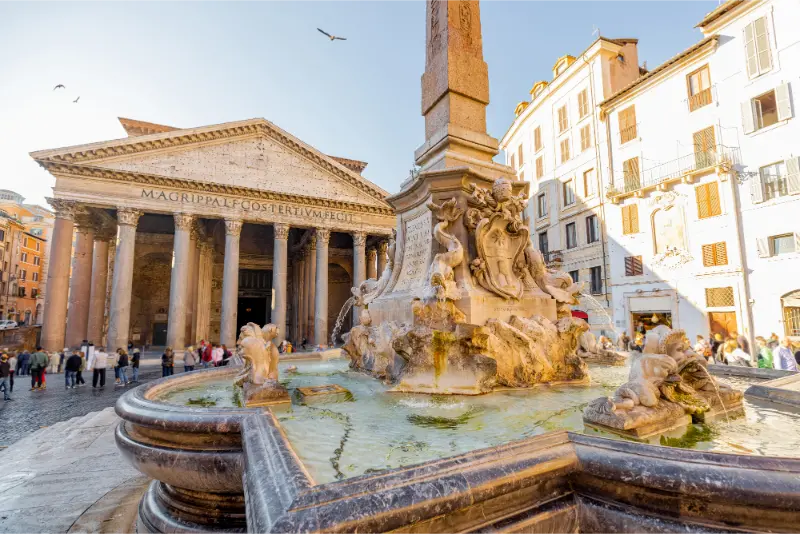
The small obelisk in Piazza della Rotonda is easy to overlook because the Pantheon dominates the square. Its scale is actually useful: it lets you see how even a modest ancient Egyptian monument could be integrated into a later fountain and urban setting.
Step to the side rather than photographing it only from the fountain edge. From several positions you can frame the obelisk against the Pantheon portico and understand how different centuries overlap in one small space. Continue with our Pantheon visiting guide.
Minerva Obelisk and Bernini’s elephant
Behind the Pantheon, the small obelisk in Piazza della Minerva sits on the famous elephant designed by Bernini’s workshop. The combination is playful, scholarly and unmistakably Baroque. It demonstrates how seventeenth-century Rome did not simply preserve ancient objects; it actively reinterpreted them.
Walk around the sculpture because the relationship between the elephant, saddle-like drapery, obelisk and church façade changes from each side. The compact square can be busy with deliveries and groups, so an early visit gives you the clearest view.
Other obelisks worth noticing
Rome’s obelisk network continues at Montecitorio, Santa Maria Maggiore, the Quirinal, the Pincio and other locations. The Montecitorio obelisk is connected to Augustus and the ancient Campus Martius; the Pincian obelisk is associated with Hadrian and Antinous; the Quirinal obelisk forms part of a monumental composition with the Dioscuri.
Do not try to see every obelisk in one marathon. A better strategy is to notice them across several days. Each one becomes a marker that helps you read a different neighborhood and period of Roman history.
How to tell Egyptian and Roman-made obelisks apart
A traveler does not need to become an Egyptologist, but it helps to know that origin, inscriptions and date vary. Some shafts are ancient Egyptian monuments with pharaonic hieroglyphs; others were made under Roman emperors using an Egyptianizing visual language. Modern restorations and papal additions further complicate what you see.
Use the plaque or official site for each monument rather than assuming every hieroglyph is pharaonic. The most interesting question is often not “is it Egyptian?” but “why was this object moved here, and what message did the new setting create?”
A practical self-guided obelisk route
For a walkable central route, start at Piazza del Popolo, follow Via del Corso toward Montecitorio, continue to the Pantheon and Piazza della Minerva, then reach Piazza Navona. This gives you several major obelisks without turning the day into a transport exercise. Add the Vatican and Lateran on separate days because each belongs naturally with a larger sightseeing cluster.
Morning and late afternoon light make inscriptions and relief more readable than flat midday sun. Bring a zoom lens or use your phone camera to inspect high details, but also step back. Obelisks were designed to dominate space, so distance is essential to understanding them.
Trying to see every obelisk in a single day turns an enjoyable theme into a long, uneven walk. For a first route, group Piazza del Popolo, the Pantheon and Piazza Navona in the historic center, then decide whether to add the Vatican or Lateran according to your hotel and other plans. Keep religious sites and museum visits as separate optional blocks, because their opening arrangements can change. Good walking shoes matter more than the nominal distances; central Rome contains uneven paving and frequent detours around busy squares. With limited time, choose a few monuments you can study rather than rushing past every one on a checklist.
Reading inscriptions, bases and papal symbols
The stone shaft is only one part of an obelisk monument in Rome. Bases often carry Latin inscriptions describing who re-erected the monument and why, while crosses, stars, doves or heraldic emblems reveal the patron who transformed the ancient object for a new political and religious context. Spend a minute on the lower part before looking up.
You do not need to translate every inscription. Identify dates, papal names and recurring words, then compare the monument with another obelisk later in the day. Patterns begin to emerge: ancient authority is repeatedly claimed, reframed and connected to new urban projects.
This is also why the obelisks work so well as a self-guided theme. They are free, outdoors and distributed across Rome, but they reward exactly the same historical skill as a museum: asking when an object was made, when it moved, who displayed it and what the new setting was meant to communicate.
Common mistakes to avoid
- Assuming every Roman obelisk was carved in pharaonic Egypt.
- Looking only at the shaft and ignoring the later base, fountain or square.
- Trying to visit every obelisk in one day.
- Skipping the Lateran obelisk because it is outside the tight historic center.
- Photographing only from directly below and losing the urban context.
- Treating the monuments as decoration rather than objects repeatedly reused for political meaning.
Frequently asked questions
How many obelisks are there in Rome?
Rome has the world’s largest concentration of standing ancient obelisks, including both ancient Egyptian examples and Roman-made Egyptianizing monuments.
Which is the tallest ancient Egyptian obelisk in Rome?
The Lateran Obelisk is the tallest standing ancient Egyptian obelisk.
Can I see several obelisks on foot?
Yes. Piazza del Popolo, Montecitorio, the Pantheon area and Piazza Navona form an excellent central walking sequence.
Are the obelisks free to see?
Yes. The outdoor obelisks in public squares can be viewed freely; nearby museums or monuments may require tickets.
Final advice
Once you start noticing obelisks, Rome’s map changes. Use them as vertical landmarks and historical clues, and you will see how emperors and popes repeatedly reorganized the city around powerful objects from the past.