St Paul Outside the Walls: Basilica, Cloister and Visiting Guide
St Paul Outside the Walls is one of Rome’s four major papal basilicas and one of the easiest great churches to underestimate. Because it lies south of the historic center, many first-time visitors skip it. Those who make the short metro journey find an enormous, luminous basilica with a monumental nave, a celebrated medieval cloister, a long sequence of papal portraits and a tradition centered on the burial place of the Apostle Paul.

If churches are a major part of your trip, combine this article with our best churches in Rome guide. St Paul offers a different experience from St Peter’s: it is generally calmer, more spacious and easier to appreciate architecturally without the same level of crowd pressure.
Why the basilica is outside the historic center
The basilica stands along the ancient Via Ostiense, outside the old Aurelian Walls, because Christian tradition placed Paul’s burial here. A major Constantinian church was established in the fourth century and later enlarged. The building that visitors see today, however, is largely the result of reconstruction after a devastating fire in 1823 destroyed much of the ancient basilica.
The reconstruction aimed to recover the scale and form of the earlier church, using precious materials and contributions from across the Catholic world. As a result, the interior feels ancient in concept but nineteenth-century in much of its fabric. Knowing this history prevents the common mistake of assuming everything visible survived from antiquity.
What to see inside
The nave
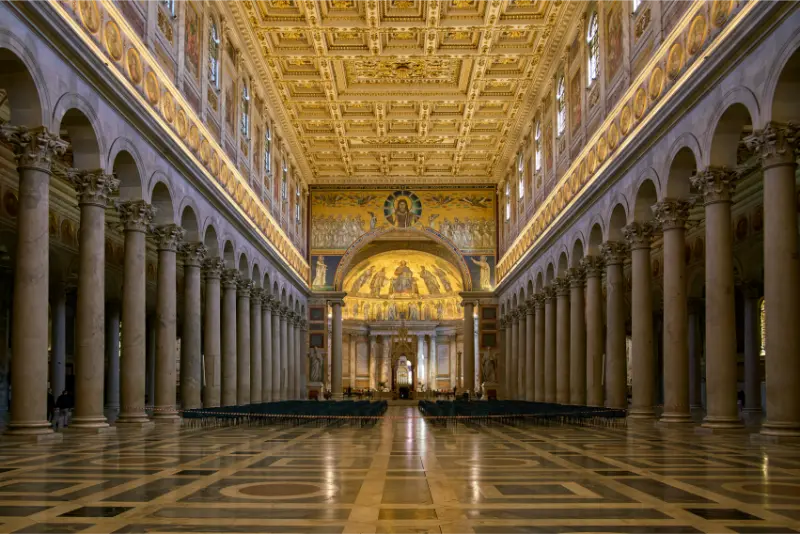
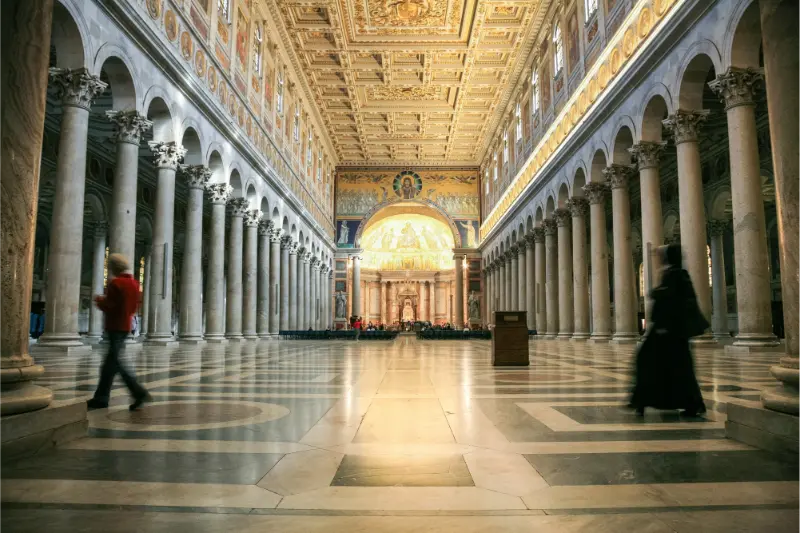
The long nave is the immediate visual shock: rows of columns lead toward the triumphal arch and apse, creating one of Rome’s grandest basilican perspectives. Walk partway down the central aisle, then turn around. The reverse view toward the entrance helps you understand the scale even better.
The papal portraits
A famous sequence of circular portraits represents the popes from St Peter onward. The series is one of the details visitors remember most because it visually turns the walls into a timeline. Do not worry about studying every portrait; use the sequence to understand the basilica’s connection with continuity and papal history.
The apse mosaic
The apse mosaic, restored after the fire but preserving medieval elements, is one of the artistic highlights. Gold dominates the composition, creating a distant visual focus that balances the long nave. Stand well back first, then approach slowly so the relationship between architecture and image remains clear.
The tomb of St Paul
The area beneath the papal altar is associated with the burial of St Paul. Archaeological investigations in the modern period confirmed the presence of an ancient sarcophagus in the traditional location. For believers this is the spiritual center of the basilica; for other visitors it remains a historically significant element of early Christianity in Rome.
The medieval cloister
Do not leave without considering the cloister. Its twisted columns, colored stone inlays and Cosmatesque decoration create a completely different scale from the vast nave. The cloister survived the nineteenth-century fire better than much of the basilica and is one of the most beautiful medieval spaces in Rome.
Opening hours and cloister ticket
The official basilica timetable lists the basilica as open every day, with free entry. The official site currently lists the cloister as open daily from 8:00 to 18:00, with last entry at 17:30, and an admission charge of €4 for the full ticket. Liturgies can affect access, so verify the timetable before traveling across the city.
Opening times published on different official pages can occasionally differ slightly after seasonal or operational updates. Use the basilica’s own website as the final reference on the day of your visit, especially around Easter, Christmas and major church celebrations.
How long to spend
| Visit style | Suggested time |
|---|---|
| Basilica only | 45–60 minutes |
| Basilica + cloister | 75–90 minutes |
| Slow art and history visit | About 2 hours |
| Ostiense + basilica itinerary | Half day |
The interior is so large that a rushed fifteen-minute visit feels unsatisfying. Allow time to walk the nave, pause at the apse and inspect the transept before entering the cloister. If you come during a service, add buffer rather than trying to sightsee around worship.
How to get there
Metro Line B is the simplest option for most travelers. The Basilica San Paolo station is a short walk from the church. This makes the basilica surprisingly easy to reach from Termini, the Colosseum or Piramide. You do not need a taxi simply because the church lies outside the historic center.
If you are exploring the wider district, continue with our Ostiense guide. Combining the basilica with Centrale Montemartini and street art creates a varied half-day that mixes sacred architecture, industrial history and contemporary urban culture.
Dress code and security
As a major papal basilica, St Paul expects appropriate clothing and respectful behavior. Shoulders and knees should be covered reasonably, hats removed where appropriate and voices kept low. Security screening may operate at the entrance. Large luggage is inconvenient and may be restricted, so visit before or after checking bags at your hotel or station.
Best time to visit
Weekday mornings are usually excellent for a quiet visit. Late afternoon can also work, but check the service schedule. The basilica’s interior is spacious enough that it rarely feels as compressed as St Peter’s, yet major liturgical dates can still draw large congregations.
What to combine nearby
- Centrale Montemartini
- Ostiense street art
- Garbatella
- Pyramid of Cestius and Protestant Cemetery area
- Eataly Roma for food shopping or a break
- Basilica of the Three Fountains if you have additional time
Common mistakes
- Skipping the cloister because the basilica is free
- Assuming the entire building survived unchanged from antiquity
- Taking a taxi when Metro B is simpler
- Arriving during a major service expecting unrestricted sightseeing
- Ignoring the surrounding Ostiense district
- Rushing the nave without turning back to appreciate its scale
Is it worth the detour?
Absolutely if you enjoy churches, mosaics, medieval art or quieter monuments. Even for a short Rome trip, the basilica can be reached efficiently by metro and provides a welcome change from the dense center. It also helps complete the story of Rome’s great papal basilicas beyond St Peter’s and Santa Maria Maggiore.
FAQ
Is St Paul Outside the Walls free?
Entry to the main basilica is free. The cloister has a separate admission charge.
How far is it from the Colosseum?
It is several kilometers south, but Metro Line B makes the journey straightforward. The travel time is usually much shorter than the distance suggests.
Can I visit with children?
Yes. The large open interior is visually impressive, but explain the need for quiet behavior because the basilica is an active place of worship.
How to make the visit more rewarding
Do not try to absorb every date or label. Choose three anchors before you enter: the building itself, one artistic or historical feature, and the relationship with the surrounding neighborhood. This keeps the experience coherent and gives you something to remember beyond photographs. Rome can overwhelm visitors with layers of information; a selective approach usually produces better understanding than reading every panel while worrying about the next reservation.
Planning around crowds
Crowds in Rome are uneven rather than constant. Large tour groups often arrive in waves, while smaller sites may become almost empty between them. If a room or viewpoint is packed, move to another section and return later when possible. Carrying a flexible sequence is more useful than chasing a theoretical “perfect” minute. In warm months, also consider how sun exposure affects outdoor sections and save covered areas for the hottest part of the visit.
A note on changing information
Opening hours, ticket rules, restoration closures and access routes can change with little notice, especially at active churches, archaeological sites and state monuments. Treat the official website as the final source for operational details and check it shortly before leaving your accommodation. This is more reliable than saving an old screenshot months before the trip. If a small area is closed, do not assume the whole visit has lost its value; Rome’s major sites usually contain far more than one headline feature.
How to fit this stop into a Rome day
The easiest way to protect the quality of a visit is to group sights geographically. Put one major timed attraction at the center of the day, then use nearby churches, viewpoints, parks or streets as flexible additions. This avoids spending the best hours crossing the city and gives you room to respond to queues, weather or temporary closures. Leave at least thirty minutes between the end of this visit and any reservation in another district; central Rome looks compact on a map, but security exits, pedestrian diversions and crowded streets can consume that buffer quickly.
What to notice beyond the headline feature
Many visitors arrive knowing the single image that made a place famous and leave as soon as they have seen it. A better method is to look for three quieter details: how people move through the architecture, which materials change from one period to another, and what you can see of the surrounding city from the site. Those observations turn a famous attraction into part of Rome rather than an isolated object. They also make the visit more memorable because you leave with a spatial story, not only the same photograph that appears on thousands of travel pages.