

Jewish Ghetto Rome: What to See, Eat and Understand
Rome’s Jewish Ghetto is small on the map but extraordinarily dense in history. Within a few streets you encounter ancient Roman ruins, the Great Synagogue, memorial plaques, Renaissance buildings, Roman-Jewish restaurants and the physical memory of a community that has lived in Rome for more than two thousand years.
A visit should balance food and atmosphere with historical understanding. It is easy to come only for fried artichokes and the picturesque lanes, but the district also carries the memory of forced segregation, persecution and the Nazi deportation of Roman Jews. This guide helps you approach the neighborhood with enough context to make the experience meaningful.
Where is the Jewish Ghetto?
The historic Jewish quarter lies between the Theater of Marcellus, the Tiber and the streets leading toward Largo di Torre Argentina. It is an easy walk from the Pantheon, Campo de’ Fiori or the Capitoline Hill. The area is compact enough for a half-day visit and works especially well as part of a central walking route.
A brief history
Rome’s Jewish community is one of the oldest in the Western world. In 1555, Pope Paul IV established a compulsory ghetto that confined Jews to a restricted area near the Tiber under harsh conditions. The ghetto system lasted for centuries, with periods of change and renewed restrictions, until the nineteenth century.
The twentieth century brought another catastrophe. On 16 October 1943, during the Nazi occupation, more than a thousand Jews were arrested in Rome and deported; very few returned. Plaques and pietre d’inciampo—stumbling stones embedded in the pavement—help connect individual names and homes to that history.
Great Synagogue and Jewish Museum of Rome
The monumental Great Synagogue, completed in the early twentieth century, is one of the neighborhood’s defining landmarks. The Jewish Museum of Rome provides the historical and religious context that the streets alone cannot fully explain, including ritual objects, community history and the relationship between Roman Jews and the city.
The museum’s schedule changes by season and follows the Jewish calendar. In summer 2026, for example, the official museum information lists opening Sunday–Thursday from 10:00 to 18:00 and Friday from 10:00 to 16:00, with earlier last admission. The museum is closed on Saturdays and Jewish holidays. Always check the official Jewish Museum information page before planning your day.
Portico d’Ottavia
The Portico d’Ottavia is one of the most visible ancient landmarks in the district. Originally part of a major Roman complex, the ruins later became embedded in medieval and modern neighborhood life. Nearby, the Theater of Marcellus creates one of Rome’s most striking juxtapositions of ancient stone and later residential architecture.
This is a good place to understand how the Jewish quarter is not a preserved historical set. Ancient, medieval, papal and modern layers occupy the same few blocks.
Roman-Jewish food
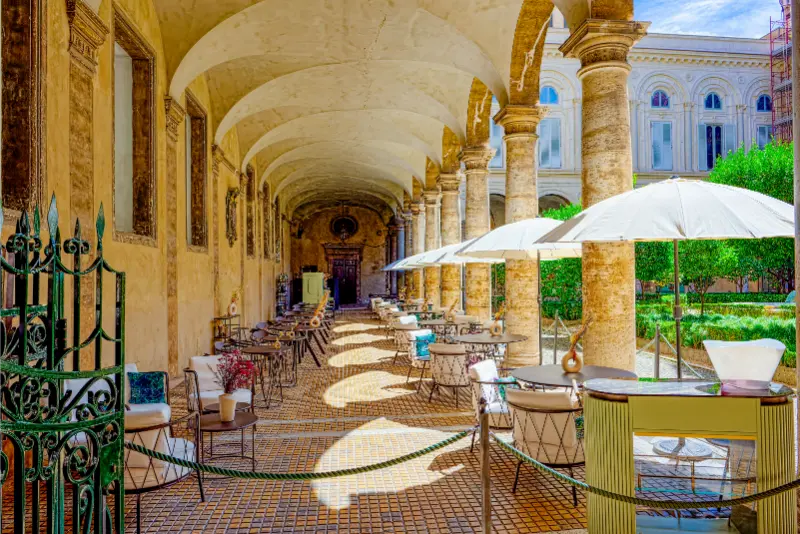
The neighborhood is famous for carciofi alla giudia, artichokes opened and fried until crisp, as well as dishes shaped by Roman ingredients and Jewish dietary traditions. Other specialties may include fried vegetables and fish, baked goods and recipes that connect the community’s history with the broader cuisine of Lazio.
Food is an important entry point, but avoid reducing the area to a single famous dish. Check whether a restaurant is kosher if that matters to you, since not every place in the neighborhood follows kosher rules. Our broader Roman food guide explains how Jewish-Roman dishes fit into the city’s cuisine.
Piazza Mattei and the Turtle Fountain
A short walk from the core ghetto streets brings you to Piazza Mattei and the charming Fontana delle Tartarughe. The square is smaller and more intimate than Rome’s famous monumental piazzas, making it an excellent pause between historical stops.
Best route through the Jewish Ghetto
- Start at the Theater of Marcellus and Portico d’Ottavia.
- Walk toward the Great Synagogue and riverfront.
- Visit the Jewish Museum if its schedule fits your day.
- Explore the lanes around Via del Portico d’Ottavia and look for memorial stones and plaques.
- Continue to Piazza Mattei and the Turtle Fountain.
- Finish toward Largo di Torre Argentina, Campo de’ Fiori or the Pantheon.
How much time do you need?
Without the museum, 60–90 minutes is enough for a thoughtful walk. With the museum, synagogue visit and lunch, allow three to four hours. The neighborhood is small, so extra time should be spent understanding what you are seeing rather than simply covering more distance.
Best time to visit
Morning and lunchtime are ideal if food and the museum are priorities. Friday hours are shorter, Saturday is not the day to plan a museum visit, and Jewish holidays affect access. Evening can be atmospheric for dinner, but you will miss much of the institutional and historical context if you arrive only after dark.
Respectful visiting
The Great Synagogue is an active place of worship, and the neighborhood is home to a living community. Dress and behave respectfully, follow security instructions and do not treat memorials as decorative photo props. If a service or religious event is taking place, visitor access may be limited.
What to see nearby
- Capitoline Hill: reach the Capitoline Museums by walking past the Theater of Marcellus.
- Campo de’ Fiori: continue to Campo de’ Fiori for market and nightlife atmosphere.
- Pantheon: about a fifteen-minute walk through the historic center; see our Pantheon guide.
- Trastevere: cross the river for a longer evening continuation.
Jewish Ghetto with children
The area is compact and relatively easy to explore with children, but the historical subject matter requires age-appropriate explanation. Older children may connect strongly with individual stories represented by plaques and stumbling stones. Younger children may prefer a shorter route combined with the fountains and open spaces nearby.
Common mistakes to avoid
- Planning the Jewish Museum on Saturday or without checking Jewish holiday closures.
- Visiting only for food and missing the synagogue, museum and memorial history.
- Assuming every restaurant in the area is kosher.
- Photographing security points or worshippers without sensitivity.
- Rushing through in twenty minutes because the neighborhood looks small on a map.
Final tip
Walk slowly enough to look down as well as up. In this part of Rome, a small brass memorial stone in the pavement can carry as much historical weight as an ancient monument. The Jewish Ghetto is most rewarding when you allow archaeology, everyday life, food and memory to exist together rather than choosing only one version of the neighborhood.
Reading the neighborhood through memorials
Small memorial markers can be easy to overlook, especially when restaurants and archaeological ruins compete for attention. When you encounter a stumbling stone, read the name and dates rather than treating it as decoration. These markers connect large historical events to individual homes and families and are among the most powerful details in the district.
Security around the synagogue
Visitors should expect visible security near the Great Synagogue and Jewish Museum. Follow instructions calmly, keep identification available if requested and avoid photographing security arrangements. Measures can change according to circumstances, so allow extra time rather than arriving just before the last admission.
Food: carciofi alla giudia and beyond
Fried artichokes are the signature dish most travelers know, but seasonality affects quality because Roman artichokes are not equally available year-round. Roman-Jewish cuisine also includes fried fish and vegetables, baked specialties and dishes shaped by centuries of adaptation to local ingredients and religious rules. Ask what is seasonal instead of ordering from a checklist.
Connecting the Ghetto with Ancient Rome
The Theater of Marcellus, Portico d’Ottavia and Capitoline slope make this area ideal for travelers interested in how the ancient city survived inside later neighborhoods. Rather than separating ‘Ancient Rome day’ from ‘Jewish Ghetto day’ too rigidly, a walking route can show how these histories physically overlap.
A note on terminology
The term ‘Jewish Ghetto’ is widely used for the historic district, but remember that the compulsory ghetto was a system of segregation imposed on a living community, not a romantic neighborhood label. Today the area is open, active and culturally significant. Using the history accurately is part of visiting respectfully.
When to plan lunch
The neighborhood is one of the places where timing a meal can shape the whole visit. If you want a Roman-Jewish lunch, arrive after a morning museum or before continuing toward the Capitoline Hill. On Fridays and around Jewish holidays, opening patterns may differ, and individual kosher businesses follow their own schedules. Check the restaurant itself rather than assuming that the entire district keeps standard tourist hours.
The Tiber and Tiber Island
The river is only steps away. After visiting the synagogue area, walk toward Ponte Fabricio and Tiber Island for a change of perspective. From there you can continue into Trastevere or return toward the historic center. This small detour adds open space after the dense lanes and helps you understand why the old ghetto’s low-lying riverside position historically exposed residents to difficult living conditions, including flooding.
Why this neighborhood deserves more than a food stop
The Jewish quarter is one of the best places in Rome to see how memory survives inside ordinary urban life. A bakery, ancient ruin, synagogue, memorial plaque and apartment entrance can sit within a few meters of one another. Taking time to read that layering is more valuable than collecting another photograph. Even travelers with little background in Jewish history can leave with a clearer understanding of Rome as a city shaped by many communities, not only emperors and popes.


2 Comments
Comments are closed.