San Crisogono Rome: Ancient Basilica, Underground Church and Trastevere Guide
San Crisogono is one of the easiest ancient churches to overlook in Trastevere and one of the most rewarding to enter. Standing close to the busy Viale di Trastevere, the basilica looks monumental from outside, yet its real interest comes from the way several Roman eras sit one above another: an early Christian foundation, a medieval rebuilding, a seventeenth-century Borghese transformation and archaeological remains below the present floor.
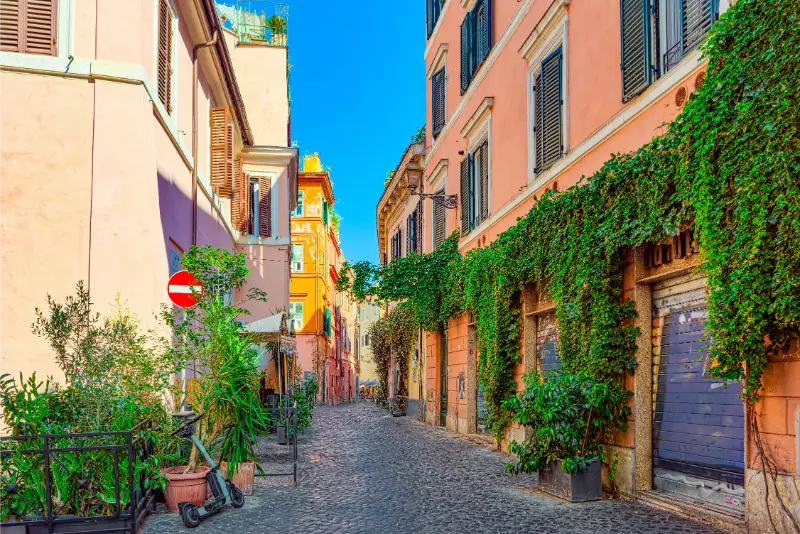
That layering makes San Crisogono especially useful for travelers who want to understand Rome beyond isolated masterpieces. You can read the city vertically here. The street outside belongs to modern Trastevere; the nave carries medieval and Baroque interventions; below, traces of the earlier church recall the Christian city that developed inside and around ancient Roman neighborhoods. It is also an efficient stop because it lies on a natural route between the Tiber, Santa Cecilia and Santa Maria in Trastevere.
| Planning point | Useful detail |
|---|---|
| Location | Piazza Sidney Sonnino, on the edge of Trastevere |
| Access | Active basilica. Opening for visitors can change around Masses and parish activities; verify shortly before a dedicated visit. |
| Cost | Main church access is normally free; any special access to archaeological areas can follow separate arrangements. |
| Suggested time | 45–70 minutes; add more time if the underground area is accessible |
| Best for | Early Christian Rome, medieval architecture, Trastevere walks and archaeology |
Why San Crisogono is worth visiting
San Crisogono works best when you treat it as part of Rome rather than as a box to tick. Its value comes from the way art, architecture, worship and the surrounding streets reinforce one another. Because it is less crowded than the city’s headline monuments, you can usually spend more time observing materials, inscriptions and spatial details instead of following a fixed tourist flow.
For travelers building a deeper itinerary, San Crisogono also provides useful contrast. Rome’s major basilicas show imperial scale and papal ceremony; smaller churches often reveal guilds, foreign communities, confraternities, neighborhood devotion and the practical history of local worship. That human scale is one reason these sites become memorable after the first trip.
History and context
The basilica is counted among Rome’s ancient titular churches and a church existed here by Late Antiquity. The current building reflects major later campaigns rather than a single construction phase, so the best way to understand it is to think in layers rather than search for one “original” appearance.
A substantial medieval rebuilding gave San Crisogono features that still define the site, including the Romanesque bell tower and the spatial logic of the basilica. Later, in the seventeenth century, Cardinal Scipione Borghese promoted another transformation. Giovanni Battista Soria’s work gave the church much of the monumental Baroque presentation visible today without erasing every earlier element.
Archaeological investigations in the early twentieth century brought renewed attention to the remains beneath the basilica. Those lower spaces are important because they help visitors connect the standing church with the earlier Christian complex and with the urban history of Trastevere before the district became the restaurant-and-nightlife quarter familiar to many modern travelers.
What to see
The portico and Borghese façade
Begin outside and look upward before crossing the threshold. The broad portico and emphatic upper façade belong to the seventeenth-century campaign associated with the Borghese family. Eagles and dragons connected with Borghese heraldry appear in the decorative program, turning the exterior into a statement of patronage as well as faith.
The contrast with the medieval bell tower is useful. Rome often preserves periods side by side rather than presenting a stylistically unified monument. Here a Romanesque vertical accent rises behind a later façade, immediately showing how successive patrons adapted an older sacred site instead of replacing its entire identity.
The nave, columns and Cosmatesque pavement
Inside, the basilican arrangement creates a long, calm perspective. Granite columns divide the nave from the aisles and lead the eye toward the sanctuary. Do not rush directly to the altar: the rhythm of the columns and the relationship between the floor, ceiling and side aisles are a major part of the experience.
The pavement includes Cosmatesque work, the geometric marble inlay associated with medieval Roman workshops. Seeing it in a functioning church makes it easier to understand why these floors matter. Their patterns are not just decoration; they organize movement, frame liturgical space and create a visual dialogue with reused ancient stone.
Medieval painting and the Cavallini tradition
San Crisogono is often linked with the artistic world of Pietro Cavallini, one of the most important painters active in medieval Rome. Even when attribution and survival are complex, the church belongs to the same cultural environment that makes nearby Santa Cecilia in Trastevere essential for anyone interested in the transition from medieval visual language toward greater naturalism.
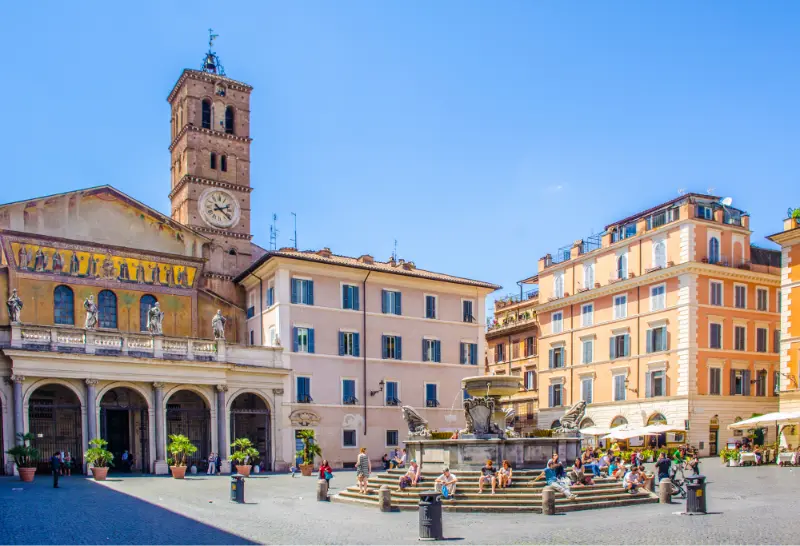
Use this connection to build a thematic walk rather than treating the basilica as an isolated stop. A visit to San Crisogono followed by Santa Cecilia creates a stronger understanding of medieval Trastevere than simply crossing the neighborhood from restaurant to restaurant.
The archaeological level
The lower remains are the feature that can transform a pleasant church visit into an archaeological one. They preserve evidence connected with the earlier basilica and with structures that predate the standing church. Access arrangements can change, so the underground area should be treated as a bonus to verify rather than something to assume will always be open.
If you do enter, look for changes in masonry, floor level and orientation rather than expecting a polished museum installation. The value lies in reading the physical sequence: an older sacred space survives because later builders constructed above and around it. That is one of the clearest recurring patterns in Rome.
How to plan your visit
San Crisogono works particularly well in the morning or early afternoon as part of a Trastevere walking day. Because it is an active parish, liturgies take priority over sightseeing. Check current access locally, dress for a church and keep voices low even when the building seems empty.
The nearest transport advantage is Viale di Trastevere, served by trams and buses, but walking is often simpler if you are already exploring the historic center. From the Tiber, the basilica is only a short detour. If the underground is closed, the upper church still justifies a stop for its architecture, floor and historical layering.
A useful way to visit San Crisogono is to separate the experience into three passes. First read the architecture from the entrance without stopping for details. On the second pass, choose two or three works that explain the site’s history. Finally, return toward the door and look back at the space from the opposite direction. This simple method prevents a richly decorated Roman church from becoming a blur of names and helps you remember the relationship between structure, decoration and neighborhood context.
Do not judge San Crisogono only by the number of famous artists attached to it. Smaller Roman churches are often valuable because scale allows you to understand relationships that disappear in larger basilicas. A chapel, memorial, floor pattern and altar may have been conceived as parts of one program. Spending ten extra minutes tracing those connections often produces more insight than adding another distant attraction to the same day.
Practical tips before you go
- Check current access shortly before visiting, especially because liturgies, maintenance and special events can change normal routines.
- Dress for an active place of worship: shoulders and knees should be covered, and hats should normally be removed inside.
- Use silent camera settings and avoid flash unless staff or posted rules explicitly allow it.
- Do not place an inflexible timed attraction immediately after the visit; allow a small buffer for unexpected closures or ceremonies.
- Read one or two key historical points before entering so the architecture and artworks have context rather than becoming a list of unfamiliar names.
If the doors are closed when you arrive, do not force the itinerary. San Crisogono sits in an area with other worthwhile sights, so use the nearby route below and return later if practical. This is often a better strategy in Rome than waiting outside an active church whose schedule has changed.
What to see nearby
San Crisogono combines naturally with Trastevere guide, Santa Maria in Trastevere, Santa Cecilia in Trastevere, Tiber Island. These nearby pages are already part of MyRomeTrip and can help readers turn one church visit into a coherent half-day rather than a disconnected detour.

Start at Tiber Island, cross into Trastevere, visit San Crisogono and continue south toward Santa Cecilia. Then loop back through quieter lanes to Santa Maria in Trastevere. This sequence moves logically from the river into the neighborhood while connecting ancient, medieval and modern Trastevere without unnecessary backtracking.
Who will enjoy this stop most?
San Crisogono is best for travelers interested in church architecture, archaeology and the layers of Rome. It is also a strong choice for repeat visitors who already know the headline monuments and want a site that rewards close observation without demanding a timed-ticket commitment. Families with older children can use the underground story as a simple way to explain how one city can literally be built above another.
First-time visitors with only a few hours in Rome do not need to replace the Colosseum, Pantheon or Vatican with San Crisogono. The better approach is to add it when geography already brings you nearby. Repeat visitors, art lovers and travelers who enjoy slower city exploration will usually get the greatest value from the stop.
Photography, accessibility and respectful visiting
The upper basilica is easier to approach than many archaeological sites, but thresholds, liturgical furnishings and any route to underground remains may create barriers. Travelers who require step-free access should confirm the current entrance and whether the archaeological level is suitable before making a special journey. Photography rules should be checked on site; avoid flash and never photograph worshippers without permission.
One more practical approach is to spend the first five minutes inside San Crisogono without taking photographs. Let your eyes adjust, identify the main axis and notice which details attract your attention naturally. Photograph afterward. This reduces screen time in a sacred space and usually results in better images because you understand the room before framing it.
Official information and changing access
For current access, services and special closures, consult the official or municipal information page: visitor information for San Crisogono. Hours published online can change, particularly around feast days, restoration campaigns and liturgical events, so readers should verify details close to the day of the visit.
FAQ
Is San Crisogono worth visiting?
Yes, especially if you are already in Trastevere. It combines a monumental basilica with medieval features and archaeological layers while remaining far less crowded than Rome’s most famous churches.
Can you visit the underground church?
Access can vary. Treat the archaeological level as something to confirm shortly before your visit rather than relying on an old timetable.
How long should I spend at San Crisogono?
About 45 minutes is enough for the upper church. Allow around an hour or more if underground access is available and you enjoy archaeology.
What should I combine it with?
Santa Cecilia in Trastevere, Santa Maria in Trastevere and Tiber Island form the most coherent nearby route.
Final tips
San Crisogono is the kind of place that makes a Rome itinerary feel more personal. It does not require the logistics of a major museum, but it rewards context, patience and respectful attention. Pair it with nearby sights, keep the timing flexible and focus on a few details rather than trying to memorize every name. That approach is often the difference between simply entering another church and actually understanding why the building belongs to the story of Rome.